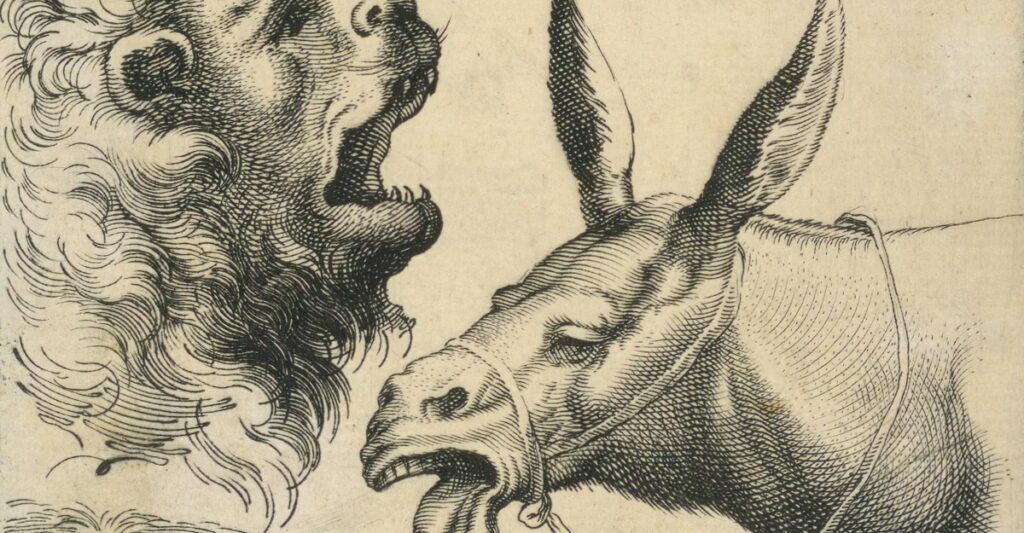
The trope that the British soldiers of World War I were “lions led by donkeys” is somewhat unfair. But the phrase can and should be applied to the current Iran war, at least insofar as the United States is concerned. The U.S. is waging a struggle against an unquestionably malign enemy, using a military that is highly competent but in some respects under-equipped, and with the worst wartime political leadership America has ever had.
Admittedly, some of the criticism of America’s leadership is wide of the mark. The notion that it has no objectives, or that those objectives are unclearly articulated, is exaggerated, because the depressing truth is that in wartime, objectives are usually muddled, occasionally implicit, and always changing. Take, for example, the most recent supposedly clear-cut case of goal setting in war.
George H. W. Bush’s four stated objectives for the Gulf War fall apart on close examination. They were: ensuring the safety of American citizens in the Gulf (a reference to hostages held by Iraq, who were released before the war), driving Iraqi forces out of Kuwait, restoring the legitimate government of Kuwait (a monarchy representing perhaps a quarter of the population), and ensuring the safety and stability of the Persian Gulf. Only the second of these was actually achieved. There were also unstated objectives such as the elimination of the Iraqi nuclear program (pretty much finished off by postwar inspections, not air strikes) and the overthrow of Saddam Hussein’s rule, which occurred 12 years later, after another war. Most important, there were unintended consequences. America extended a degree of protection to Kurdish and Shia minorities, imposed continued inspections and unpopular sanctions on Iraq, and sustained a large American military presence in Saudi Arabia. War is about politics—and therefore, objectives, which are particularly political, are often ambiguous and subject to change.
Some of the Trump administration’s goals are clear enough—destroying or severely damaging Iran’s navy, its military industries, its missile- and drone-launching capability, and its residual nuclear program. Others, such as overthrowing the leadership of the Islamic Republic, are aspirational. Still others, including reopening the Strait of Hormuz in the face of Iranian threats to mine it, may be emerging—or not, depending on President Trump’s mood.
In and of themselves, these uncertainties and changes are more or less normal aspects of wartime leadership. What is not normal, and what is stunningly incompetent, is just about every other facet of the administration’s conduct of the war. It is impossible to excuse the failure to explain the war to the American people, aside from a presentation by the president in his summer home while he wore an unserious white baseball cap. Or the failure to bring Congress into wartime decision making, or at least secure its approval for the war. Or the failure to bring allies along with a minimum of surprises and a maximum of persuasion to support the war.
But the egregious failures do not end there. The best wartime political leaders attempt to minimize internal friction and feuds. Not Trump, who, in the midst of a war with a state sponsor of terrorism, has persisted in picking fights over the funding of the Department of Homeland Security. He has likewise made doomed attempts to revoke birthright citizenship and to meddle in states’ election administration, moves that seem almost calculated to enhance internal divisions. The very notion of national unity in a time of war seems utterly beyond this president, who follows his capricious instincts and continues, as ever, to spray venom at domestic opponents (and, for that matter, allies) when they are needed to wage and win the war.
His advisers are, if anything, even worse. Rarely has a president been surrounded by such an array of toadies and lickspittles, operating beyond their competence in an atmosphere of organizational chaos. A deliberate National Security Council process might have included interagency planning for wartime risk insurance, diplomatic outreach to allies, and planning for supplemental defense appropriations. But no such process exists, and therefore those things did not happen.
Never has the United States had a secretary of defense less capable, more egregiously belligerent, or less suited to provide civilian direction of a war than Pete Hegseth. He, like Trump, cannot unify, deciding in the middle of this war to turn down the promotions of four officers—two Black, two female—for reasons that do not seem to transcend mere prejudice. He can strut and hurl bombast; he has yet to show that he can do the more serious business of directing a war.
The civilian leader of the Department of Defense, in a war with an Islamist power but in which the U.S. has partnered with other Muslim states, has decided to place his own, peculiarly militant Christian beliefs at the center of his public rhetoric, a decision of unconscionable stupidity. More serious yet: It is an open secret that the senior echelons of the U.S. military hold in contempt this bullying and posturing former National Guard major whose military and civilian careers (except as an incendiary television commentator) were failures. When things go badly during a war—and they always do—it is essential that the civil-military dialogue be based on mutual respect even in the toughest moments. Hegseth has forfeited that.
The president’s other key advisers—Vice President Vance, National Security Adviser and Secretary of State Marco Rubio, and the undersecretary of defense for policy, Elbridge Colby—have all avoided leadership in this war as best they can. Vance is an isolationist, Colby an Asia-firster, Rubio a Latin Americanist by instinct. And so they are all silent. Diplomacy has been handed over to the president’s real-estate friend Steven Witkoff and his son-in-law Jared Kushner, neither of whom know the first thing about war.
The only positive thing one can say about Trump and Hegseth as war leaders is that they have few compunctions about talking about winning. But even here, they endanger and degrade their own cause. The use of childish internet and video-game memes to describe violence is coarse and unworthy of the men and women who go in harm’s way.
On October 1, 1939, a month into World War II, Winston Churchill gave a speech in which he described the Royal Navy hunting U-boats “night and day, I will not say without mercy—because God forbid we should ever part company with that—but at any rate with zeal and not altogether without relish.” Less than a month into the Iran war, Hegseth cried, “No quarter, no mercy, for our enemies.” Quarter is the technical term for sparing the lives of enemies who have surrendered. Denying it is a war crime. The second of those remarks was delivered by a resolute and, when necessary, ruthless but principled statesman; the first by a thug, who proclaims a faith of meekness even while he celebrates cruelty and killing.
There is a reason that even those of us who fully recognize Iran’s menace and are pleased with the elimination of much of its military capabilities, and who hope for the eventual fall of this brutal and dangerous regime, find it impossible to advocate for what is, in many ways, a just war. With political leadership so feckless, so dysfunctional, so incapable of planning, so willing to betray friends and allies for short-term advantage, so willing to lie and advocate criminal behavior, our military is simply not in responsible hands. It may yet succeed, and even succeed greatly, but that will be a tribute only to the lions, not the donkeys.
The post Lions Led by Donkeys appeared first on The Atlantic.