Today we discuss probability, self-destruction and political bossism.
Wow. California, which is as blue as Lake Tahoe, is about to elect a Republican governor! How crazy is that?
Whoa. Hold up, pony. Let’s not get too far ahead of ourselves.
Well, there’s certainly a lot of Democratic angst out there.
That’s for sure. It’s reminiscent of the panic that followed Joe Biden’s wretched debate performance in Atlanta, the biggest disaster to hit the city since a 2009 flood caused more than half a billion dollars in damage.
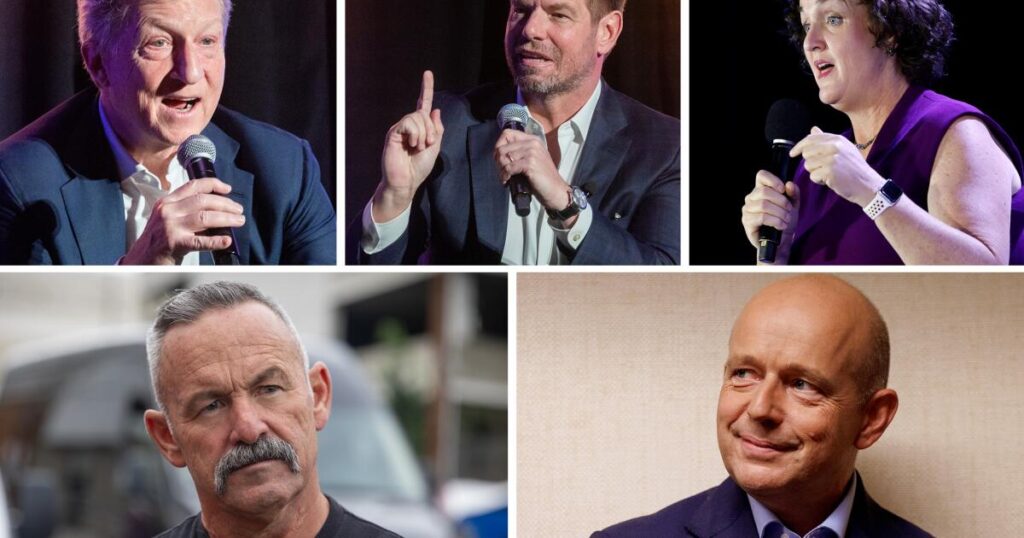
In California, the high anxiety is a result of the state’s “jungle” primary, in which all candidates appear on the same ballot, regardless of party, with the top two finishers advancing to a November runoff. With so many Democrats running, there’s the genuine prospect of them splintering partisan support, resulting in the leading GOP candidates — Chad Bianco and Steve Hilton — grabbing both slots and moving past June 2.
How likely is that to happen?
I can’t say. And Nostradamus is away on spring break.
But one of California’s leading political savants, Paul Mitchell, has developed a helpful online tool to suss out the possibilities. Visitors to his site have run tens of thousands of simulations, which right now put the odds of a Democratic freeze-out at about 17% to 20%.
Which suggests it’s unlikely. But it’s also not impossible.
Why don’t some Democrats step aside, for the good of the party?
That’s easy for you to say.
Anyone putting themselves out there by seeking public office has to have a certain amount of faith, in both their capabilities and the prospect of good fortune smiling upon them. (Luck being a greatly undervalued factor in political success.)
To be clear, no one is running away with the gubernatorial contest. For all the talk of Republicans “leading” in the polls, it’s more like a four- or five-way tie for first place, when you factor in the margin of error. And 20% support — which is roughly what the top candidate receives in surveys — is hardly a number to strike fear in the heart of rivals.
There’s also the YOLO factor.
You mean the county just outside Sacramento?
No, that’s Yolo.
I mean, YOLO — as in You Only Live Once
Several of the candidates mired near the bottom of polls — Antonio Villaraigosa, Xavier Becerra, Betty Yee — are probably looking at the end of the line if they lose this race. So you can understand, if not necessarily agree with, their reluctance to drop out and call it a day, in the hope that, just maybe, that proverbial bolt of lightning will strike.
So why doesn’t someone force some candidates to drop out?
Like who? There is no Tammany Hall. This isn’t Chicago under Boss Daley. Modern-day California has never had that kind of all-powerful political machine.
The closest approximations were in San Francisco, where brothers Phil and John Burton held great sway, and Los Angeles, where another pair of siblings, Howard and Michael Berman, exercised enormous clout with their compatriot, Henry Waxman. But their influence was mainly limited to Congress, the Legislature and local politics. They weren’t kingmakers when it came to electing California governors.
And the two major political parties, which never wielded the powerthey enjoy in other states, have become even less influential in this entrepreneurial age of politics, when candidates raise their money online and boost their profile by going on the political chat shows on TV.
What about Gavin Newsom?
The governor could certainly try to pare the Democratic field. But he’d risk humiliating himself and hurting his presidential prospects in the process.
How so?
It would be embarrassing if Republicans were to seize the governorship on Newsom’s watch. (At least among those political insiders who pay attention to that kind of stuff.) It would also be embarrassing if the governor tried to muscle candidates aside and failed.
It’s not at all clear Newsom would have much clout. He isn’t particularly close to any of the candidates running. No one needed his blessing to enter the race, or his backing to sustain their candidacy. And there isn’t very much the term-limited governor, playing out his final months in office, can offer as incentive to quit.
Newsom also has to consider how it would look if he tried to ease out the laggards — whose ranks happen to include all the prominent candidates of color: Becerra, Villaraigosa, Yee and state Supt. of Public Instruction Tony Thurmond.
We saw how that worked out for USC, which abruptly canceled a scheduled debate after a storm of criticism over its selection process and the exclusion of those four candidates.
Would Newsom care to veto Thurmond et al., then defend his actions in, say, South Carolina, where Black voters typically constitute more than halfthe Democratic primary electorate?
Sounds like Newsom doesn’t have many good options.
No.
Speaking of options, is there anything Democrats could do if they’re frozen out of the runoff?
Such as?
Waging a write-in campaign in the fall?
Nope. Under California law, write-in candidates are allowed only in the primary.
Hmm. How about a Democrat running as an independent?
Nope. Same rule applies. Only the two candidates getting the most votes in June will be on the November ballot.
So what can Democrats do?
Hope their voters consolidate around a single candidate, or either Bianco or Hilton pull far enough ahead with GOP votersthat there’s room for a Democrat to make the top two.
Failing that, get ready for a Democratic-led recall campaign, beginning early in 2027.
The post Is California really going to elect a Republican governor? Is there a Democratic Plan B? appeared first on Los Angeles Times.