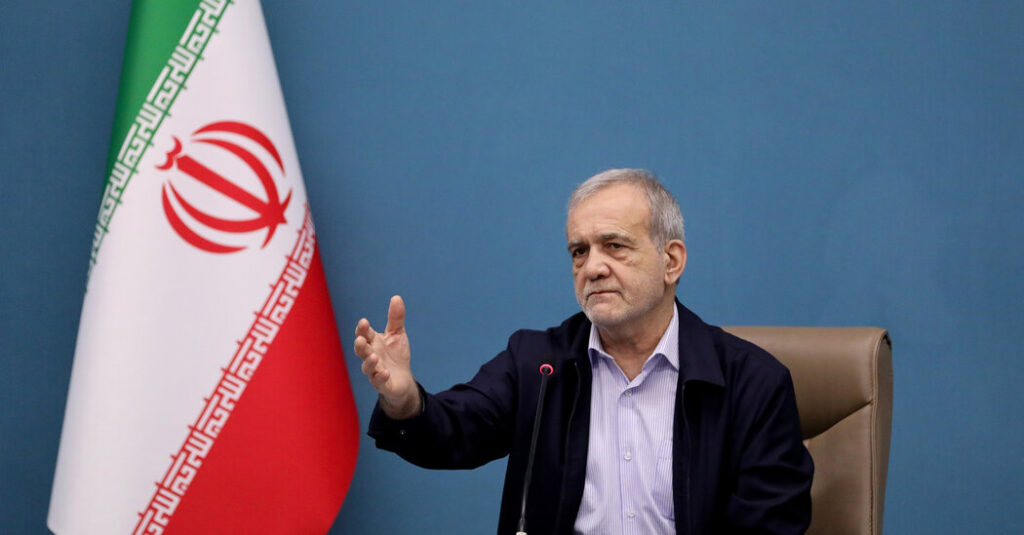
President Masoud Pezeshkian of Iran on Wednesday released a letter addressed to the American people that said the “path of confrontation is more costly and futile than ever before” and suggested the possibility of diplomatic engagement.
Mr. Pezeshkian’s open letter came just hours before President Trump was scheduled to address the nation on Wednesday evening with what he described as an “important update” on the Iran war. Earlier in the day, Mr. Trump said on social media that Iran had requested a cease-fire.
Mr. Pezeshkian did not lay out specific steps for how further conflict could be avoided but his tone was conciliatory.
“Today, the world stands at crossroads,” Mr. Pezeshkian said in the letter, which was released by his office, adding, “The choice between confrontation and engagement is both real and consequential; its outcome will shape the future for generations to come.”
It was not clear whether Mr. Pezeshkian’s letter represented a consensus among Iran’s leaders. Earlier in the day, the spokesman of Iran’s Ministry of Foreign Affairs, Esmaeil Baghaei, said Mr. Trump’s claim that Iran was seeking a cease-fire was “false and baseless.”
In the letter, published in English and Persian and about 1,000 words long, Mr. Pezeshkian’s tone also swung into defiance and patronization. He delved into historical lessons about Iran surviving centuries of invasions and upheaval, asserting: “Iran has never initiated a war. Yet it has resolutely and bravely repelled those who have attacked it.”
In Iran’s dual system of government, the president’s role and authority is overshadowed by the supreme leader, Ayatollah Mojtaba Khamenei, who succeeded his slain father in early March. Mr. Khamenei has the last word on all important state issues, such as negotiations with Washington or conditions for ending the war.
Since the war started, the Islamic Revolutionary Guards Corps have also gained more prominence, and senior military commanders have started calling more shots, including a former commander, Brig. Gen. Mohammad Bagher Ghalibaf, the current speaker of parliament and one of the generals running the war. Mr. Trump has said the United States was in contact with more moderate factions in Iran, without giving details.
It remained unclear whether Mr. Pezeshkian’s letter was written in coordination with Mr. Khamenei or the Guards. Iran has not officially responded to the Trump administration’s 15-point peace plan delivered to Tehran through Pakistan. Mr. Trump has said that Vice President JD Vance could meet senior Iranian officials if peace negotiations were to take place.
Mr. Pezeshkian spoke to the president of the European Council, António Costa, on the phone on Tuesday and told him that Iran would be willing to end the war if its conditions were met, namely a guarantee of a permanent end to hostilities, according to a readout of the call by Iranian state media.
Iranian hard-liners attacked the president for suggesting Iran was open to negotiations on a cease-fire. Elias Hazrati, the head of communicants for the president, said in a social media post that attempts to undermine the president were “merely playing into the hands of aggressors.”
In his letter, Mr. Pezeshkian also laid out Tehran’s longstanding grievances against the United States, and recapped nuclear negotiations that he said ultimately led to Israel and the United States launching surprise military strikes on Feb. 28. But then he suggested there was a distinction between America’s government and its people.
“The Iranian people harbor no enmity toward other nations, including the people of America, Europe or neighboring countries,” he wrote. “Even in the face of repeated foreign interventions and pressures throughout their proud history, Iranians have consistently drawn a clear distinction between governments and the peoples they government.”
Mr. Pezeshkian defended Iran’s retaliatory attacks against Israel and Arab countries in the Persian Gulf. But he did not address Iran’s closure of the Strait of Hormuz, which has caused chaos to the global economy.
“What Iran has done — and continues to do — is a measured response grounded in legitimate self-defense, and by no means an initiation of war or aggression,” said Mr. Pezeshkian.
Farnaz Fassihi is the United Nations bureau chief for The Times, leading coverage of the organization. She also covers Iran and has written about conflict in the Middle East for 15 years.
The post Iran’s President Suggests Diplomatic Engagement Possible in Letter to U.S. Public appeared first on New York Times.