Wagner’s “Tristan und Isolde” is nearly four hours long, but very little happens in terms of pure plot: The title characters are foes, then lovers, then dead. The piece endures because it presents emotions as forces on an almost cosmic scale — which makes it hypnotic to take in but challenging to stage.
In their acclaimed new production of “Tristan” at the Metropolitan Opera, the director Yuval Sharon and the set designer Es Devlin focus on duality and doubling. The main spatial conceit involves an area downstage centered around a simple table, representing everyday life and objects, and an elevated one upstage made of complex tunnels framed by what looks like a giant iris, a mythical realm of magnified emotions.
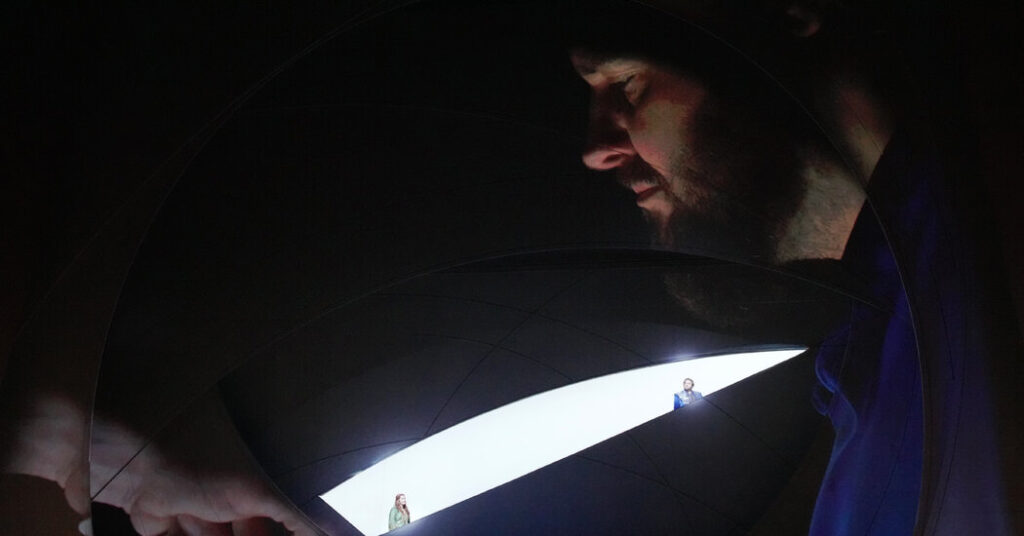
The two places are in direct conversation, especially during one crucial scene at the end of the first act. Tristan (the tenor Michael Spyres) and Isolde (the soprano Lise Davidsen) start by sitting at the table. They are eventually replaced by the dancers Tim Bendernagel and Caitlin Scranton and make their way to the upper plane. While the Isolde doppelgänger at the table holds a knife to Tristan’s throat, Davidsen and Spyres sing from inside a gigantic projection of the blade’s outline, the pointy tip hovering near Spyres’s jugular.
“It shows off the epic-ness of everything in one scene,” said Jason H. Thompson, the projection designer. And that only works if every element — singers, actors, musicians, technicians — are precisely in sync.
In two video interviews, Sharon, Devlin, Thompson and the video designer Ruth Hogben explained how the scene unfolds. Below are highlights from the conversations.
Influences
“I brought every artwork I’ve ever looked at or made, honestly — they’re all in there,” Devlin said. “I brought Barbara Hepworth, Brancusi, the layered paper sculptures of Picasso; Mona Hatoum and Rachel Whiteread; endless artists that have all gone to make me who I am. We spoke a lot about the Vietnamese Buddhist Zen master who I’ve been practicing with. I would also reference Hannah Höch, Kurt Schwitters, this piecing together from found objects.” Sharon had as many, citing, for example the use of color in the Wong Kar-wai film “In the Mood for Love.”
Filling the Frame
The sheer scale is overwhelming. Devlin said this was the first time the Met had built a sculpture that filled its stage’s entire 54-foot-tall proscenium. She began exploring that space for the overture of a production of Verdi’s “Otello” in 2015, in which she used a single gauze scrim, and wanted to pick up where she had left off. “The space cries out, the space wants things,” she said. “And this theater seemed to be longing for that whole frame to be filled.”
The Iris
There was a direct antecedent, especially for the iris and for what Devlin called “the apertures, portals, cones” in her previous collaboration with Sharon: a revival of Meredith Monk’s opera “Atlas” at the Los Angeles Philharmonic in 2019. “These spiraling iris gestures could be seen now as the path that the knife took,” Devlin said.
Dual Tension
One major reference was “Rest Energy” (1980), a performance piece in which Marina Abramovic is holding onto a bow and the German artist Ulay is pulling on an arrow cocked into the bow and pointing at her heart. “You get this feeling that their lives are in each other’s hand,” Sharon said. “We felt this work is kind of the perfect encapsulation of what love is in this opera, which is so dangerous.”
Lighting
The production’s lighting was designed by John Torres, who brought in another influence. “There are moments where John’s experience with Robert Wilson really comes through in very direct ways,” Sharon said, singling out “the way that the knife is lit from behind the rear projection.”
Time
The video goes from live image magnification (a technique imported from the kind of pop extravaganzas Hogben usually works on) to prerecorded footage of Spyres’s head. “We shot Michael for four minutes at a higher frame rate, and then we slowed it down to a quarter-speed,” Thompson said. To help Spyres maintain an intense focus, Hogben held a knife to his throat during filming. (Her hand was replaced in the video.)
Alignment
A big challenge was to have the projection perfectly line up with the set. “We took in a plate of the entire set and basically put it in a monitor,” Thompson said. “When we filmed it, we could see the knife come into place so that we could get the right proportions and the right scale.”
‘American Psycho’
“We looked quite a lot at an amazing image from ‘American Psycho,’” Hogben said. “It was a really clear knife with a reflection in it and a starburst. For me, starbursts are always really important. Maybe not so much for Jason.” Thompson added: “Look, I’m converted. I love them now, too.”
Movement
Choreography by Annie-B Parson connects the body language of the singers and dancers, Sharon said. “It maintains a sense of tension, maintains suspense,” he said. “Especially in the knife scene, what they’re doing is in such fantastic counterpoint to what Lise and Michael are articulating.”
Color
Throughout the production, Clint Ramos’s costumes associate Isolde with green and Tristan with blue. Color was important to Sharon. “We wanted transformative, ecstatic color in the line of Hilma af Klint because that’s what we hear in the music,” he said. “This is such an overflow of chromaticism, not just musical chromaticism, but also in terms of the actual color. For me one of the big revelations of what we discovered together as a team is that unlike the productions that are so obsessed with death and destruction as the dominant idea of this opera, we brought out the colorful life force of it.”
The post How ‘American Psycho’ and Marina Abramovic Fed the Met Opera’s ‘Tristan’ appeared first on New York Times.