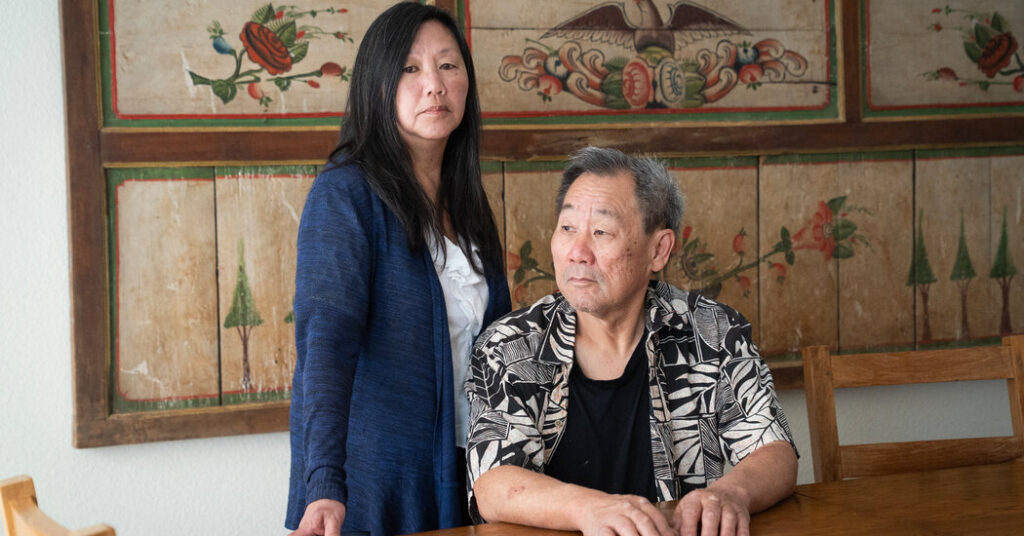
Sandra Wong was at her father’s funeral, looking at a display of mementos, when she saw a newspaper clipping and learned something surprising: She was a direct descendant of Wong Kim Ark, a cook in San Francisco who was behind the landmark 1898 Supreme Court decision granting citizenship to virtually anyone born on American soil.
Before that day in 2011, she had never even heard of the name Wong Kim Ark. Nor had she known that birthright citizenship was a contentious issue, as it is now once again. On Wednesday, the Supreme Court will hear arguments on the constitutionality of President Trump’s executive order last year rolling back birthright citizenship for the children of undocumented immigrants and temporary visitors, including international students.
“I always thought that if you were born in America, you were a citizen,” she said.
That Ms. Wong was not aware of her genealogical link is partly a measure of how deeply ingrained birthright citizenship has become in the American consciousness and how rarely Wong Kim Ark’s case is taught in schools.
As Ms. Wong dug more into her family history, she found a rich and complex legacy — one that shows how birthright citizenship gave her family members a powerful legal foothold in the country, but not complete acceptance, which they struggled to attain.
Discrimination and bias continued. Family members were separated across oceans. And, caught between the pressure to assimilate and the desire to maintain ties to their heritage, the descendants of Wong Kim Ark had to make difficult choices about which stories and traditions to pass down to their children — and which to withhold.
“We tend to sell this idea of American citizenship as the pinnacle in an immigrant story that somehow marks your complete acceptance in society,” said Hardeep Dhillon, a history professor at the University of Pennsylvania. “But in reality, you can be a U.S. citizen and still have very differentiated rights.”
Growing up in San Francisco, Ms. Wong and her three brothers did not hear much about either side of their family.
Their mother, Kimiko Takeuchi, who was Japanese American, had been interned along with her family in an incarceration camp in Utah during World War II, but did not speak often about that experience.
Their father, Wong Yook Jim, also rarely talked about the past. He worked as a ship steward and traveled for long stretches at a time. They knew that he was Chinese, but didn’t know much more.
Later, they learned that he had known about the Supreme Court case. But he never mentioned it to his children.
“You could tell there was a lot of pain,” said one of his sons, Norman Wong, now 76.
The Wongs have since learned that their grandfather, Wong Kim Ark, was born in 1870 in San Francisco’s Chinatown, just a few miles from where they grew up. His parents had come as part of a wave of Chinese workers who flocked to the United States starting in the mid-1800s.
But these laborers soon encountered virulent racism and violence, and increasing restrictions in the form of federal laws like the Chinese Exclusion Act of 1882, which barred most Chinese people from entering the country.
Around that time, Mr. Wong went back to China with his family. But he soon tried to return to the United States, lured by the promise of higher wages.
After being denied re-entry in 1895, he took the extraordinary step of suing the United States government. He was only 24 years old, a cook in Chinatown who wore a braided queue.
Even after he won the case, Mr. Wong’s struggles continued. Like most Americans of Chinese descent at the time, he was repeatedly subject to interrogations by border officials and had to obtain letters from white witnesses attesting to his birth in America, said Beth Lew-Williams, a history professor at Princeton University.
Mr. Wong also tried to bring his sons from China, where they were born, to the United States, which had better economic opportunities.
Because Mr. Wong was an American citizen, his children should also have been considered citizens. But officials denied entry to one son after days of interrogation. His three other sons were also subject to intense questioning, but were ultimately permitted entry.
The youngest was Yook Jim, Sandra and Norman’s father, who was admitted in 1926 at the age of around 11. (The Wong family and some experts now believe that Yook Jim may not have been Wong Kim Ark’s son, but rather his grandson, based on the timing.)
Even though Kim Ark eventually moved to China, Yook Jim stayed. Still a child, he settled with distant relatives in the Midwest, Norman said. Like many Chinese boys at the time, he would have been expected to work and send money back home to relatives.
He later moved to San Francisco and married Ms. Takeuchi, with whom he had four children, including Norman and Sandra.
In 1945, he enlisted in the U.S. Navy under the name James Yuen Wong. Decades later, he would still speak proudly of his service, Ms. Wong recalled.
But he also held on to his Chinese roots. Ms. Wong recalled seeing the flag of the People’s Republic of China flying outside his home in Rio Linda, Calif. He later took a second wife in Hong Kong, and had another child.
Now, almost 130 years since Wong Kim Ark successfully won the right to be an American, some of his descendants have only faint ties to their ancestral homeland.
Growing up in San Francisco, Norman and Sandra spoke English at home. They watched Disney movies and westerns on television.
They didn’t celebrate any Chinese holidays and knew only vaguely about anti-Chinese exclusion laws.
They went to college. Norman attended the University of California, Berkeley, and went on to work in different jobs, including as a carpenter. Sandra went to San Francisco State University, and worked in marketing.
It never occurred to them that they might be anything other than American. They know whom to thank for that.
“If he had not fought for that right,” Mr. Wong said. “I probably wouldn’t have existed.”
Amy Qin is a national correspondent for The Times, writing primarily about Asian American communities.
The post He Won Birthright Citizenship for All. His Own Family Never Knew. appeared first on New York Times.