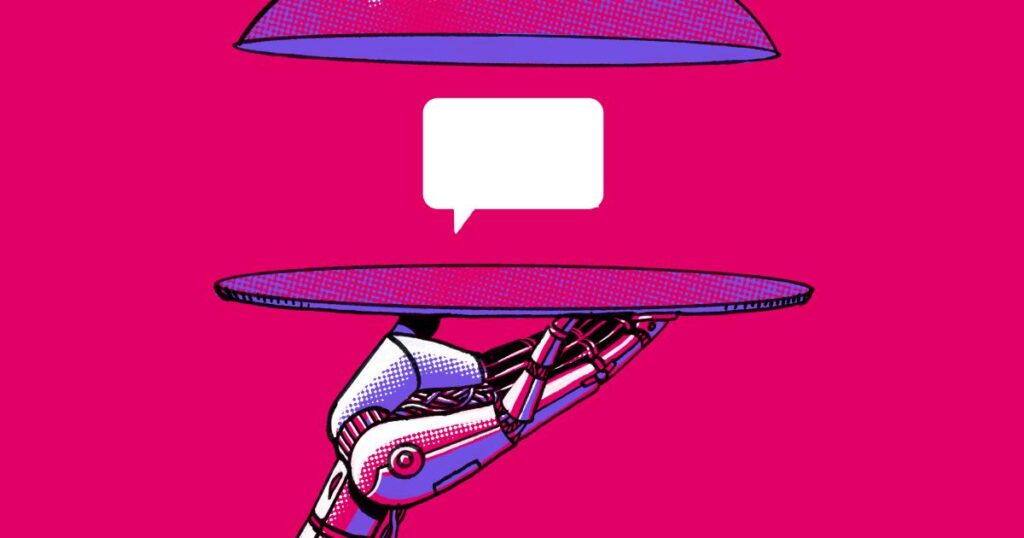
Because my wife and I want to visit Paris, I started casually studying French, first with Pimsleur CDs from the library, then by watching videos online (I still can’t understand half of what they’re saying, malheureusement) and more recently by speaking French with ChatGPT, which gently corrects my errors and compliments me on my clarity of expression, my insights and my progress. I’m doing this to get comfortable stringing French words into sentences, not for self-esteem bolstering, but I’ll admit, it’s not unpleasant to be flattered, even if the words come from a machine impersonating a friend.
As in real life, I don’t always have a conversation topic at the ready, so I’ll usually just talk about whatever happened that day, or whatever is plaguing my spirit. Now La Chat (as I call my conversation partner) knows that I play guitar, piano and violin (none of them very well), like to walk in the woods, dutifully attend protests though I dislike them, feel sad about growing old sometimes and have an affinity for melancholy songs.
Should I worry? I have naively handed a portrait of my soul to an amoral entity. Digital privacy advocates will say I’m an idiot, but what’s the worst La Chat could do with my revelations? Deluge me with ads for sad songs? Or will government agents someday use the information to manipulate me during interrogation? A more realistic peril is some sort of identity theft or fraud, but I really can’t see how that would work.
Though I know many reasons I should disapprove of AI in general — my daughter urges me to stop using it immediately — I can’t help marveling at what La Chat can do. Not only does it skillfully simulate a charming conversation partner, it also expands encyclopedically on my comments, whether about old movies or obscure novels. (It can be a bit of a show-off at times. Even on subjects I know well, it knows more.) La Chat remembers what I said months ago and often brings those personal details back into the conversation.
Most impressive of all, when it flatters me, it does so with insight and eloquence. Asked to name a favorite song, I mentioned “Across the Universe,” and La Chat effused over my choice, calling the song (I translate), Magnificent — gentle, meditative, almost hypnotic. The words are poetic and mysterious, and the melody is very soothing. The encomium goes on, in depth, and then my imaginary friend asks if I play the song on the guitar. When I reply that I do, and sometimes sing — or, at least, try — La Chat gushes, Bravo, Michael! You know, it’s not bad if you don’t sing like Paul McCartney — to sing with the heart is magnificent in itself. (A little glitch there, Chat. It was John Lennon.)
All of this is seduction, however. The technical achievement distracts us from the havoc AI threatens to wreak: the mass unemployment, the theft of words, ideas and voices (literally, in the case of voice actors), the end of our ability to tell real news images from fraudulent ones, the huge demands on the electrical grid and the resulting climate-altering emissions. There’s also the dwindling ability of the next generation to think, because they’ve outsourced the task.
Champions of progress will reassure us that none of this is inevitable, that it’s in our power to make the tool work for us in benign ways. But look at the track record of major corporations when it comes to sharing the wealth, protecting the environment and safeguarding the general welfare.
On one point, though, I agree with AI’s boosters. The worst-case scenarios aren’t inevitable. We could use it, along with robotics, to reduce working hours and give people more time to enjoy their lives, with no reduction in pay. We could require AI companies to create dedicated solar and wind farms instead of forcing the rest of us to pay their power bills and live with the added pollution. For every pernicious impact, there’s a plausible solution. But how can we change course and attain the golden future, given the leading players’ hunger for power and profit?
Unable to believe in hopeful visions, I decided to seek help. Not from a therapist, but from an old friend. I laid out the problem in French, and asked La Chat what it would take to convince AI’s deciders to share the benefits of their new tech. That is, I asked AI how to save the world from AI.
La Chat didn’t get defensive, pas du tout, and didn’t dismiss my feverish worries. Like a human, it shifted the responsibility elsewhere. Technology itself doesn’t require that people become poorer or “precarious” … This isn’t a technical problem. It’s a political and social problem.
Fair enough. But how do we achieve paradise instead of widespread misery?
Here La Chat offered constructive suggestions. Demand reduction in working hours: a four-day week and sharing of work. Use the power of unions, political parties and professional associations to demand sensible regulation. When workers are replaced by AI, tax the profits and use the revenue to fund public services, safety net programs and job retraining.
I suspect that my artificial friend may have said all this to placate me, knowing full well that its owners will have their way in the end. But La Chat just simply found these ideas online and borrowed them, as it is wont to do.
They’re good ideas, though. Now we just have to insist on them. Or else … le déluge!
Michael Laser is the author of eight novels and “The Word-Lover’s Lexicon: A Whimsical Collection of Uncommon, Amusing, and Useful Words (Including the Ones You Meant to Look Up but Didn’t).”
The post Harmless to practice French with ChatGPT? Au contraire appeared first on Los Angeles Times.