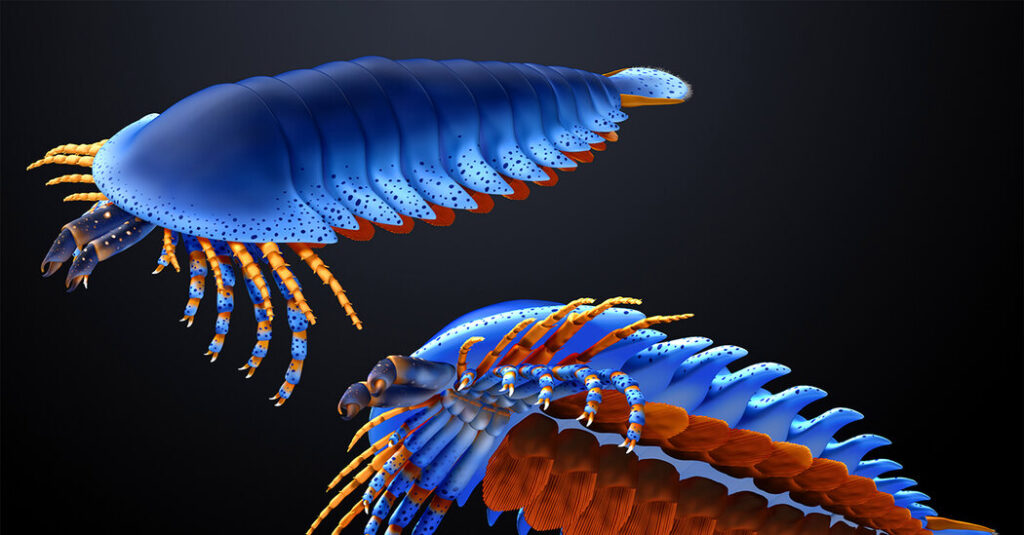
Everyone has come across a chelicerate.
This diverse group of arthropods contains more than 120,000 known species, including spiders, scorpions, mites and horseshoe crabs. Each of these critters is armed with a pair of chelicerae, a pincer-like appendage adapted for snatching prey, injecting venom and even spinning silk.
Scientists have struggled to determine when this group of creepy crawlies scurried onto the scene. But a long-overlooked fossil from Utah may provide solid evidence that chelicerates were already around more than 500 million years ago. The specimen, described on Wednesday in the journal Nature, preserves several features reminiscent of modern chelicerates, including a pair of prodigious pincers.
“Finding the pincers is the golden character we need to conclude this is a chelicerate,” said Javier Ortega-Hernández, a paleontologist at Harvard and one of the authors of the new study. “It’s not even a smoking gun — this is the gun being fired right in front of you.”
Before this research, the oldest clear fossil evidence of chelicerates dated back to the Early Ordovician Period around 485 million years ago. The complexity of these animals, some of which resembled horseshoe crabs, hinted that chelicerates originated during the earlier Cambrian Period. However, few Cambrian fossils presented compelling evidence of the group’s namesake pincers.
The newly described fossil was discovered by Lloyd Gunther, an amateur fossil collector, in the Wheeler Formation in western Utah, which dates back to the Middle Cambrian around 507 million years ago. At the time, the area was a warm sea home to trilobites and several soft-bodied critters that rarely fossilized.
Mr. Gunther donated one of these fossils to the University of Kansas Biodiversity Institute and Natural History Museum in 1981. The relatively unassuming fossil, which looks like the rusty imprint of a giant screw and measures less than 3.5 inches, sat for decades in the museum’s collection.
But in 2019, the fossil caught the eye of Rudy Lerosey-Aubril, a visiting paleontologist from Australia. Dr. Lerosey-Aubril, who is now one of Dr. Ortega-Hernández’s colleagues at Harvard and the lead author of the new paper, spent more than 50 hours preparing the fossil.
As the surrounding rock was removed, a puzzling creature came into focus. The animal had a circular head shield, nine body segments and an assortment of branching appendages. The oddest aspect of the animal was the front pair of rust-color appendages, which were nothing like the thin antennae seen in contemporary creatures like trilobites. Instead, the structures were thick, segmented claws reminiscent of the pincers wielded by living scorpions.
The team named the new species of early chelicerate Megachelicerax cousteaui. The first name is a mash-up of the Greek words for large, horn and claw, in reference to the animal’s pincers. The second name pays tribute to the famed ocean explorer Jacques Cousteau, a personal hero to the French-born Dr. Lerosey-Aubril.
Beyond its pincers, Megachelicerax exhibits other features seen in modern chelicerates. Below its head shield are five additional pairs of specialized limbs that helped it scuttle about and feed. The animal’s underside is covered with sheet-like structures that helped it breathe and swim; they resemble the book gills that line the abdomens of horseshoe crabs.
But Megachelicerax does possess some unique anatomy: Unlike all living chelicerates, it lacks eyes on the top of its body.
According to Dr. Lerosey-Aubril, Megachelicerax illustrates that chelicerates had already developed their anatomical blueprint by the Middle Cambrian.
But some researchers think the newly described fossil is old news. In a 2019 paper, paleontologists pointed to Mollisonia plenovenatrix, a thumb-sized animal with bulging eyes that was discovered in Canada’s famed Burgess Shale. While Mollisonia’s potential chelicerae were tiny, the critter also possessed plate-like book gills.
“We have evidence that chelicerates were around in the Cambrian from a slightly older site,” said Jean-Bernard Caron, a paleontologist at the Royal Ontario Museum in Toronto and one of the authors of the 2019 paper who was not involved in the new study.
He was intrigued, though, by the pincers on the Utah fossil. “Megachelicerax may have been the first with big chelicerae and it may attest that this group was more diverse early on” than previously thought, Dr. Caron said.
Dr. Lerosey-Aubril said the Mollisonia found in Canada is probably in the same lineage as early chelicerates. But he maintained that the newly described fossil presented more compelling evidence that chelicerates were around in the Cambrian.
“There is no debate anymore,” he said, referring to Megachelicerax’s large, clearly defined pincers, which the animal used to grab prey or scavenge carrion along the seafloor.
While Megachelicerax possessed many of the trappings of modern chelicerates, its scarcity suggests it was a bit player in an ecosystem dominated by trilobites. Their big break most likely occurred when chelicerates crawled ashore and found new opportunities on land.
To figure out how these early chelicerates took root, Dr. Lerosey-Aubril invoked his favorite explorer. “Cousteau was discovering what lay below the surface,” he said. “We do the same, but instead of the depth of the sea, we are looking at the depth of the past.”
The post Fossil of Pincer-Wielding Crawler Reveals Origins of Spiders, Scorpions and Others appeared first on New York Times.