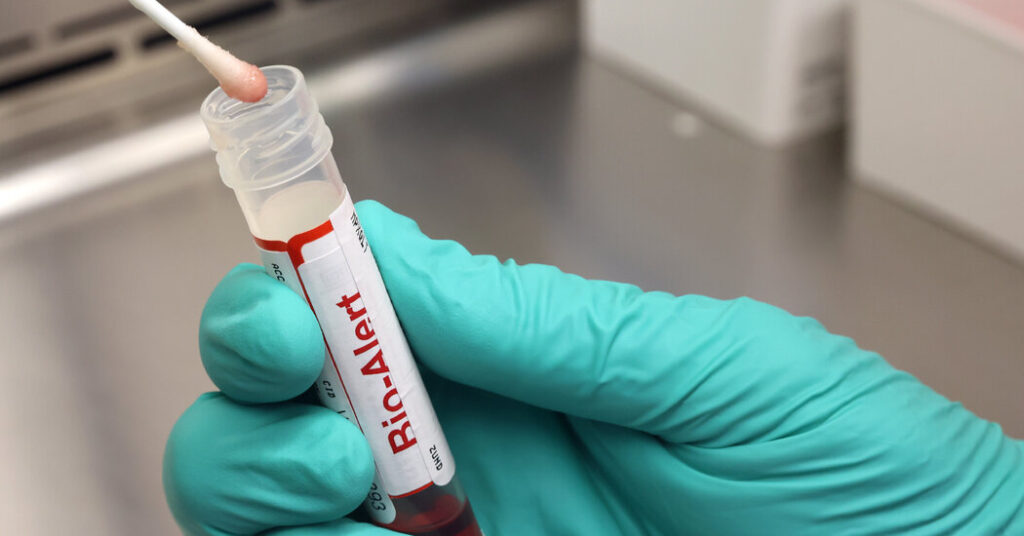
The Centers for Disease Control and Prevention has temporarily paused testing for rabies and pox viruses, the family of viruses that includes smallpox and mpox, according to an update to the agency’s website on Monday.
The C.D.C. offers testing for dozens of pathogens to assist state and local public health laboratories that are not equipped to conduct them. The organization began evaluating its tests in late 2024 as part of an agencywide review.
But widespread layoffs, hiring freezes and resignations have shrunk the number of qualified scientists who can assist state labs. The C.D.C.’s rabies and pox virus teams have lost many of their members. By July, the rabies team will be down to just one person with the clinical expertise to advise state and local officials, and the pox virus team will have none.
The teams already have too few members to offer after-hours advice for states as the agency has long done, according to an official with knowledge of the situation who asked to remain anonymous because of fear of retaliation.
Several public health experts said they were concerned with the shortage of testing and expertise at the nation’s infectious disease agency. The country faces the threat of emerging diseases such as bird flu and is also preparing for major events, including the World Cup tournament and the celebrations for the 250th anniversary of U.S. independence, that will amass large crowds.
“In relative peacetime of no major outbreaks, no major pandemics, it’ll be fine,” said Jill Taylor, who directed the Wadsworth Center, New York State’s public health laboratory, until October 2020.
But, she said, “If we have an emergency all of a sudden, God help us.”
Andrew Nixon, a spokesman for the Department of Health and Human Services, did not provide details about the availability of specific tests.
But he said in an emailed statement, “We anticipate some of these tests will be available through C.D.C. labs again in the coming weeks.”
“In the meantime,” he added, “C.D.C. stands ready to support our state and local partners to access the public health testing they need.”
Two state public health labs, in New York and California, have the capability to provide rabies testing, and many labs are able to conduct preliminary tests for pox viruses. But the C.D.C. typically confirms such infections and only the agency can track diseases nationwide.
“It’s not just about the laboratory testing; it’s about the actionable data,” said Leonard Peruski, director of the Wadsworth Center.
“If we have something bad in another state that happens, will the rest of the country find out about it in a timely fashion to make a difference?” Dr. Peruski said.
“Should, heaven forbid, another pandemic start up, we would not have that capacity,” he added, speaking of the Wadsworth Center. “Our resources would have to be directed to the state of New York.”
In 2025, Wadsworth received more than 13,000 samples from 23 states to test for diseases including chikungunya, dengue, West Nile and other viruses, as well as a case of drug-resistant tuberculosis in Texas. The center also served as the national reference laboratory for influenza last summer.
Fewer than five Americans are diagnosed with rabies each year. But testing is important because the virus infects a few thousand animals, including bats, raccoons and skunks, and about 60,000 people are treated for potential exposure to the virus. The disease is nearly always fatal in people who are not treated promptly.
The United States first had a major outbreak of mpox, a cousin of smallpox, in 2022, but hundreds of cases were reported last year. More than a dozen cases of a more severe type of mpox previously only seen in Africa have also been reported in the United States.
Widespread layoffs at the C.D.C. last April did not affect the center in which the rabies and pox virus teams work. But appointments for many specialized scientists could not be renewed because of federal hiring freezes.
“I’m concerned about where we go from here,” said Scott Becker, chief executive of the Association of Public Health Laboratories. “The bleeding inside C.D.C. has got to stop.”
For more than a year, the agency has been without a permanent leader to forestall or plan for such crises. Instead, a series of acting directors and political appointees have made decisions at the agency for all but four weeks of President Trump’s second term.
Dr. Taylor, who was part of a committee convened to assess the agency’s lab operations, said the C.D.C.’s approach to testing had longstanding problems that needed to be addressed.
Early in the Covid-19 pandemic, the agency struggled to develop and distribute accurate testing kits. During the outbreak of mpox in 2022, the C.D.C. had an effective test but took weeks to make it widely available. In the interim, clinicians needed to order it from public health laboratories, leading to long delays in diagnosis.
Those failures made it clear that the agency needed to collaborate with academic, commercial and hospital labs to develop and distribute tests, according to the report released in 2023 by Dr. Taylor and other committee members. Major decisions about tests required input from more than 100 people at the agency, the report found, and the C.D.C. did not have enough people certified to ensure the quality of laboratory testing.
In response to the report, the C.D.C. began assessing whether to streamline its portfolio of more than 500 diagnostic test methods, according to a notice sent by the Association of Public Health Laboratories to its members in December 2024, a copy of which was reviewed by The New York Times.
Some tests were discontinued because they were available at commercial or academic labs, according to the agency’s website. Others required specialized reagents that were no longer regularly available or relied on outdated techniques.
“Knowing there’s a weakness in the system is good information, because you can do something about it,” Dr. Taylor said. But “I have no trust in this administration to do something about it.”
As the tests being evaluated were moved on and off the list, the number of the ones unavailable has fluctuated from nearly 50 in January 2025 to 38 in June 2025 and to 27 as of this week.
Among others, the C.D.C. has discontinued testing for Oropouche virus, a mosquito-borne pathogen that causes severe joint pain, vomiting and fever, since at least November.
Apoorva Mandavilli reports on science and global health for The Times, with a focus on infectious diseases and pandemics and the public health agencies that try to manage them.
The post C.D.C. Pauses Testing for Rabies and Mpox appeared first on New York Times.