If President Trump succeeds in eliminating universal birthright citizenship, there could be 6.4 million U.S.-born children without legal status by 2050, according to a new study.
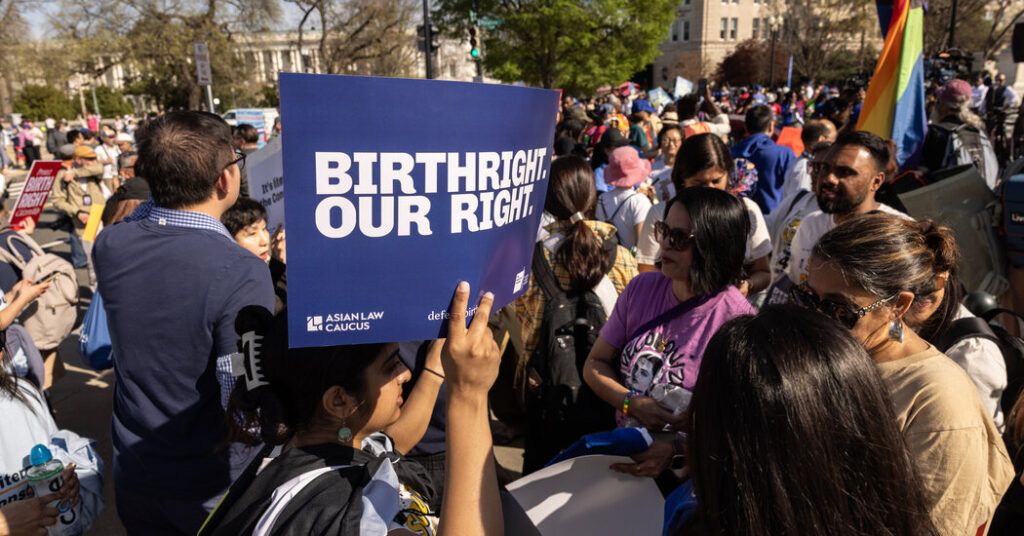
In addition to affecting undocumented immigrants in the country, the authors say, that change would have a disproportionate effect on Asians who are in the country lawfully.
The Supreme Court is hearing arguments on Wednesday over Mr. Trump’s executive order to deny U.S. citizenship to children born in the country to undocumented immigrants and to those born to foreign nationals in the country lawfully on temporary visas. His plan, if upheld by the court, would reinterpret the 14th Amendment of the Constitution.
The largest number of people affected would be Hispanics, according to the study, which was conducted by Penn State scholars who research immigration. Latinos compose the largest undocumented group in the United States, and Hispanic babies would account for eight out of 10 people born in the country but not considered American citizens by 2050.
However, the biggest relative change in births of babies without citizenship would be among Asians, at 41 per 1,000 Asian immigrants. That compares with 17 births of children without citizenship per 1,000 undocumented Latinos, according to the authors of the study.
“For Latinos, we would see the most growth in absolute numbers of undocumented people,” said Jennifer Van Hook, a demographer who is a co-author of the study, which was based on analysis of census data and immigration records.
“But relative to the small size of the undocumented Asian population, we would see very high numbers of Asian children born in the U.S. without citizenship,” she said. “We would be creating an undocumented population of Asians out of thin air.”
Many of the children would be born to parents from countries such as India and China who are in the United States on student or work visas. Under Mr. Trump’s executive order, they would no longer be U.S. citizens.
About half the people in the country on temporary student and work visas eventually obtain legal permanent residency, which puts them on the path to American citizenship. If birthright citizenship is eliminated, their children would have no such path.
Most of them have been working and paying taxes in the United States for years and are in their prime childbearing years. And many have been waiting in a backlog for more than a decade to obtain permanent legal residency through their employer. Often, they have already had children born in the United States who have the full rights of citizenry.
“This executive order would generate mixed-status families for Asians, where parents are here legally waiting for green cards and would have children akin to undocumented,” said Nicole Kriesberg, who is an assistant professor of public policy at Penn State and an author of the study.
“The U.S. would be recruiting people for these visas and depriving their children of citizenship,” she said.
The United States is among at least 30 countries that automatically grant citizenship to anyone born within its borders. The beneficiaries include the children of foreign nationals in the country on temporary visas, millions of undocumented residents as well as so-called birth tourists, who travel to the United States while pregnant with the objective of having American babies.
Of the 51.3 million people in the United States in 2023 who were born in another country, nearly half were citizens, according to a report last year by the Migration Policy Institute. Another 19 percent were lawful permanent residents who could become naturalized citizens. And 5 percent were in the country on student, work or other temporary visas.
The remaining 27 percent, or about 13.7 million people, were undocumented.
Beyond significantly adding to the undocumented immigrant population, the end of birthright citizenship for many children could create an underclass of U.S.-born children that would stretch across generations, according to the institute’s report.
In a brief filed to the Supreme Court, 141 scholars said that research has demonstrated that Mr. Trump’s order would cause “great harm” to the children and their families and communities, as well the U.S. economy. (The Penn State scholars are not part of this group.)
“If enforced, the order would dramatically expand the undocumented population of the U.S., destabilizing U.S. communities and labor markets,” they wrote.
Miriam Jordan reports from a grass roots perspective on immigrants and their impact on the demographics, society and economy of the United States.
The post Birthright Citizenship’s Demise Would Affect Asians Disproportionately appeared first on New York Times.