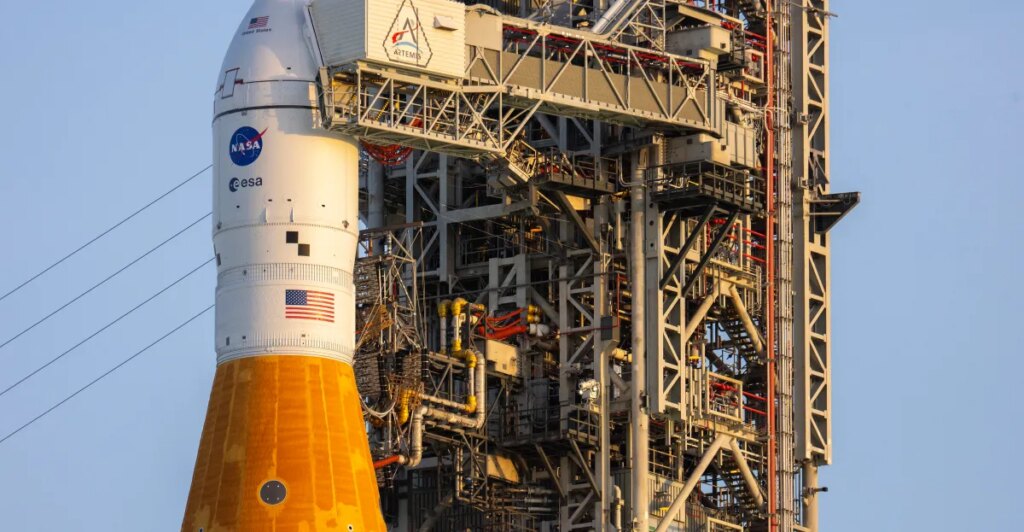
I have yet to see Project Hail Mary, the buzzy space blockbuster starring Ryan Gosling. But who needs science fiction when you have…science reality?
At 6:24 pm Eastern, NASA is scheduled to launch four astronauts on a 10-day journey around the moon. The launch is part of the Artemis program, which hopes to return humans to the moon by the end of the decade and establish a bona fide base on the lunar surface.
This launch is part of a bigger, global push to return to the moon. So, this morning, we’re looking at what’s driving the new space race — and where it’ll blast off in the future.
The space race is back on
It’s been many moons since a human last set foot on the lunar surface. But over the past five years, unmanned missions and lunar flybys like Artemis II have become markedly more frequent.
Since 2023, government space agencies, nonprofits, and private companies from Russia, India, China, and Japan have all attempted lunar landings to mixed (but generally successful) results. South Korea launched its first lunar orbiter, Danuri, in 2022. Israel also attempted an unmanned moon landing in 2019, though its craft suffered an engine failure.
America’s last lunar venture went down in February 2024, when the US landed an unmanned lunar spacecraft called Odysseus near the moon’s south pole; its first in 50 years. Odysseus carried six NASA experiments and six commercial items, including a Jeff Koons sculpture.
If all goes to plan, Artemis II will mark the first time humans have travelled into deep space since the Apollo program. (The astronauts are orbiting — but won’t land on — the moon.) They could also set a new record for distance travelled from earth.
“It is a fact: We’re in a space race,” former NASA administrator Bill Nelson told Politico.
Why everyone’s heading back to the moon
The first space race was driven by geopolitical competition between nations — and there’s still an element of that, as Nelson’s full comments to Politico suggest. (He went on to warn that the Chinese could try to claim territory on the moon, though a 1967 treaty prohibits that.)
Generally speaking, however, today’s wave of lunar exploration is driven less by Cold War-style rivalry than by commercial interests. Private equity firms have poured hundreds of billions of dollars into private space companies over the past 10 years, seizing on lucrative government contracts and aiming to capture a share of a fast-growing market.
The unmanned lunar spacecraft that landed on the moon in February 2024, for instance, was produced by Intuitive Machines, a Texas-based engineering firm. For the Artemis missions, the US has relied heavily on technology developed by Boeing, Lockheed Martin, Elon Musk’s SpaceX, and Jeff Bezos’s Blue Origin.
These companies hope to supply the infrastructure for future space exploration, transportation and logistics, which will — according to plans NASA announced last week — include a $20 billion US base on the moon. Longer-term, the lunar surface could also theoretically be mined for valuable resources or used as a refueling station for longer, deep-space missions.
Next stop: Mars?
That is, after all, the ultimate ambition of the Artemis project: to put astronauts back on the moon, yes — but as a stepping stone to one day getting them to Mars. Manned lunar missions help scientists better understand how extended space travel affects the human body, as well as test life-support, communication, and navigation systems. Researchers have also hypothesized that the large ice deposits at the moon’s south pole — first discovered in 2008 — could be transformed into breathable air, drinkable water, or fuel for longer trips.
But those sorts of ambitions are still years away, at best. Artemis II is the second of five planned missions in the Artemis program, each intended to build on the one before it. Humans aren’t expected to return to the lunar surface until Artemis IV, currently slated for 2028. And it won’t be until Artemis V that NASA lays the planned groundwork for that permanent lunar base.
This is all the more reason to seize your chance to watch the launch tonight. Whatever the plans, we don’t know for sure when American (and Canadian!) astronauts will head towards the moon again. You can stream it on NASA’s YouTube channel or via C-SPAN.
The post America is going back to the moon appeared first on Vox.