Forget “Marty Supreme” and its orange table tennis balls. Forget “A Clockwork Orange” and “Orange Is the New Black.” Forget Cheetos and Reese’s Pieces. Forget Halloween.
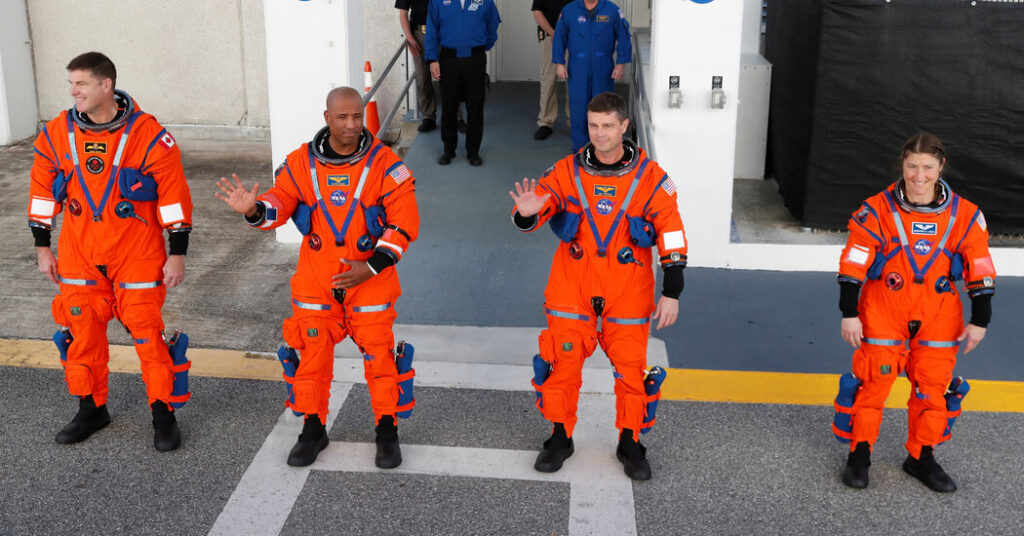
The orange that’s set to ignite the popular imagination is International Orange, and it’s the color of the flight suits worn by the four Artemis II astronauts on the first mission to the moon since 1972. When Reid Wiseman, Victor Glover, Christina Koch and Jeremy Hansen stride onto the tarmac at the Kennedy Space Center in Florida, they will be wearing the bright orange suits. When they emerge from the capsule 10 days later after traveling around the moon and journeying farther into space than humans have ever gone before, they will be wearing the orange suits.
In other words, when they become part of history, so will their orange suits.
Though much of the spacesuit-related attention thus far has been levied on the white spacewalk suits being created by Prada and Axiom Space, it is the orange suits that may be the more eye-catching — by design.
If Elon Musks’s SpaceX suits are what James Bond might wear on the Starship Enterprise; if the Prada/Axiom EVA (Extravehicular Activity) suits display a spacewalk-meets-runway style; and if Jeff Bezos’ Blue Origin flight suits have a moto-space-cowboy vibe (with the female version, as worn by Lauren Sánchez Bezos and her all-woman crew, offering a “Charlie’s Angels” take on the same), the orange suits situate astronauts closer to the superhero end of the Marvel universe.
The suits, which function as mini life-support systems (astronauts can live in them for 144 hours, if necessary), were custom-made to each astronaut’s physique by NASA engineers. They also feature reflective, sky-blue accent stripes that form a heroic V at the torso and circle the thighs and the upper arms, where they emphasize the armadillo-like articulation of the shoulders.
Not that the blue is merely decorative. The V indicates external straps for rescue crews to grab onto, and blue pouches that look like external batteries contain life preservers and backup oxygen bottles. And the hue is a vivid contrast to the orange, adding a further flex to the suit’s primary shade.
Though that color has its own striking history.
Officially known as AMS Standard 595 color #FS 12197, according to a U.S. federal government standard created for paint, International Orange is described by Merriam-Webster as “a vivid reddish orange,” deeper than safety cone orange or fluorescent orange and specifically meant to stand out against ocean and sky blues.
“Orange is the combination of red and yellow, two highly energetic and visible colors,” said Leatrice Eiseman, executive director of the Pantone Color Institute. “It is perceived as the color of urgency, demanding to be seen.”
While International Orange had long been familiar in the maritime industry, it came to public attention in the 1930s when the architect Irving Morrow chose it for the Golden Gate Bridge, the better to make it stand out against the water and sky. The Navy adopted it for airplane fuselage markings in 1947, the same year Chuck Yeager’s International Orange Bell X-1 rocket plane broke the sound barrier.
The Air Force embraced the color in the 1970s, using it for high-altitude pressure suits — the orange facilitated water rescues — and it finally made its way to NASA when the Challenger disaster in 1986 prompted the agency to explore new safety measures. Previous launch and re-entry suits had been white, but the efficacy of orange in search and rescue was impossible to ignore. (The NASA EVA suits, which are worn by astronauts for spacewalks on the International Space Station, remain white because the color repels heat more effectively.) By 1988, the International Orange suits had appeared, complete with a new nickname: “pumpkin suits.”
The name reflected the fact that those suits were shapeless and blob-like, if widely recognizable, which helps explain why they made the leap from uniform to Halloween costume so easily (and also made an appearance in the 1998 film “Armageddon”). Today’s suits have a custom-made look that is more extraterrestrial than vegetal.
It doesn’t necessarily constitute a superpower, but it is sort of magnetic.
Vanessa Friedman has been the fashion director and chief fashion critic for The Times since 2014.
The post Why the Artemis II Astronauts Will Be Wearing Orange appeared first on New York Times.