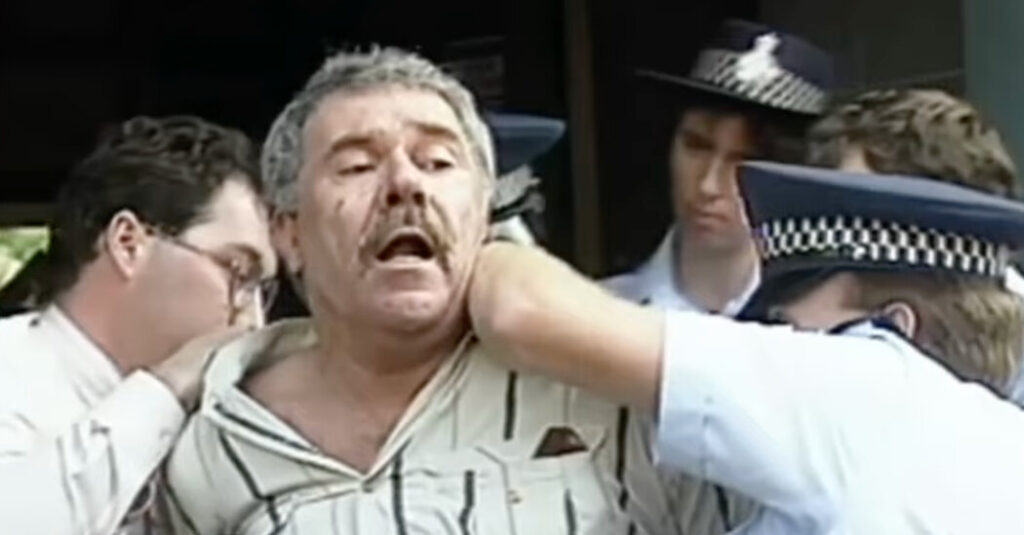
Australia’s National Film and Sound Archive has long preserved the echoes of history, including landmark speeches and endangered Indigenous languages. This week, it also made room for a man shouting about his groin in front of a Brisbane Chinese restaurant.
The archive’s annual selection of new recordings that have exceptional cultural, historic or aesthetic significance, announced on Monday, includes what has become one of the country’s most viral internet memes — the 1991 arrest of the con man Jack Karlson.
Video of the arrest, and the eccentric speech Mr. Karlson delivered as he was shoved into a police car — pontificating about democracy and his “succulent Chinese meal” — almost slipped into obscurity. But years later it resurfaced online, where it has been shared, remixed, debated and, now, made an indelible part of Australian audio history.
“It’s one of the most beloved clips on the internet,” said Rafal Zaborowski, a senior lecturer of digital culture at King’s College London. “I find it really hard to get through a Chinese meal without quoting it once.”
What’s in the video?
On a balmy Friday in October 1991, a local TV news crew in Brisbane got a tip that a man was about to be arrested at a Chinese restaurant, and they sped over to capture the action.
The reason for the arrest, and whether the police detained the person, remains in dispute. But the man they arrested, Jack Karlson, was indeed a petty criminal and con man. As officers detained Mr. Karlson, he theatrically protested his innocence and delivered an over-the-top speech, as seen in this 7 News clip that aired after his death in 2024.
“Gentlemen, this is democracy manifest,” Mr. Karlson shouts with a Shakespearean flourish. He then begins to narrate his arrest for the camera.
“Have a look at the headlock here,” he says, before demanding that a police officer take his hand off his groin.
“Why did you do this to me? For what reason? What is the charge?” he asks, winding up to deliver perhaps his most famous line from the exchange. “Eating a meal? A succulent Chinese meal?”
Mr. Karlson is eventually stuffed into the back seat of a police car, shouting “ta-ta and farewell,” as he disappears from view. Roughly two decades would pass before the video of his arrest resurfaced online, where it would eventually be viewed tens of millions of times in various forms.
Why is the video famous?
The full recording of Mr. Karlson’s arrest was tucked away for years, largely unknown, until 2009, when a tape operator for an Australian news station stumbled across it and uploaded it to his YouTube channel, according to the National Film and Sound Archive.
At first, the video didn’t make waves. But in 2013, it was mentioned by the content creator Ray William Johnson in one of his YouTube videos that excavated the internet for viral clips, according to the archive. Daily viewership of the original video began to surge, and a meme was born.
“It sort of encapsulates the internet in a very short clip,” Dr. Zaborowski said. “It compresses several things that makes whatever is happening memeable and spreadable.”
It’s very short, the recording is clear and it includes unusual words, like “succulent,” that people just can’t help but repeat (think “demure” from 2024). Mr. Karlson’s performance was also exaggerated and theatrical, and happened in the context of a confrontation with the authorities, which gave it a touch of the absurd.
“Oh yeah, and of course there’s the line about genitalia, which is just perfect for the internet,” Dr. Zaborowski said, referring to Mr. Karlson’s admonishing of the police officers for handling his groin. “All of it just works, just works so perfectly.”
Who was Jack Karlson?
Born in Brisbane in 1942 as Cecil George Edwards, Mr. Karlson used several aliases during his lifetime, but he generally went by Jack Karlson, according to the national archives.
Mr. Karlson spent years in and out of jail. While serving a prison sentence he met the Australian playwright Jim McNeil, according to the archives, and began to star in his plays, some of them in prison. Mr. Karlson’s television credits include parts in the 1970s series “Division 4,” “Cop Shop,” “Matlock Police” and “Homicide.”
Mr. Karlson always maintained that his arrest in 1991 was a case of mistaken identity.
Over the years, Mr. Karlson has given a range of theories as to why he was so melodramatic during his arrest, from “no idea” to “I thought they might take me to a mental asylum rather than jail,” according to the archives.
Mr. Karlson died in 2024 at the age of 82.
What else is in the archives?
The “Sounds of Australia” collection at the National Film and Sound Archive, established in 2007, contains commercial jingles, historic speeches and animal calls. The preserved recordings are selected for their ability to “travel far beyond their original moment” and “shape our sonic landscape,” according to the archives.
Beyond operatic arrest footage, the sounds that are being preserved this year include the tone emitted by the PB/5 pedestrian crossing button, a jingle for an adult literacy hotline and the 2004 pop music hit “Scar” by Missy Higgins.
Dr. Zaborowski said that the inclusion of the video of Mr. Karlson’s arrest in the collection was important because it was an example of media widely circulated and recalled by the public — not media that officials or experts deem to be significant.
“That’s how people make sense of the world through collective interpretation of unrelated to them events — such as Jack Karlson being arrested and delivering this speech,” he said, adding: “We make the world our own through shared moment like this.”
Jonathan Wolfe is a Times reporter based in London, covering breaking news.
The post Why Australia Enshrined ‘a Succulent Chinese Meal’ Rant in Its Archive appeared first on New York Times.