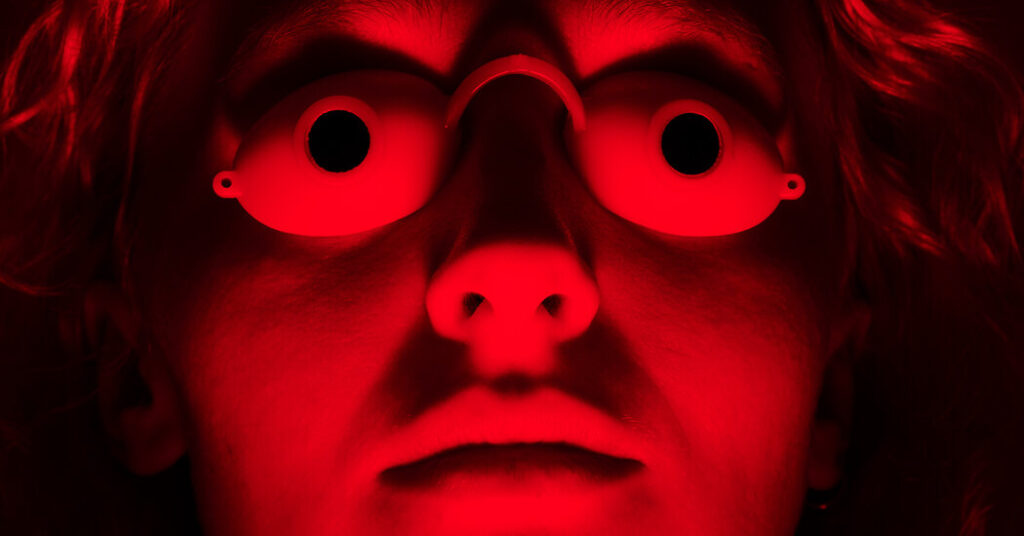
On the third day that I hauled out my dazzling new machine to douse myself in red light, my partner implored me to please, please at least close the door. You know that scene in the horror movie when the murderer guts someone and a tsunami of blood washes across the walls? That’s what it looked like in our little New York City apartment.
I can’t say for certain when red-light therapy entered my awareness, but it must’ve been sometime after the pandemic made domestic fetishists and self-improvement junkies of us all. Instagram’s hype machinists were first to bathe in the bright tomato glow. This practice, they informed everyone, yielded all sorts of nifty benefits — muscle relaxation, wound healing, hair growth, a passport to the land of perfect skin — thanks to the research-proven ability of scarlet wavelengths to jump-start cellular energy production. Doctors recommend red light for pain and inflammation; NASA has used red-light-emitting diodes (a.k.a. LEDs) to speed up photosynthesis in plants and tissue repair in astronauts.
Now, red light is a $444 million market, projected to swell to $658 million by 2032. Consumer contraptions come in various shapes — one of the most popular being a plug-in headpiece seemingly inspired by the hockey mask of Jason Voorhees in “Friday the 13th.” A friend of mine swears that waving a red-light wand on her cheeks has reversed jowl sagging to the point that she’s getting carded at bars again. Another says his red-light veil “obliterated” his lifelong cystic acne and psoriasis. Julianne Moore, Jennifer Aniston, Joe Rogan, Andrew Huberman and LeBron James — they’ve all been known to saturate themselves.
So when the luxury wellness company HigherDOSE released a six-and-a-half-foot red-light mat souped up with 1,000 LEDs a few months ago, I took the opportunity to carpe diode on this maximal measure of crimson. How much could it Benjamin Button me? Would the paper cut on my palm close up, Wolverine-like, before my eyes?
These, it turns out, were not the questions to ask.
The mat retails for $1,119. This comes out to $1.12 per LED. Sprawling on the plastic coating, I spent my first light session trying to prophesy my electricity bill, then thrashing to and fro the way any internet-addled person asked to lie still is wont to do, then finally giving up and pulling my laptop over to catch up on emails, which is the activity I’d normally be doing at that time of day. Because red-light therapy requires repetition for results, I committed to an hour every day of this: reading and writing, brushing my teeth, stretching, whatever, bathed in a ruby halo.
At some point, my partner put his foot down, forcing me to drag the mat to another, much smaller room — where the redness was made ever more intense by silence and white walls. Sitting there in solitary confinement, I had to admit: This was nice. This was what I’d even go so far as to call a very enjoyable experience. The ritualized shine; the swift, theatrical flush from darkness to light; the silent and slightly campy ceremony of sitting down to do dull, ordinary tasks, only now doing them while swaddled in hues between cranberry juice and pan-seared salmon. I started looking forward to the daily burst of pigment with all the anticipatory giddiness of going on a beach vacation.
Except for one thing: I never felt any sort of beachy calm. Rather the opposite. Each morning’s burst of vivid light energized me — made me feel exuberant and bubbly and impulsive and even, at times, a little angry.
It’s not random that stop signs and alarm buttons everywhere are slathered in red, that so many athletic teams don the color or that the term “seeing red” means getting so upset you could behave totally irrationally, maybe even criminally. The color provokes a physiological response. It signals to the brain that there is some sort of EMERGENCY GOING ON!!! — that you should breathe harder and get all worked up and make snap judgments based less on logic than on gut feeling.
TikTok videos tagged “red-light therapy” claim some 70 million views and counting, and the maker of the hockey-mask headgear brags that it has sold 600,000 of those things. Had I become one of hundreds of thousands of people microdosing not beauty but, instead, rage? This was a little worrying. For society, I mean. An increasingly angsty, preternaturally on-edge population — soaking up something that subliminally makes it more prone to violence — is probably the last thing the world needs. And yet, I thought, glancing guiltily in the mirror, this cherry spotlight somehow made my face look so good.
The more time I spent basking in carmine luminescence, the more a kind of demented, solipsistic euphoria washed over me. Who cares about thicker hair or smoother skin? What “wellness”? There is another type of light source that is known to flatter your appearance while altering your mood: It’s called the sun. But red-light therapy doesn’t come with the UV damage — nor is it beholden to the spin of the Earth. At the touch of a button, I was all-powerful. I could summon my own private star for my bidding. And that’s to say nothing of the equally wondrous couple of minutes afterward, each time, when I unplugged the mat and strode out into a world rendered newly lush — suffused, thanks to the afterimage seared into my eyes, with the color green.
The post What One Month of Intense Red-Light Therapy Did to My Mind appeared first on New York Times.