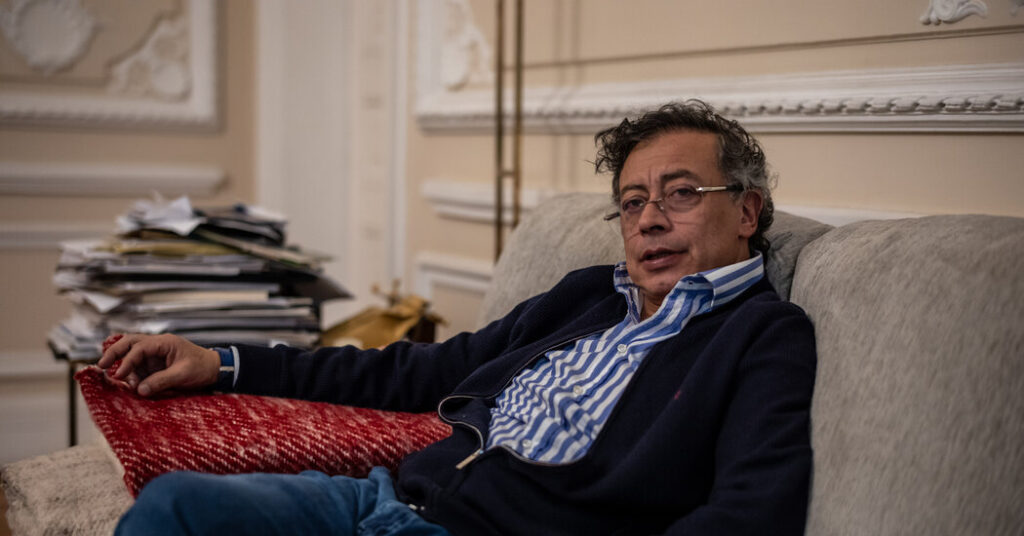
President Trump and Colombia’s left-wing president, Gustavo Petro, have had a volatile relationship, with Mr. Trump shifting from calling Mr. Petro a “sick man” and a “drug leader,” to later, “great!”
When The New York Times recently revealed that federal prosecutors in New York were investigating Mr. Petro for possible links to drug traffickers, many took it as a sign that relations had taken yet another turn.
The report came months after the United States captured Venezuela’s president, Nicolás Maduro, on sweeping drug charges, prompting political commentators to wonder if U.S. authorities had an indictment prepared for Mr. Petro, too.
But U.S. officials have assured Colombia’s government that Mr. Petro does not face criminal charges related to the New York investigations right now, according to four officials from the United States and Colombia, who spoke on condition of anonymity to discuss a sensitive matter.
U.S. officials may want to reassure Mr. Petro, political analysts said, because Colombia faces the first round of presidential elections on May 31. Though limited to a single term, Mr. Petro can influence his left-wing party’s candidate, Iván Cepeda, who is leading in the polls.
Mr. Cepeda, known for his work on human rights and peace negotiations, has not committed to the military strategy Mr. Petro has recently deployed against his country’s powerful trafficking groups, including former leftist rebels involved in the cocaine trade.
The Trump administration is pushing a hard-line, military approach across the region aimed at eradicating cartels and trafficking groups.
The Justice Department’s two criminal investigations into Mr. Petro, which are separate, are in their early stages, and it is unclear if either could result in criminal charges, The Times reported. The inquiries have been exploring, among other things, possible meetings Mr. Petro may have had with drug traffickers and whether his presidential campaign solicited donations from traffickers.
Mr. Petro denied having any ties to drug traffickers.
Legal experts say U.S. federal prosecutors often open investigations into politicians, including heads of state, without ultimately bringing charges. Allegations can arise from broader investigations into corruption, drug trafficking, and other crimes.
It is rare for the U.S. government to bring charges against a sitting head of state. Charges will often be unsealed after a leader leaves office.
While such high-profile, sensitive criminal investigations are generally conducted in secret, The Times’ reporting on the investigations uncovered no indication that the White House played any role in initiating the inquiries into Mr. Petro.
The White House referred a request for comment to the Justice Department; federal prosecutors have declined to comment on The Times’ reporting. The State Department also declined to comment for this article.
Mr. Petro, his country’s first left-wing president, drew Mr. Trump’s ire last year with frequent, fiery critiques of his policies toward Latin America and even Gaza. Mr. Trump publicly threatened Mr. Petro with both steep tariffs and military action; U.S. authorities revoked his visa and placed sanctions on him.
The two leaders recently appeared to turn a new leaf, with phone calls and a White House meeting in February that both described in enthusiastic terms and said had been focused on working together to combat Colombia’s trafficking groups.
Mr. Trump has at times drastically changed his assessment of political foes after speaking with them.
The criminal investigations have been viewed with deep skepticism in Colombia, at a time when the U.S. Department of Justice is widely viewed as a tool that Mr. Trump uses to go after his enemies.
According to Rachel Barkow, an N.Y.U. law professor, federal prosecutors around the country are still undertaking the same kinds of prosecutions that they always have. “But the outside public doesn’t know which ones are tainted and which ones are the business-as-usual prosecution — and that’s the problem that we have now.”
News of the investigations also comes at a time when Mr. Trump, eager to exert American dominance over the hemisphere, has intervened in several Latin American elections, helping to fuel a right-wing wave.
The Colombian Embassy in Washington issued a strongly worded statement refuting the Times report. Mr. Petro described it as election interference.
Politicians on the right seized on it as a political gift.
Abelardo de la Espriella, a far-right candidate, said in a video that the time had come for Mr. Petro to respond for his “scandals.”
Mr. Petro replied to Mr. de la Espriella, saying, “I’m not interested in the investigations in the United States because in my country, I have never been accused of anything like what is suggested.” Prosecutors in Colombia have never brought criminal charges against Mr. Petro.
Many in Colombia see the news report as timed to affect elections, said María Jimena Duzán, a prominent Colombian investigative journalist. “Here, people feel it is an act of intervention,” she said.
Popular figures on the right, including former president Álvaro Uribe, have sought to extend the shadow cast on Mr. Petro to Mr. Cepeda, the left-wing candidate.
Mr. Cepeda did not respond to a request for comment but has publicly dismissed the investigations as “rumors” intended to damage Mr. Petro’s image for “political and electoral purposes.”
But news of the investigations could ultimately benefit the left, Ms. Duzán noted.
“It could help Petro’s candidate,” she said, explaining that Mr. Petro’s popularity has surged whenever Colombians have felt that he was under attack by Mr. Trump.
That same effect could now benefit Mr. Cepeda.
Several days after the Times report appeared, a poll showed Mr. Cepeda remained in the lead and had gained ground.
Despite the news of the probes, Mr. Petro has mostly held his tongue. Many Colombians had expected that he would revert to verbal attacks on Mr. Trump, said Luisa María Lozano, director of political science at Colombia’s Universidad de La Sabana.
Instead, a “tense calm” has prevailed. Mr. Trump has also stayed quiet.
Officials have likely sought to downplay the investigations, analysts said, at a critical juncture.
The Trump administration has recently broadened an antidrug push beyond fentanyl, making it a priority to “smash the grip of cartels and criminal gangs” across Latin America, as Mr. Trump said at a recent summit of the region’s conservative leaders in Florida.
Mr. Petro, who was not invited, has nevertheless taken a harder line on his country’s powerful armed groups.
After peace talks with the groups failed, “the military is engaging in the proverbial war against drugs that it always has,” said Juan Gabriel Takotlian, an international relations expert who specializes in Colombia.
Should Mr. Cepeda win, U.S. officials want “continuity” with Mr. Petro’s approach, he said, adding that Colombia is also a key partner as the United States works to stabilize neighboring Venezuela.
Another staunch leftist is surely not Mr. Trump’s first choice for president, said Ms. Lozano, the political scientist. Yet what appears to be most important is having a collaborative leader in office, she added, pointing to Mr. Trump’s alliance with Venezuelan’s interim leader, Delcy Rodríguez, an avowed socialist.
“At the end of the day, Trump is looking for a government that aligns and collaborates with the United States,” she said.
Luis Ferré-Sadurní contributed reporting from Bogotá, and Jonah E. Bromwich, Nicole Hong and William K. Rashbaum contributed reporting from New York.
Annie Correal is a Latin America correspondent for The Times.
The post U.S. Assures Colombian President He Does Not Face Charges Right Now appeared first on New York Times.