Success in President Trump’s war on Iran now appears partly to depend on whether Washington can reopen the Strait of Hormuz, stave off global economic decline and avoid another endless war.
Turkish history offers both a warning and a way forward about how to deal with this vital waterway, which Iran has effectively closed, sharply reducing the flow of oil through the Persian Gulf. Specifically, the lessons concern the Dardanelles, the narrow strait linking the Aegean Sea to the Sea of Marmara and, beyond it, the Bosporus and the Black Sea.
The Strait of Hormuz remains one of the world’s most important energy choke points, carrying oil equivalent to one-fifth of global consumption and roughly one-fifth of the global liquefied natural gas trade. That is precisely why the temptation to address the problem militarily is so dangerous.
On paper, choke points can create a false sense of simplicity, especially for a superpower that enjoys a vast technological and military edge over its adversary. To war planners in Washington, a narrow passage can look like a technical problem to be overcome by force. In reality, strategic waterways are never merely geographic bottlenecks; they are tests of sovereignty and the balance of power.
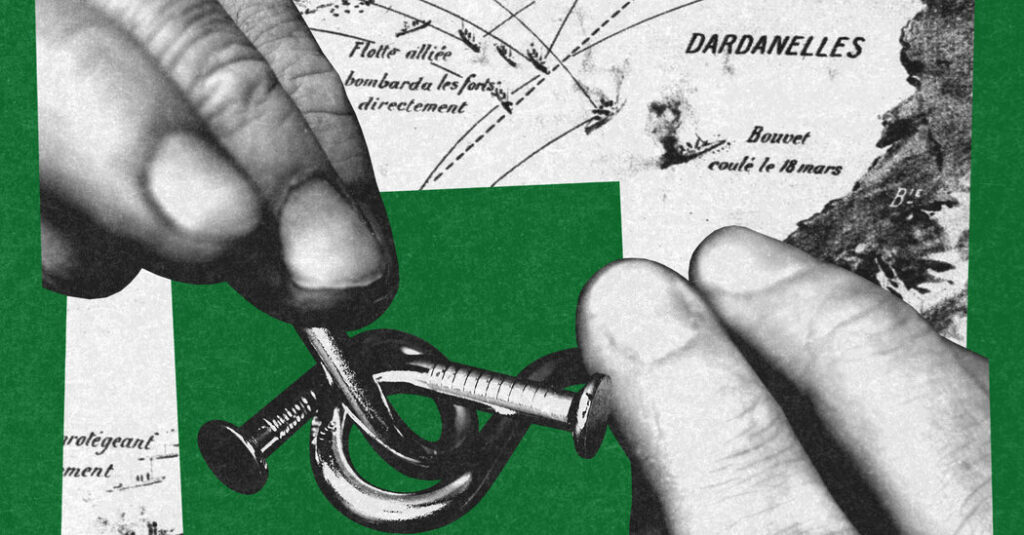
That is what the British and French discovered during World War I when they tried to force passage through the Dardanelles, then controlled by the Ottoman Empire. The Gallipoli campaign, as it was named for the peninsula that runs along the strait, of 1915-16 was Winston Churchill’s brainchild as first lord of the Admiralty. The Ottomans had entered the war on Germany’s side and seemed weak. Britain’s idea was to free up passage in the strait, knock the Ottomans out of the war, and reopen supply routes to Russia. Instead, the campaign became one of the war’s bloodiest disasters for the Allies, killing more than 130,000 men — roughly 44,000 Allied troops and at least 86,000 Ottoman soldiers — and costing Churchill his post.
In Turkish memory, Gallipoli is a story of national birth. Mustafa Kemal, the Ottoman officer who would later become Ataturk, the founder of modern Turkey, made his name in the defense of the straits. “Canakkale cannot be passed,” a reference to a city on the strait, remains a potent slogan.
The British defeat also left the Ottomans blocking Russia’s only viable warm-water exit to the Mediterranean for grain exports and military aid, deepening the economic and military crisis that fueled revolutionary unrest at home, hastening the collapse of the Romanov dynasty in 1917 and the Bolshevik seizure of power.
A U.S. effort to open the Strait of Hormuz by force would be risky, military experts warn. Iran can exploit the advantages of asymmetric warfare, mining the passage and using drones, missiles and small-boat swarm attacks to make fighting for a narrow waterway costly even for a superior navy.
But for President Trump, the choice does not need to be between a military gamble and acquiescing to Iranian control over the strait — and, by extension, over global energy markets. The United States can borrow a page from Turkish history and push for a negotiated maritime agreement, taking inspiration from the 1936 Montreux Convention. The document is foundational for modern Turkey and insures that this critical waterway stays open while acknowledging the sovereignty and security concerns of the state that overlooks it.
For much of the 19th and early 20th century, control of the straits stood at the center of Russia’s imperial ambitions and European great-power rivalry. After World War I, the new Turkish republic accepted a regime of free passage and demilitarization under international supervision. But by the mid-1930s, Europe was rearming, collective security was eroding and Turkey feared growing pressure from both the Soviet Union and Fascist Italy. Ankara pushed for a new convention that would guarantee safe passage without sacrificing the republic’s own survival.
Thus came the Montreux Convention, which was signed by 10 nations, including France, Britain, the Soviet Union, Turkey and several other Black Sea nations. Montreux preserved freedom of passage for merchant shipping in peacetime while restoring Turkey’s sovereignty over the straits. It also gave Turkey greater discretion in time of war to impose restriction on warships — which Ankara invoked early in the war in Ukraine to restrict the Russian fleet’s access to the Black Sea. In other words, Montreux was a rules-based compromise between openness and sovereignty: It kept commerce moving while recognizing that the state controlling the waterway could not be expected to ignore its own security.
This model offers a useful lesson and perhaps an off-ramp in talks with Iran, even though Montreux is not a copy-and-paste model for Hormuz. Turkey in 1936 was revising an existing international regime in peacetime; Hormuz sits inside an active war.
The geography is also more complicated. The Dardanelles are controlled by one state, Turkey. Hormuz lies between Iran and Oman, with the main shipping lanes largely in Omani waters. Any Hormuz version of Montreux would have to be very specific: no attacks on merchant shipping, no mining of transit lanes, rules to avoid conflict between naval forces, provisions during wartime to allow for restrictions on warships from non-Gulf states. There should also be some outside mechanism — through Oman, the United Nations or a small contact group of Arab Gulf nations — to monitor compliance.
Washington should test Iran’s appetite for tying a cease-fire to a multilateral framework that guarantees freedom of passage. At its core, a Hormuz convention would need to do what Montreux did: give Iran something it values in exchange for legally binding, verifiable commitments to permit commercial passage. A durable peace in the Gulf is unlikely to come from pretending Iran has no residual capacity to threaten the strait. Nor can the international community accept a situation in which Tehran turns a global artery into a weapon. A deal would have to recognize the security concerns of Iran and the other Gulf states, such as Kuwait, Qatar and Saudi Arabia, and be tied to a broader cease-fire.
This arrangement would not reward Iranian coercion. It would reflect the hard truth that strategic choke points are governed not by force alone, but by rules and compromises that emerge from war, diplomacy and the balance of power. To avoid turning the conflict over the Strait of Hormuz into his Gallipoli, Mr. Trump should start thinking about how to build a Montreux.
Asli Aydintasbas is a fellow at the Brookings Institution and director of the institution’s Turkey project. Source photograph by andreygonchar/Getty Images.
The Times is committed to publishing a diversity of letters to the editor. We’d like to hear what you think about this or any of our articles. Here are some tips. And here’s our email: [email protected].
Follow the New York Times Opinion section on Facebook, Instagram, TikTok, Bluesky, WhatsApp and Threads.
The post Trump, Don’t Make Churchill’s Deadly Mistake appeared first on New York Times.