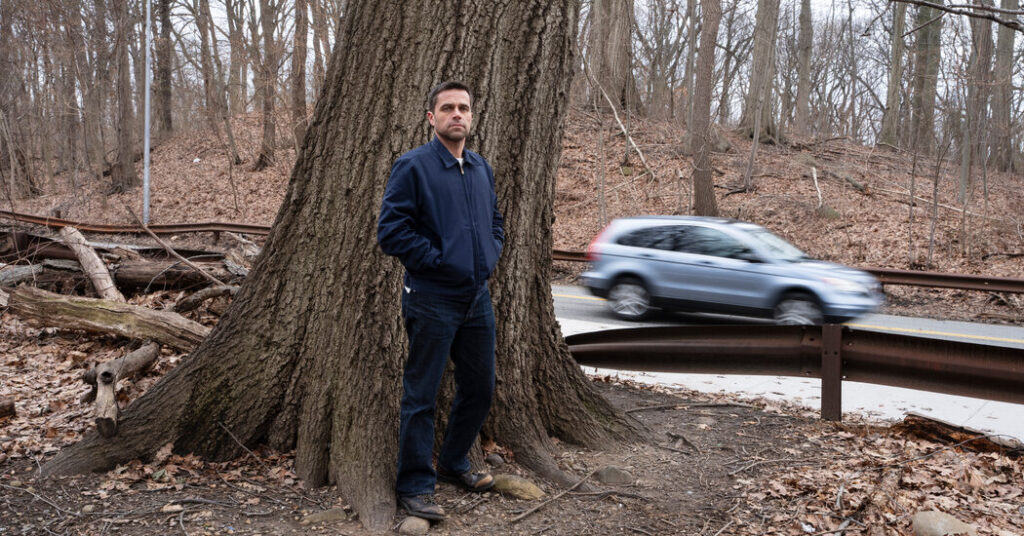
Freedom Drive in Forest Park has become a shortcut for drivers in Queens, but on Wednesday it will be closed to traffic and turned back over to pedestrians, cyclists and skateboarders.
Though the road had been car-free for years, that changed in January when cars were allowed back during the colder months. Park-goers who had eagerly taken over the asphalt protested the move.
“We really kind of fell in love with this new stretch of open space,” said Andy Smith, 45, who lives a few blocks away and started a petition to keep cars off the road. “We all took it for granted.”
Now, as the weather turns, cars will be banned temporarily on Freedom Drive, starting on Wednesday. But parks and transportation advocates want to make the ban permanent. They have planned a rally on April 17 to celebrate the closing of a road that they never want to reopen.
The rally for a car-free Freedom Drive is part of a new citywide campaign calling on Mayor Zohran Mamdani and city officials to ban personal cars from all New York City parks.
While Central Park and Prospect Park have been car-free since 2018, traffic flows daily through many other city parks — cutting across open spaces, bringing noise and pollution, and creating potential conflicts between drivers and pedestrians and cyclists.
But some local officials and residents have countered that closing park roads inconveniences drivers, increases travel times and shifts traffic to surrounding roads. They also say that park roads can become more deserted without a steady stream of cars, raising public safety concerns.
The car-free parks campaign is led by two advocacy groups, New Yorkers for Parks and Transportation Alternatives. “When you have cars on roads running through urban parks, it is not only unsafe, it halves the amount of park space available because families with children, seniors, and other people are afraid to cross the street,” said Adam Ganser, the executive director of New Yorkers for Parks.
Making Space in Crowded Cities
Large urban parks were originally built at the edge of cities, where land was cheaper, beginning in the mid-1800s, said Galen Cranz, the author of “The Politics of Park Design: A History of Urban Parks in America.” They were designed with a “circulation system” of curving roads for park-goers in horse-drawn carriages.
Even Central Park was built in a remote area, away from early settlers in Lower Manhattan, after business leaders pushed back against a plan to construct it on what is now the Lower East Side. The Dakota, the famed apartment house that was built next to Central Park in the early 1880s, got its name “because it was so far away that it might as well be in North or South Dakota,” Ms. Cranz said.
In later decades, as cars replaced carriages, roads were built along or through parks to move traffic more efficiently around cities. Robert Moses, who became New York’s parks commissioner in 1934, “wanted to run roads through parks because they were nice empty spaces and it would be efficient to run roads straight,” Ms. Cranz said.
Mr. Moses built part of the Belt Parkway along Brooklyn parkland, including one stretch that divided Bensonhurst Park. In the early 1950s, he even proposed running a road through the middle of Washington Square Park in Manhattan but was thwarted by residents who rallied to “save the square.”
The new car-free parks campaign builds upon a global movement to remake car-clogged streets for pedestrians and cyclists, an effort that accelerated during the coronavirus pandemic as cities scrambled to create more outdoor spaces for urban dwellers.
In San Francisco, a stretch of John F. Kennedy Drive in Golden Gate Park that was closed to cars in 2020 later became permanently car-free. In Washington D.C., a section of Beach Drive in Rock Creek Park was closed permanently to cars in 2022 for recreational use, though cars have since been allowed back twice a year for “scenic driving days.”
And London has sought to ban or restrict cars in some parks to reduce through-traffic and improve safety and air quality.
But cars — and traffic — have increasingly returned as cities have moved past the pandemic.
In New York, a pandemic initiative to create a network of open streets that banned cars at designated times peaked at 83 miles before falling to slightly over 20 miles by 2022.
City transportation officials said that while there were more open streets during the pandemic than there are now, many did not actually operate when scheduled. Today, there are roughly 200 open streets (the city did not provide the total mileage) and the transportation department “has focused on quality and consistency — and locations operate consistently as scheduled.”
Ben Furnas, the executive director of Transportation Alternatives, said the car-free parks campaign was a response to concerns that the city had been “backsliding” on pandemic-era gains. They have called on Mr. Mamdani and city officials to develop a citywide plan to reduce and eventually eliminate personal cars in parks, while still allowing vehicles for park operations and emergency services.
“This should be an expectation in parks all across the city,” Mr. Furnas said. “Parks are for people, not for cars.”
There are a total of 2,000 city parks, but parks officials said they did not track how many of them have roads.
In 2020, about 4.5 miles of roads within parks, along with another 2.5 miles of roads adjacent to parks, were turned into open streets, according to parks officials. Since then, only two roads have been reopened to cars: Freedom Drive in Forest Park and Silver Lake Park Road on Staten Island.
City officials said they were considering the car-free parks campaign. Jeremy Edwards, a spokesman for the mayor, said that “our parks are our backyard” and that the administration was always working “to explore additional opportunities for New Yorkers to enjoy the outdoors.”
A Closed Road Becomes a Popular Path
In Central Park, cars gradually disappeared after the city began restricting them in 1966. Cars were finally banned in 2018. “It was one of the great days for Central Park,” said Betsy Smith, the president and chief executive officer of the Central Park Conservancy.
Ms. Smith said that going car-free had opened the six-mile Central Park Drive to runners, bikers, parents with strollers, and many others — creating additional recreation space. The drive has become “the most heavily used resource in the park by a wide margin,” Ms. Smith said.
On Staten Island, the road through Silver Lake Park was closed in 2020 and became a destination for pedestrians, running clubs and cyclists who rode laps on it. Since it reopened to cars on weekdays last year, nearly 900 people have signed a petition to keep Silver Lake Park car-free.
Richmond County District Attorney Michael McMahon said that reopening the road to cars brought more people into Silver Lake Park and was part of a broader public safety effort — along with increased security cameras and police patrols — that has reduced crime in the park. “This compromise allows us to prioritize both public safety and recreation,” he said.
Some Queens officials, including City Councilwoman Joann Ariola, whose district includes Freedom Drive, and residents had seen the road closure as “a constant headache” for drivers who had to take detours around the park. In November, the local community board voted to reopen the drive.
But Mr. Smith, the Queens resident, said that it was used by park-goers year-round. One morning last fall, he sat at one end of the drive and counted more than 50 people walking and riding bikes and skateboards within two hours.
“There’s space to move around,” he said. “And we can let go of some of that cramped feeling we all get as New Yorkers.”
Winnie Hu is a Times reporter covering the people and neighborhoods of New York City.
The post The Push to Ban Cars From All New York City Parks appeared first on New York Times.