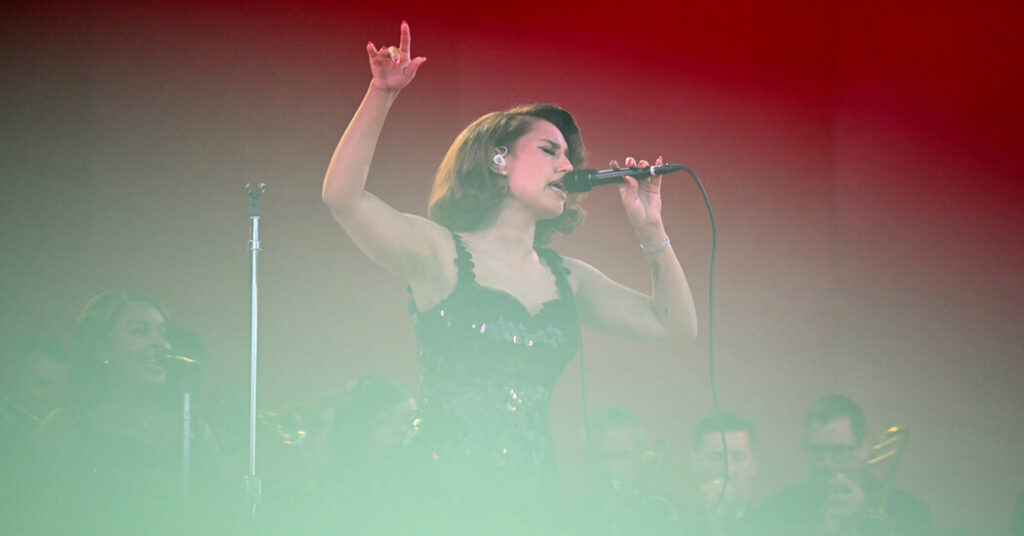
Tabloid reports say the latest Spice Girls reunion has been canceled. Blame it on infighting among the famed flag-bearers of Cool Britannia, or the latest round of Beckham family drama, but don’t blame it on a lack of interest in British culture itself.
In recent months, a crop of 20-something British performers like Raye, Olivia Dean, PinkPantheress and Lola Young have stormed the Billboard charts and become a dominant force in internet pop culture, presenting a compelling and variegated picture of British identity for the first time since the ’90s breakthrough of artists like Oasis, Blur and the Spice Girls.
English artists have been a fixture in the United States since the British Invasion of the ’60s that saw artists like the Beatles and the Rolling Stones shoot to international fame. The dawn of MTV in the ’80s sparked another surge, with synth-pop and new-wave artists like Duran Duran, Eurythmics, Spandau Ballet and the Human League finding a foothold Stateside. A wave of indie-rock bands that regularly graced the cover of the rock magazine NME, like the Arctic Monkeys and the Libertines, made a mark in the early 2000s, mostly by touring clubs and festivals and finding hype online.
But the most impactful 21st century British pop stars thus far have almost always been outliers, rising to the top without being part of a larger movement. With her second album, “Back to Black,” Amy Winehouse broke through to the American charts and won five Grammys in 2008, becoming one of the most successful British artists in the United States practically overnight. Adele is a commercial behemoth, and her albums “21,” “25” and “30” — along with their indelible singles, including “Hello” and “Someone Like You” — represent some of the best-selling and most-decorated records in American history. Likewise, Ed Sheeran has sold over 100 million records in the United States and is consistently listed as one of the highest-grossing touring artists here.
These artists all broke through, in part, off the back of their distinct Britishness: All three were rough around the edges and celebrated for it, capitalizing on an unfussy, unpretentious aesthetic typical of the United Kingdom in contrast to their glossy American counterparts. They were also, generally, the British curios in a sea of Americans, as opposed to representatives of any broader cultural wave.
Aside from Dua Lipa, the late 2010s and early 2020s saw few British pop breakouts. But a new cohort of stars — led by four multiracial women — seems intent on changing that. In the past few years, TikTok has elevated a handful of English musicians to newfound renown in the States; this new class of stars emphasizes and plays off its Britishness, with broad accents and Vivienne Westwood corsets. (Though they largely avoid traditional markers of Anglomania, or representations of the Union Jack, like their mostly white forebears.) And, for the most part, they work in a mode familiarized by Winehouse and Adele: that of the brassy British soul diva, sharing unfiltered feelings in a classicist package.
Leading the charge is Raye, the 28-year-old Londoner who broke through in 2022 with her angsty TikTok hit “Escapism.” Signing with Polydor, an imprint of Universal Music Group, at 18, Raye spent a decade in the major-label trenches, releasing a series of EPs, providing guest vocals for EDM producers like Jax Jones and Joel Corry, and serving as a hired-gun songwriter for Beyoncé and Charli XCX, among others. In 2021, she spoke out, saying that the label had been withholding her debut album; shortly after, they parted ways. “Escapism,” a weepy hybrid rap-soul song, was one of her first independent releases, and peaked at No. 1 on the U.K. charts.
Since the release of “Escapism,” Raye’s career has been on a steady climb: She supported Taylor Swift on her blockbuster Eras tour in 2024, and performed at the Oscars in 2025, covering Adele’s Bond theme “Skyfall”; later that year, she released “Where Is My Husband!,” a glitzy funk track that went viral on social media and subsequently peaked in the Top 20 of the Hot 100.
“Where Is My Husband!” was the first single from Raye’s second album, “This Music May Contain Hope.,” released last week. It is, for the most part, an album of uber-traditionalist soul and vocal jazz that dabbles, occasionally, in the run-on cadences of contemporary rap and clumsy TikTok slang. It also plays up the fact that Raye is not American: On the opening track, she sings that “some people say I remind them of Amy,” and multiple songs name check South London, where Raye grew up. She has clearly identified her Britishness as a selling point: Posters for her current tour dub her “The oh-so fabulous gal from South London.”
Raye’s music feels like it’s in conversation with that of the singer Olivia Dean, who shunned the music factories in Los Angeles for her second album, 2025’s “The Art of Loving,” instead asking her collaborators to decamp to a house in London that was refitted into a studio. But where Raye’s music is tightly stitched and intentionally showy, Dean’s is loose and conversational. She starts with the same soul diva archetype and removes much of the fuss, in line with younger tastes, while remaining staunchly throwback. “Man I Need,” a single from the album, has spent much of the year hovering in the Top 5 of the Hot 100; although that song draws from Motown and classic soul — and finds Dean adjusting her accent accordingly — other songs on the album, like “So Easy (to Fall in Love)” showcase the distinct contours of her London-native accent.
At this year’s Grammys, Dean lost best new artist to another Londoner: Lola Young, the foul-mouthed belter whose 2024 track “Messy” has been an inescapable hit for nearly two years straight. On her 2025 album, “I’m Only Fucking Myself,” Young makes a meal out of her London-ness, incorporating sounds that have a strong place in the city’s musical heritage — Afrobeat, pub-rock, motorik post-punk. Young, who is tattooed and mulleted, presents herself as a product of her generation, but still expresses clear fealty to her forebears; she is even managed by Nick Shymansky, who oversaw the early years of Winehouse’s career.
In her decidedly TikTok-informed presentation, Young is similar to Sienna Spiro, a husky-voiced 20-year-old torch singer. Spiro’s string-drenched soul ballads owe a clear debt to Adele, but her presentation is glamorous and decidedly “vintage” in a very 2020s way, with finessed makeup and minimalist styling.
Then there’s PinkPantheress, the young producer and vocalist who went viral during the pandemic for her intuitive, bedroom-pop flips of classic British dance tracks. PinkPantheress is the outlier of this latest British Invasion: Unlike that of her compatriots, her songs feel musically progressive — and in conversation with other alt-pop artists of the moment like Salute and Fcukers. When it looks to the past, it specifically draws from big-beat 2000s British producers like Basement Jaxx and Groove Armada, rather than just a murky assemblage of vague signifiers.
British identity was always baked into PinkPantheress’s music, but her second mixtape “Fancy That,” released last year, embraced full-on English kitsch: In the imagery associated with the project, the musician is pictured wearing crown jewels and surrounded by scrapbook-y pictures of red telephone boxes and landmarks like Big Ben. One song, “Stateside,” is about an American man who’s never met a British girl; already a popular song on TikTok in the months following its release, the track’s remix featuring the Swedish singer Zara Larsson has surged in recent weeks thanks to the Olympian Alysa Liu, who adapted a dance featured in the video for one of her winning figure-skating routines in Milan.
“Stateside,” with its retro beat and winky nods to the inherent Britishness of PinkPantheress’s whole project, feels emblematic of pop’s current, Brit-forward moment: Stars no longer have to adapt to the international market. Instead, they can crash-land straight in its center.
The post The Next British Invasion Is Here, and It’s Led by Women appeared first on New York Times.