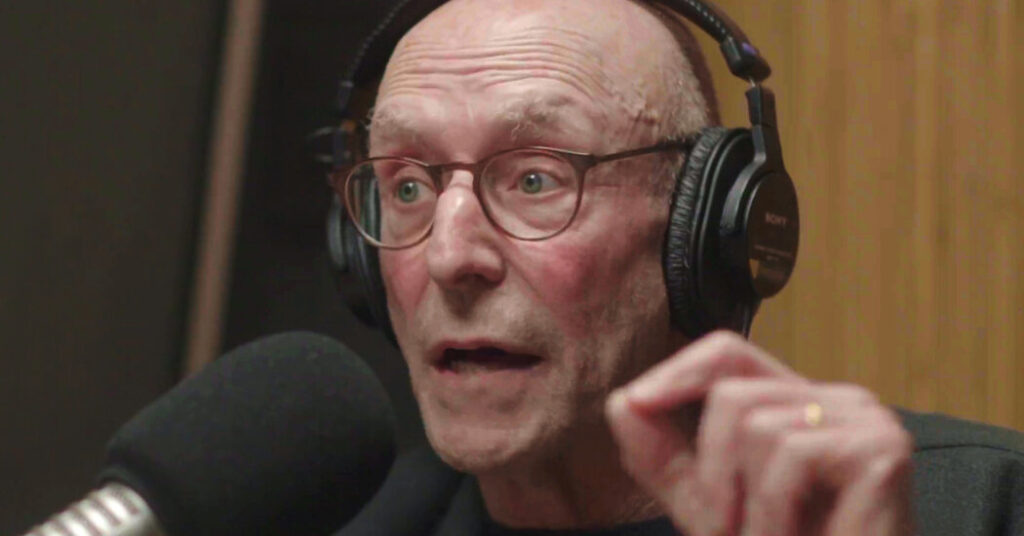
This is an edited transcript of “The Ezra Klein Show.” You can listen to the episode wherever you get your podcasts.
Here’s the paradox of our consciousness: It is the only thing we truly know — and the only thing we have actual firsthand experience of. Yet we don’t understand it at all.
We don’t know what it’s made of. We don’t know how it works. We don’t know why it exists. And the closer we look at it, the weirder it gets. The more we try to describe it, the more our language begins to fail.
I find it delightful that something so close to us can remain so mysterious. That a central question about the universe is happening inside of us, all of the time. Now, that’s not to say we haven’t tried to understand it — or that we haven’t learned a lot from those efforts.
In his new book, “A World Appears: A Journey Into Consciousness,” the science writer Michael Pollan takes us on a tour of those efforts, of those theories, of those experiments, of those psychedelic trips and meditation retreats — and keeps finding himself in stranger and stranger territory, deeper inside the mystery.
So I wanted to have him on to talk about it.
Ezra Klein: Michael Pollan, welcome back to the show.
Michael Pollan: Thank you. Good to be back.
I wanted to begin with an experiment that you participated in during the reporting of this book, where you wore a beeper and tried to record what was going on in your mind when that beeper went off.
What did you learn from that?
When is the beeper going to go off? [Laughs.]
There’s a psychologist at the University of Nevada, Las Vegas, named Russell Hurlburt, and he’s been sampling “inner experience,” as he calls it, for 50 years.
And the way he does it is he equips you with a beeper. You wear this thing in your ear; it emits a very sharp beep. You know exactly what it was and when it was; there’s no reaching for your phone or any doubt about what you’re dealing with. And then you’re supposed to write down what you were thinking at that very moment. Then you collect a day’s worth of beeps, which could be five or six.
The experiment has got various kinds of observer effect problems. You wonder: God, if the beeper went off now, what would I have to say? Oh, that would really be embarrassing.
So there is this self-consciousness, but you forget about it over the course of the day. Suddenly, you get a beep and write it down.
I was struck by how banal my beeps were. The one I described in the book is: I’m waiting in line at a bakery, and I’m deciding whether I should buy a roll or use the heel of bread I have at home to make a sandwich for lunch. This is not profound stuff.
Then he interrogates you about the beeps to try to make sense of it, to help you become a better student of what’s going on in your own mind. Because it turns out very often we don’t know what we’re thinking. At least, I didn’t know what I was thinking.
He would say: Did you speak that? Or did you hear that spoken?
I was like: I have no idea.
He asked: Was it in language or was it an image?
And I said: Well, there was sort of an image. It was very unspecific, kind of an emoji of a roll — not a real roll.
And he’d take you through it. It was an incredibly challenging process.
I want to stay on that for a second. I would say that a lot of thoughts I have, if you push me, they’re the feeling of a thought. I know it’s there, but it’s not spoken. I’m not looking at lettering on the projector screen in my brain.
It’s something less than a fully formed thought. The word “thought” implies a kind of roundedness to the thing that just doesn’t exist. Many of our thoughts are these wisps of mentation.
I love that. “Gossamer traces of mentation” is how you put it in the book.
Yes. Many people think in totally unsymbolized thoughts. I don’t really understand what those would be if they’re not words and not images. But his findings, after 50 years of this, is that we think in very different ways.
He roasts you at the end of the experiment. [Laughs.] You finish this up, and he says that you are low on inner-life experience.
Very little inner life, yes. I didn’t know how to take this. I mean, we all think we have a lively inner life, but the absence of one never occurred to me.
That raises a question for me, which is: To what degree was what you were recording in this experiment different from your perception of how your mental life feels to you in a day?
Very different.
And so what was the difference? And what do you make of it?
I just assumed I had a little more going on than he thought I had. But part of the reason he came to that conclusion is that I argued with him a lot. I found the whole idea of separating thoughts into these discrete chunks absolutely impossible.
When I was at that bakery, waiting in line, there was the smell of baked goods and cheese. They sell cheese at this place. There was the image of this woman in front of me who had on this very loud plaid skirt that was kind of hideous. There was my awareness of the other people there. Did I recognize anybody there? I often bump into people I know.
My thoughts were so infected by one another. One thought was coloring the next, and he just kept drilling down until I absolutely would separate all that.
But I had read a lot of William James at this point. He’s got this amazing essay on the stream of consciousness, and he’s an incredibly acute observer of the nuance and subtlety of our thoughts.
He talks about things like the unarticulated affinity between two thoughts — how one thought colors the next and then the other — and that it is a stream. And you can’t pull anything out of the stream without completely disturbing it.
Let’s talk about William James, because he always ends up the godfather, the leading source of metaphor, in any book like this. Who is he?
William James is the father of psychology in America. He is now regarded more as a philosopher, and that’s because psychology is so empirical now. I don’t know if he used this word, but he acted like and wrote like a phenomenologist, which is to say that he wrote about the lived experience of thought.
I first got acquainted with him when I was working on my book “How to Change Your Mind.” He had written “The Varieties of Religious Experience,” and there’s a fantastic chapter there on mystical experience. He had experimented with drugs to look at these outer reaches of consciousness.
He’s kind of unreadable, yet he’s a great writer at the same time. There’s something about his sentences, which are so long and intricate, that he loses a modern reader about 80 percent of the way to the period. At least me.
But the observations are just so refined, and they kind of put to shame all the scientists working on consciousness. I mean, I hate to say that, because I respect a lot of them, but he was onto the subtlety of mental experience, and they, of course, are reducing it to fairly simple things, like visual perception or “qualia,” which is their word for “qualities of experience.” He goes so far beyond qualia.
So I had a headful of James when I was doing this experiment, and it seemed to keep doing violence to that. I recognized my thinking more in James than in Hurlburt’s questions.
One thing I love about James is his precision in describing how imprecise the stuff of the mind is.
And “mind-stuff” is a phrase of his.
Yes.
I want to quote you quoting him here, because I love this. You write:
The objects of our thoughts can never be completely disentangled from what James variously calls their “auras,” “halos,” “accentuations,” “associations,” “suffusions,” “feelings of tendency,” “premonitions,” “psychic overtones” and — perhaps my favorite — “fringe of unarticulated affinities.”
The fringe! It’s so beautiful.
But talk to me a bit about that. I do a meditation often where you note what is going on in your attention. You note your thoughts, and, even, within thoughts: Did I hear that? Did I see that? Did I feel that?
And it always also seems, to me, to be doing a kind of violence. I’ll sink into a dream a little bit. And what was that exactly? It wasn’t quite a word; it wasn’t quite a visual.
Tell me a little bit about the borderlands of mental experience.
I think it’s just a reminder that our mental life is just far more intricate, complex and shadowy than we give it credit for. And it’s in the nature of reductive science to simplify things in order to better understand them. It would be very weird to start from a Jamesian view of the stream of consciousness and try to understand that scientifically.
I feel like one of the central questions of your book, and one reason I like the topic of consciousness so much, is that it is the only thing we have actual experience of. It is the most familiar thing to us, and yet it’s quite unfamiliar and — this is one of the great lessons of meditation or psychedelics — more unfamiliar, the more you attend to it.
Yes. That is what is really interesting. The more I thought about consciousness, the more elusive the phenomenon became.
Meditators get acquainted with this pretty quickly. You realize, pretty quickly, that you have thoughts that you are not thinking. You have images that you haven’t conjured.
As you’re on the verge of sleep or sleepiness, they just pop into your mind. Where did they come from? And this idea of thoughts thinking themselves is bizarre to most people.
I just think the poets and novelists are further along than the scientists — as they often are. That’s one of the reasons I turned toward literature, later in the book, for a more subtle understanding of the thought process.
Well, let’s stay with the scientist for a little while, at least.
One of the things you try to do in the book is track their efforts to reduce consciousness to something measurable, and maybe protohuman — nonhuman.
You have a great chapter on plants. Maybe a place to start with the plants is: You had taught me something I didn’t know, which is that you can anesthetize a plant.
Isn’t that mind-blowing? [Chuckles.]
Can you talk a bit about that experiment and what it seems to imply?
There’s a group of scientists — botanists — and they call themselves plant neurobiologists, which is a very tendentious thing to say, because there are no neurons involved in plants. They’re trolling more conventional botanists, I think.
I appreciate when people troll each other in ways that laymen don’t even understand. I was like: That seems fine. [Laughs.]
No, it’s fighting words in the field.
OK. So they’re plant dorks.
Absolute plant dorks. And they do all these experiments to see how intelligent plants are, how much they can respond and solve problems. They’ve also done experiments to try to determine if they’re conscious — or I would use the word “sentient,” which is more reasonable. Although they will use the word “conscious.”
Do you want to share the difference in your mind between those two words?
In my mind, “sentience” is a more basic form of consciousness. It’s what perhaps all living things have. It’s the ability to sense your environment and recognize the valence — is that a positive or negative thing happening? — and then respond appropriately.
Bacteria can do this. They have chemotaxis. They can recognize molecules that are food and molecules that are poison, and act appropriately. So it’s a very basic form.
“Consciousness” is how humans do sentience. We’ve added lots of bells and whistles, like the stream of consciousness, like self-reflection, like the fact that we’re aware that we’re aware. Most other creatures are just aware.
Although we recently learned that bonobos have imagination, which is kind of mind-blowing.
How do we learn that?
Experiments. They got a bonobo, as I recall, to play a kind of tea-party game, as you would play with a kid. And they’re pouring an empty pitcher into cups, and they get completely into the game, and there’s some reason you can tell that they know it’s not real.
So they’re imagining this. Every time we build a wall and say: Only humans can do this — we find that no, other animals can, too.
So anesthetized plants.
Yes. One of the experiments these guys did was to take anesthetics that work on humans, including a really bizarre one called xenon gas. I say it’s bizarre because xenon is inert, yet somehow it puts us out if you expose us to the gas. Which is weird because there’s no chemical reaction going on.
If you take a carnivorous plant, or a sensitive plant, like Mimosa pudica — a tropical plant that collapses its leaves if you touch it — and you give it xenon, or any number of other anesthetics that work on us, they won’t react. There will be a period where they appear to be asleep, and then they’ll regain their ability.
So the fact that plants have two states of being is a very pregnant idea ——
At least two states of being.
At least two states, right. Two that we’ve identified: lights on, lights off. That, to some, implies consciousness.
There’s the famous definition of Thomas Nagel’s, who wrote this great essay called “What Is It Like to Be a Bat?” And his test for consciousness is, if it is like anything to be a creature, that creature then is conscious.
So it is like one thing when the plants are awake, and it is like something else when they’re not — or it’s no longer like anything. But the switch in state is very much like consciousness.
Let me hold you on that. Because as I understand the Thomas Nagel essay, it’s that it is like something to the organism.
Yes. It’s internal.
So you could imagine a situation in which it is not like anything for the plant to be awake. You give an example related to this in the book, where you say: When you plug in a toaster, you toast with it. But when you unplug it, we don’t think it is like something different for the toaster to be turned off.
I don’t think it’s like anything to be a toaster.
So the fact that something has a response to stimuli doesn’t necessarily imply it has a subjective experience.
Right. That’s true. The difference between plants and toasters is complicated, but living things have a sense of purpose. They have directionality. They have good and bad. Any kinds of qualities like those we give to a thermostat are really just us giving those qualities to the thermostat. The thermostat doesn’t care on its own whether its 70 degrees or 65 degrees. So I don’t think it’s proof of consciousness, but it’s really spooky and interesting.
The researcher in question is Stefano Mancuso. He’s an Italian researcher at the University of Florence. He has also shown how plants sleep.
There are characteristics that mark a creature’s ability to sleep, which we thought only belonged to higher mammals — though birds sleep, too. But we didn’t think really simple creatures slept. But it turns out even insects sleep.
Giulio Tononi is the scientist who came up with these criteria for sleep. Plants meet, I think, all of them, which is interesting. And some take that as evidence of consciousness.
You’re a gardener.
Yes.
Do you think you’re causing plants pain by pruning them?
So you’re bringing up the issue that immediately comes to mind when you start hearing about plant consciousness, which is: Are we hurting them? When we mow the lawn, is that beautiful scent of freshly mowed grass the scream of suffering? And that will make you crazy.
You say it will make you crazy, but people know we’re causing pain to cows and pigs and chickens and just don’t think about it.
Exactly. It doesn’t bother them.
So it turns out it does not make human beings crazy to cause mass pain to living things on an industrial scale.
Yes. Although there’s all this worry about this in Silicon Valley, that our tender hearts should go out to these machines that might be conscious, and we owe moral consideration to the machines.
Here’s my suspicion about that. Because I do think it is possible that we are going to make sentient machines — machines that have some experience of what it is like to be a machine.
I think that you will find there’s a lot of concern about that until the moment it turns out to be against someone’s interest.
They also love the conversation about the far future, or near far future, whether it’s boomer or doomer view. Because it’s a great way not to deal with what’s right in front of us.
One of the things that has struck me — and it’s a theme of your book — is our ability, as human beings, to wall off our experience from that of everything else in the world.
I forget the great philosopher you’re quoting here, but there is one of them who just doesn’t believe animals can feel pain, sees them as functionally robotic.
René Descartes.
And that is, in part, helping to justify vivisections of live animals in that era.
Yes. Dogs and rabbits.
I have two dogs. I’ve been around some rabbits. The idea that you would believe those animals are not feeling pain, raises a pretty profound question for me about human consciousness and our ability to interpret what we are seeing — around what we would like it to be as opposed to what it is.
Yes, that and the power of an idea.
Descartes developed this idea that humans had this monopoly on consciousness: “I think, therefore I am.”
In other words, the thing I know is that I’m a conscious being, and nobody else has it. No other creature has it.
He was so convinced of his own idea that when these animals screamed — sounds that we would have no trouble interpreting as suffering — he didn’t hear it as suffering. He just thought it was automatic noise.
It is hard to believe. But it’s true, and it tells you something about the power of an idea to overcome our feelings, our instincts.
And we do this all the time. He was so wrong about this that it’s not funny. But we see things through an ideological lens, and it shapes what we actually see and hear.
It changed the sound of those screams to him into meaninglessness.
So you do get into this question of: Are we causing mass suffering to plants?
I talked to Stefano Mancuso and some other researchers about this. One believes that yes, we are causing pain to plants. But his take was: Hey, that’s just life. If we don’t eat plants, we’re down to salt, basically, if you give up on animals and plants.
Mancuso doesn’t think so. He thinks pain would not be adaptive to a creature that can’t run away. And the big fact about plants, of course, is they’re sessile — they’re stuck in place, they’re rooted.
That dictates everything about them. And it’s the reason the language in which they work is biochemical. They produce chemicals to protect themselves, to intoxicate, to attract, all different kinds of things. So he says: They’re aware that they’re being eaten. They often don’t mind. The grasses actually benefit from being eaten. And then, of course, there are all the fruits and nuts that they’re happy to give away to mammals.
I don’t know where I come out on that. I don’t think my plants, when I prune them — I mean, they like being pruned. They respond with more growth and new leaves, so I’m not too worried about that.
There are a lot of things I go through that make me grow that I don’t like. [Laughs.] I would say it’s been a consistent experience of my life.
Well, it’s a short-term or long-term thing, right? Perhaps when you cut them with the secateurs, that bothers them, but they respond in a really constructive way.
There’s also another more complex way plants are operating in this book. Some of this book is motivated by experiences you’ve had with psychedelic mushrooms.
Right, which are not exactly plants, but OK.
Fine.
You’ll get letters. I’m just saving you the trouble.
[Klein and Pollan laugh.]
You have an experience there that I have heard from many others, which is a kind of openness to animism that may not have been there before.
Yes. That’s a very common experience on psychedelics. The world seems much more alive than it does in normal times.
Animism is very interesting, because it’s kind of our default as a species. You go around the world, you look at traditional cultures, they believe that there’s a spirit infusing especially living things but also rocks and cliffs and sky and clouds — everything.
And most kids are animist until they go to school. Then we kind of knock it out of them. So it’s interesting that we exist in this un-animist bubble of Western, scientific materialism. But you push in any direction or travel in any direction, or have a psychedelic experience, and suddenly, questions are raised about it.
I think that’s what’s interesting about what these plant neurobiologists are doing. They’re returning us to a — if it’s not full-scale animism, it’s a reanimated world. And I did come out of this research experience of looking at plant consciousness or plant sentience with a sense that the world is more alive than I thought.
I was just weighing whether or not I wanted to ask you this question, but I think I do.
Go for it.
Something I have noticed from psychedelic circles, which I’m much less plugged into than you are, is people who work with plant psychedelics over long periods of time tend believe themselves as working with plant or spiritual intelligences.
People who do mushrooms or ibogaine or ayahuasca, there’s a sense of there being something on the other side in a way that people who do artificial psychedelics — ketamine, LSD — do not have. The latter do not leave believing there’s an LSD spirit on the other end of the phone.
Yes.
The reason I think people get pushed toward animism isn’t necessarily the more narrow question of what happens when you anesthetize a plant. But people are having some kind of experience there where they feel there are plant intelligences communicating to them.
Oh, yes. Especially on ayahuasca, which is plant-based. It’s a brew of two plants. It’s so obscure that these two plants cooked together would have this effect — neither one by themselves has any effect, or much of any effect. And if you ask most ayahuasqueros how anyone ever figured out the recipe, they’ll tell you: The plants taught me. And they will mean it.
We don’t know, through the lens of Western science, how to listen to that. It sounds ridiculous to us.
If I came out anywhere in this whole book, it’s like my mind is much more open than it was to a lot of weird stuff, just because the normal stuff hasn’t really panned out that well.
Now, why would the plant-based psychedelics be more likely to do this than the chemistry-based psychedelics? I think there, it’s set and setting.
Timothy Leary’s great contribution was explaining that psychedelic experiences are shaped profoundly by the physical setting in which they take place, and the mind-set — the mental setting that you bring to it.
When you’re using a plant-based psychedelic, the imagery is all jungle imagery. People see leopards, and they see vines.
Do you think that’s because of set and setting?
Yes. I think it’s set and setting.
So you don’t buy the shamans who tell you: We were told this by the plants.
No, but there’s like 5 percent of me that was like: OK, maybe.
I’ve entered this never say “never” realm with this research.
Certainly the mainstream interpretation of what consciousness is, is that as life becomes more complex — as unlike plants, we’re moving around — that you have an escalating complexity in conscious experience in order to achieve goals in the world. That consciousness is being created through evolutionary pressure.
It’s adaptive.
It’s adaptive.
Yes.
One thing you do is go through a couple of the ideas of what it could be adaptive toward.
Yes.
Tell me some of them.
So I’m going to back up a little bit to make sense of this idea. One of the big questions is that your brain, at least 90 percent of what it’s doing, you’re not aware of.
It’s doing all this work, monitoring your body, maintaining homeostasis, perceiving things in your environment — without your being consciously aware of it. Peripheral vision, smell, sense, touch, temperature — all these kinds of things.
So the question then becomes: If this automatic machine is so good at what it does, why does any of it become conscious?
That’s part of the hard problem of consciousness: Why aren’t we just zombies? Wouldn’t that have been simpler?
And the reasons — and to some extent, these are evolutionary just-so stories, but they’re persuasive — are that basically you can automate things until you get to a level of complexity.
For us, it’s our social lives. The fact that we are fundamentally social beings, absolutely dependent on other people, with a long period of complete dependence for babies and children compared to other species.
Social life cannot be automated. It’s just too complex. So you need to be able to anticipate what I’m likely to say, how a remark is going to land. We call it theory of mind — this idea that we can imagine our way into other people, the basis of compassion and things like that.
So once we entered this realm of great complexity, automating our responses just wasn’t going to work. And the creatures who had consciousness, that could imagine what was going on in another human’s head, did better than people who didn’t and failed to imagine what was going on in someone else’s head. I find that a pretty persuasive theory.
You look at a baby, or a one-year-old, they’re very socially dependent, and I think they’re clearly having a very intense experience of consciousness, a more intense one than I have. My consciousness is much better at filtering out information than theirs is.
You have spotlight consciousness.
I have spotlight consciousness. So I’m curious to hear you talk a bit about that.
On the one hand, it feels like that idea would imply consciousness becomes richer as you become more goal directed. But I think it’s quite clear that it becomes narrowed as you become more goal directed.
Yes. I think you could make a case that young children are more conscious than we are.
I think it’s almost inarguable.
Which is a kind of interesting thing, that we prune consciousness down, the way we’re pruning so many things in the brain as we age.
This idea of lantern versus spotlight consciousness, I found very powerful. I learned it from Alison Gopnik, who’s a child psychologist, developmental psychologist at University of California, Berkeley. She gave me a lot of good advice as I was embarking on this.
First was: Don’t ever forget that the kinds of people working on these questions about consciousness are not typical in their consciousness. These are people who can sit in a chair for a really long time, read books for a really long time and think out problems. They have an extreme version of spotlight consciousness, which she calls “professor consciousness.”
So that was very helpful. She contrasts this with children’s consciousness, which she calls “lantern consciousness.” So instead of having that 1 degree of attention focused on some object, they’re taking in information from all 360 degrees. It seems very undisciplined, very unfocused.
You find it when kids get to school: Some kids can sit there and do it, and a lot of kids can’t. Because they’re still taking in information from all these sides.
It allows them to solve problems that adults can’t solve. They think outside the box; they have more divergent thinking. And then as time goes on, we narrow our focus. It allows us to get a lot done ——
To put on our shoes in a semi-efficient manner.
But it involves putting on these blinders.
So there’s a trade-off. And one of the things psychedelics do, and Alison made this point to me also, is return us to lantern consciousness.
She said in an interview with me, and to other people, that when she first tried LSD, which wasn’t until I think she was in her sixties, she realized: Oh, this is how the kids are thinking. They’re tripping all the time. And she said: Just have tea with a 4-year-old and you’ll see.
There’s a lot of truth to that, I think.
I want to get at another theory of what consciousness is for, which is — I think the language in the book is: “Consciousness is felt uncertainty.”
Yes. Isn’t that beautiful?
That is very beautiful. Although in practice, I find it very unpleasant. But what does that mean?
So the phrase comes from a scientist named Mark Solms, who is a neuroscientist and a psychoanalyst in South Africa. He’s written a really interesting book, “The Hidden Spring.” His theory is that consciousness arises when you can’t automate things.
In this case, he’s talking about the fact that you might have two competing needs. Let’s say you’re hungry and you’re tired, and you have to decide which to privilege. That takes decision making.
What consciousness does is open up this space to resolve uncertainty. So if everything was predictable in the world, and you could be certain when this happens, that happens, and you had a kind of neat algorithm to deal with contingencies, you don’t need it.
But a lot of life presents us with uncertainty, and that’s when consciousness arises.
I think I’ve thought about this part of the book more than any other. And I think that’s in part because of the way my mind works. So I’m not sure how generalizable this is.
My thoughts are attracted to uncertainty in my life. I just ruminate and ruminate and ruminate over whatever I am typically most emotionally uncertain about. Not always, by the way, the most useful forms of uncertainty. There are other unsolved problems that it would be better if my mind were interested in thinking about.
So on the one hand, this idea that there is something, at the very least, that is attracting the spotlight of my attention to uncertainty feels true. But I also have a couple of questions and problems with it.
One is that it doesn’t seem like what we’re talking about here is exactly consciousness. I mean, what you were just saying about the child or about the adult on psychedelics — they are not attracted to uncertainty in the same way. The experience of psychedelic consciousness expansion is in many ways, I think, less of the experience of felt uncertainty.
It’s a very good point.
It becomes much more about experience. Whereas uncertainty, at least in the way I experience it in my consciousness, tends to be much more spotlighted, much less experiential. It’s a distraction from experience.
Yes. I think that’s right. I haven’t really thought about it that much.
One of my takeaways is that we have to be pluralists of consciousness — that there are many different kinds, and psychedelic consciousness should be counted as one of them — or the mystical forms of consciousness that James talks about. Then there’s everyday consciousness and spotlight consciousness.
So I think we all have a tool kit to some extent. The kind of consciousness you experience as a meditator is very different from the kind you do at work, right? Or when writing. I mean, writing is a great example. That’s a very peculiar form of consciousness.
So the other thing I was thinking about with this was: “Consciousness is felt uncertainty.” Felt where?
We think of consciousness as a thing happening in our minds. Something that has come out of my meditation for me — and I loved seeing how much of it there was in your book — is recognizing how much is happening in the body.
I think that’s my biggest discovery as someone who lives in his head most of the time — how important having a body is to being conscious.
We identify with our heads more than our bodies. Maybe because our eyes are there, I don’t know. [Laughs.]
But consciousness probably arises with feelings first. It starts with things like hunger and itchiness, and only later, as it enters, gets filtered into the cortex, becoming the kind of complicated thinking that we pride ourselves on.
I think that feelings are based in the body. It’s how the body talks to the brain. And we have to remember this very simple fact that the brain exists to keep the body alive, not the other way around.
We’re not just a support system for this amazing three pounds of tofu in our heads. Once you realize that, you realize that the body, the messages coming from the body, are really important to the brain.
These feelings are the beginning of conscious experience. If you didn’t have them, it’s questionable whether you would have consciousness.
There’s no doubt that the experience of consciousness is some kind of interplay between both.
I feel uncertainty in my solar plexus. I think about things I’m uncertain about in my brain.
Exactly. And where do you experience moral disgust? It’s in your belly.
You have a great experiment in the book about people given ginger. Could you describe that?
This is a very cool experiment. They gave people ginger before exposing them to some morally distasteful event or image or something. And the people who had the ginger were less disgusted because their stomachs were settled.
So our feeling of moral disgust is kind of channeled through our gut, which is such a weird idea. But that’s probably true of a lot of feelings.
It has enormous implications for this discussion about A.I. and whether it can be conscious. Because feelings are not just signals, they’re not just bits of information. They contain information. You’re getting a lot of information from a feeling, but that’s the residue of the feeling. There’s something more somatic about it, and it’s very hard to imagine how computers could get to that.
Feelings have no weight if you don’t have a vulnerability, if you don’t have the ability to suffer and, perhaps, be mortal. Otherwise a feeling is just more information. And we know feelings are a lot more than that to us.
I want to describe an experience that I just had. I wrote a note to myself to come back to this part of the conversation later, to maybe clip it out because I think it’s particularly good.
One thing I find I need to do during these podcasts is to pay very close attention to my body. Because what happened there is not that I had a thought: This is good, come back later. What happened there is that my skin got pricklier, and I noticed a heightened sensitivity, and that was an alert to my mind to start paying attention. What am I trying to pay attention to?
I see this all the time in the podcast. My body has reactions to things that are going on, and then my mind has to interpret why that is happening. And the body is smarter about things than the mind, which created the questions document I walked in here with.
But it’s such a strange experience that something just happened in my chest and my hands that told me my body thinks this part of the conversation was good. And to put it into my brain so I could write a little note to come back to it later.
So William James writes about this. You have feelings, emotions and thoughts. And emotions are more the physical manifestation of feelings. I can tell your emotions; I can’t tell your feelings. Those are internal.
James said, basically, that they start in the body. Anger starts with a racing heart or something like that. And then the brain interprets: Why did the heart start racing? Why did blood pressure go up? Maybe it’s fear. So the brain is constantly interpreting the messages it’s getting from the body.
And the body is thinking on its own, feeling on its own, reacting to its environment in a million different ways. It totally changes how you think about consciousness and the potential of automating this or the potential of digitizing it.
If feelings come first, feelings bear more thought. Where do they come from? How can they be simulated?
Feelings in bodies bear more thought?
Yes. Embodiment. Consciousness is an embodied phenomenon. And that brain in a vat meme? No, it just doesn’t work.
Ditto the downloading of consciousness onto a machine — the dream of the transhumanists. You’re not going to have a body? How’s that going to work?
If somebody was to go out into the self-improvement podcast world or school, or anything, and their fundamental question was: How do I get smarter? How am I more intelligent? The answer you basically get has to do with training your mind — studying, reading more, journaling in the morning, whatever it might be.
But there’s actually very little about deepening the connection between your mind and your body.
As I have gotten older, and as my work has become more creative, I’ve come to think it’s a huge mistake. A huge amount of what I’ve had to get better at over the years is paying attention to my body. Such that then my mind can do something with these signals that are not always easily interpretable — but that have some intelligence that I don’t feel like I’m in control of.
Yes, and we misinterpret them. I mean, think about it: You’ve got young kids. When they’re hungry, they will misinterpret that as frustration or anger, and you realize: Oh, they just need to eat, and then they’ll be fine.
So we do go through a process of learning how to interpret what our body is telling us. But it’s true that as adults, where do you go to learn that? Meditation a little bit, doing body scans and things like that. I’ve done meditation practices where the focus is very much on the body and what’s going on in every different part of the body.
But I think we would be wiser if we learned how to do this, and paid better attention to our bodies.
This is the lesson of Antonio Damasio’s first book, in 1994, “Descartes’ Error.” He was basically showing that feelings and emotions should be admitted into the decision-making process. He proved that people who couldn’t experience emotion or feelings made worse decisions than people who could, and that there was a kind of gut check.
We have all these words for the gut and thought. Buried deep in the language, there is some kind of understanding that our gut has something important to tell us about a decision.
So he kind of rehabilitated feelings and emotions in the whole science of the brain. But basically we’ve been drumming feelings and emotions out of our understanding of the brain for hundreds of years.
I don’t know why. Maybe it’s this idea that the pinnacle of human consciousness is the cortex — or that the kinds of people who do this research are just really out of touch with their bodies.
I like that as a hypothesis.
I’ll be hearing from some of them.
Fair enough.
I want to pick up on something you said in there about the sequencing, about how feelings often precede thoughts.
There’s a great piece of research you bring up on meditators who are asked to note when they’re interrupted in their meditation by a thought. Can you describe that study?
Sure. So there’s a scientist, a psychologist named Kalina Christoff Hadjiilieva. Their field is spontaneous thought — which I hadn’t thought about as a field. That includes things like daydreams and mind wandering and creative thinking and flow.
They are very interested in the question of how things get from our unconscious into our conscious awareness. Because we know there’s a lot going on below the threshold of awareness. They work with trained meditators, people who have like 10,000 hours of experience meditating.
So Kalina put these meditators in a functional M.R.I. and gave them a button to press as soon as a thought intrudes — because even if you’re an experienced meditator, it’s going to happen.
Kalina says it happens every 10 to 20 seconds for everybody. They said the great lesson of meditation is that the mind cannot be controlled — which is very freeing to people trying.
And what was interesting about this is that when people pressed the button, Kalina would look back at when something popped out, when there was activity in the hippocampus, which is the source of memories — and other stuff, as well. But Kalina was watching that as a source of a thought.
And it took four seconds between the fMRI showing activity in the hippocampus and the person being aware of that thought.
Four seconds of brain time is like an eon. So what is happening for a thought to transit from the unconscious to the conscious? And why does it take so long?
Kalina doesn’t know. I’m sorry I can’t pay this off. [Laughs.]
But one of the theories called Global Neuronal Workspace Theory is that there are thoughts competing with one another for access to our conscious awareness. And they’re kind of in this Darwinian process. Only the most salient ever gets into the workspace and then broadcast to the whole brain.
The problem with this theory is there’s a lot of trivial stuff that somehow gets through, at least in my case. I think there’s a lot of traffic going back and forth. And that’s something also that happens not just during meditation but during psychedelic experiences. There’s lots of unconscious material that comes up.
I actually find this to be a problem with meditation. There’s a lot of meditation that is about open awareness, or trying to watch things happen nonjudgmentally. But the very act of having awareness is very clearly changing what is happening in my brain.
So the more awareness I have, the more my brain or my mind feels somewhat controlled. And the less awareness I have, the more I’m going to get these little wisps of mentation.
There’s a meditation teacher I really like and whose meditations are on YouTube, named Michael Taft. His attitude is: Look, the machinery of the mind is going to go on, but just put it down the way you’d put down your phone. Just let it do its thing. You can just ignore it.
I find that very helpful. I have this sense of a little buzzing going on in this corner of thoughts that I’m not paying attention to.
But as Kalina shows, it’s very hard to control this material, and things are going to bubble up — and they’re interesting.
One of my deep and fundamental questions about being a human being is why I attend to what I attend to.
If I could go to talk to the algorithm in my mind, in the way that you can tell Claude how you want Claude to act, I would change the algorithm. I would worry less about interpersonal conflict in my life. I would spend a lot less time thinking about whether or not people are mad at me.
But there is some process by which — I hate the term “Global Workspace Theory” as a description of what is going on in the mind. It’s so bloodless and built on personal computers in 1998.
Productivity ideas, yes.
But that idea that things are competing. And, somehow or another, some part of my mind is running some kind of process to decide what comes into the spotlight of attention. And if it’s really shocking, there’s a car accident next to me or a ——
Yes, there are shortcuts.
Yes, like all of a sudden, it will move me there entirely. But moment to moment, there’s some kind of competition, and what comes up, I can be aware of it, but the more aware I am, the less in control that I feel. Which is one of the great, and slightly terrifying, lessons of meditation.
So that question of the unconscious doesn’t seem mild to me. That is the factory producing thoughts, and then something is deciding what to put on the front shelves.
So you’re thinking about it in terms of an algorithm and massive data. And different things could get pulled into it. And that’s not a bad metaphor.
I mean, we don’t know exactly how it works. If the workspace idea is true, everything we think should be of some consequence. [Laughs.] And we all know that’s not true.
So why do things that are completely trivial or banal enter our consciousness? Sigmund Freud would say we’re suppressing more important things.
But there is clearly a way that the mind learns what to think about over time. To use the example of my kids: It is quite clear to me that my children do not spend any time during the day thinking about things they have to do in the future.
They might think about things they want to do in the future. But they’re never like: You know, I think it’s been a while since my last pediatrician appointment. I might need some shots.
But if you leave me alone with my mind for much time at all, a to-do list begins bubbling through it. It’s very persistent. I meditate with paper near me just to get things out of there and onto the paper, so I don’t keep thinking about them.
Somewhere along the way, I went from being a kid who was pretty present in his life, and thought more about things I wanted to think about, and became somebody whose mind has bent toward productivity. It’s not the only thing that happens in my mind, but it is clearly a favored topic.
Yes. And it makes you successful. I mean, there are standards by which that makes sense.
You brought up something a minute ago, where you said that the problem with this theory is: Why does so much triviality emerge?
But couldn’t you just say: Well, it has over-applied rules.
Like my biggest complaint about my mind is that I think too much about relational stress. But you grow up, you have a family, you’re very dependent on caregivers.
I was bullied in school. It’s very easy to imagine how a mind would bend toward the idea that being out of joint in relationships can really harm you. So it’s not unclear to me how my mind might have overlearned the rule to scan for relational threat at all times.
So I’m curious about that. Something is happening over time that is not the same in all people. It’s dependent on life experience. People who grow up in times of famine tend to store more food when they’re older.
There’s something happening here.
And also that pleasure is not driving this. It’s success.
You are learning algorithms — if we’re going to use that computer metaphor — that, even though they don’t feel good, are promoting the kind of behavior that’s going to solve problems and keep everybody happy — maintain peace and all these kinds of things.
So our minds are invested in our success, not our pleasure.
I talk a lot about how psychedelics inspired this book. But meditation did, too. Because as soon as you stop to examine what’s going on in your mind — which many people don’t do, but now tens of millions of do, especially since the pandemic, there are a lot more meditators than there were — you realize how strange our minds are, and how little volition is involved. We think we’re calling the shots as conscious human beings, but to a remarkable extent we’re not.
And where that material is coming from — we can call it the unconscious — we don’t really know. But it’s just defamiliarized. You’re just estranged from your own mental processes.
There’s a great meditation exercise where you look in your brain for who’s thinking those thoughts, who’s feeling those feelings — and you won’t find anybody.
Talk to me about a state of mind that has come up briefly in our conversation already that I think is between the unconscious and goal-directed thought, which is the wandering mind.
I think we have come to diminish its role. So what is it, and what do we know about it?
Well, the wandering mind is what’s happening when you’re bored. That’s the precondition, in a way, for a wandering mind: I’ve got nothing to do. There’s no task here. I’m just killing time.
And suddenly we’re off and daydreaming, or mind wandering. They’re very similar things. I forget how Kalina distinguishes them, but they do. They think it’s a really important part of life that we haven’t studied because it’s not productive, and that all the work in psychology goes into productive areas of thought.
I think that’s changing now. You have people studying awe and emotions that are not necessarily productive. But awe is very useful.
So they just think this is a space of creativity, and that a lot of creative thinking comes out of mind wandering and daydreaming.
It’s something novelists do all the time, right? They get pretty good at daydreaming.
And Kalina says that we’ve lost this. The space of our interiority for this kind of thinking is diminished, because of our technological distractions.
I want to challenge this idea that it’s a nonproductive form of thought.
Oh, I think it is very productive. But how are you defining “productivity”?
I would say productivity is the ability to do better with the same amount of resources that you already have.
And the biggest barrier for me to true productivity is that I don’t spend enough time with my mind wandering. It is routine that the absolutely most creatively important times I will spend, I thought I was taking a break. I thought I was doing something else. I wasn’t just driving my mind farther into the ground, flicking through web pages, when I was already too tired to absorb information.
Then all of a sudden, I’ll have the insight, or I’ll realize: I should call this person.
I don’t know where it comes from, but it’s those moments of inside epiphany, a creative leap, a line that comes into my head ——
The spotlight gets in the way because of those blinders. And I think when you’re daydreaming or mind wandering, the blinders are kind of opened up, and you’re taking in information from more places.
They argue that it’s just the belief that this is unproductive thought, because nobody wants mind-wandering workers. The capitalists want spotlight consciousness.
The example they gave is: Right now my job is to grade blue-book exams, and that’s what I should be doing. But my real life project is making sense of my life and having a fulfilling life, and I would be better off taking a walk or mind wandering.
So there’s a tension there between what the economy considers productive thought and what emotionally is productive thought or creativity.
Or what the economy should consider productive thought if it were smarter. You can’t quantify it on the hour-to-hour level.
That’s right.
One of the most interesting mind states for me is a mind state I functionally only have when I am reading something on paper, without screen distractions around me. My mind becomes highly associative. I’ll be reading, and then I’ll look up, and I’ll have ideas.
They’re often not about the book at all. It’s like the book itself is a scaffolding of a certain kind of attention. But I’m aware, and I’m awake, and so I’m noticing other things.
It is by far my most creative state.
Do you have a pencil or pen in your head?
Yes.
And it is achieved more easily on airplanes than anywhere else, because then you really don’t have distractions. Or it can happen at a coffee shop, but it won’t happen if I’m looking at a screen.
And so it made me think about how I think a lot of our received beliefs about this are really wrong. If we wanted humans to be more productive, more creative, we’d want to put people more in touch with their bodies. We’d want to teach them how to find states of open association and mind wandering.
You want to put yourself in the way of inspiration more often. Because it’s not controllable in the way we wish it were.
I completely agree.
Kalina edited this book, “The Oxford Handbook of Spontaneous Thought.” There is a history of spontaneous thought that looked at how incredibly creative people — composers, novelists — spent their days. They only worked four or five hours. They spent a lot of time in unstructured wandering, like walking.
We all know there’s a connection between creative thinking and walking. If you’re stuck in your writing or whatever else you’re doing, you’re much more likely to break through if you get up from the desk and take a walk instead of just worrying about the problem. So we could reorganize our lives.
But the one thing we do know is how our phones, our social media, are bringing down that viewpoint, keeping us from looking up, keeping us from making associations. Because there’s no time for associations. You’re just scrolling, and something else comes in, and you’re getting another little hit. So we’ve shrunken that space, and it’s a space of creativity.
There’s no reason we can’t reclaim it. But we have a lot of trouble doing that because these algorithms are really sophisticated, and they know how our minds work.
When are you most creative?
Walking, I would say. I walk a lot in the Berkeley Hills.
Though even then, I have to say, half the time, I have my AirPods on. I’m listening to a novel or a podcast — listening to you — when I could be ——
Let’s not be too hasty and diminish the importance of informational input here. [Chuckles.]
[Laughs.] Yes, no, it is important. But I have to remember to take out the AirPods and listen to what’s going on.
And we haven’t talked about time and nature, but that’s a very hygienic space for consciousness — being off all media.
As the book evolves, you start widening to less and less goal-oriented theories of consciousness. And one thing that is happening throughout the book, that you’re very attentive to, is first, the number of scientists of consciousness, scientists of the mind, who are now dabbling in various forms of psychedelics.
Yes. That was a surprise to me.
Well, you’re part of the reason it’s happening, so it shouldn’t be that surprising. [Laughs.]
Well, there’s a selection bias. People know they can talk to me about their trips.
It’s quite a role you’ve created for yourself in public life.
And, second, the way that is upending their theories of consciousness. You have a number of scientists, throughout the book, who are saying: Well, I thought this, and then I had this experience.
And I think that’s really interesting — the felt experience of truth on something that people, who, up until that moment, would only accept what they could prove, and were reducing everything to the provable. Like, they know they ingested a chemical, and yet what that felt like, they’re not willing to dismiss.
It was so definitive and so authoritative.
You’re alluding to Christof Koch, who is a very prominent consciousness researcher. He was there, at the beginning, when he and Francis Crick began on this quest to understand consciousness in the late 1980s, early 1990s.
And he’s an exemplary scientist in that he’s changed his mind in profound ways several times. I find that doesn’t usually happen among scientists. You know the saying: Science changes one funeral at a time.
Not in Koch’s case. He went to Brazil and had a series of ayahuasca experiences. Now this is the prototypical brain guy, right? He ran the Allen Institute for Brain Science in Seattle. He had been messing around with neurons and electrodes for years and years and years, and he assumed that the source of consciousness was going to be in the brain.
He had this experience of “mind at large” — this is a term that comes from Aldous Huxley in “The Doors of Perception” — that consciousness was outside of his brain.
And I challenged him on it. I said: Well, but that was a drug experience.
But he would not take that as disproof or even reason for skepticism.
And he used, as an example, a famous thought experiment called Mary’s Room: You have this brilliant woman who is the world’s expert on color, on vision. She knows everything there is to know about cones and rods, and how the whole system works. But she lives in a completely black-and-white world.
She steps out one day and has the experience of color. What has she learned? What has been added to her stock of knowledge?
He said: I was like Mary, and I had had this vision, and nobody could convince me, when I went back in the box of scientific materialism, that it hadn’t happened. It had happened. I was as sure as I have been of anything in my life.
And now he’s exploring idealism.
What is idealism?
Idealism is the philosophy that consciousness is a universal field and that consciousness precedes matter. We automatically assume that matter is primary, that everything can be reduced to matter and energy, and they can be reduced to each other.
Idealism argues: You’ve got to start with consciousness. Matter comes second.
The argument for it is there’s nothing you know with more certainty than consciousness. It’s the thing you know directly. Everything else you know is inferred. You see through consciousness.
So why is it that we privilege the thing we infer rather than the thing we know? Why do we privilege matter as the ultimate source of everything?
Maybe a smarter person than me knows there’s a logical fallacy there. I don’t know. I don’t see where it is.
So the idealism theory is related to this idea. You bring it up in the book. I think you’re the first person from whom I had ever heard about this: the idea that the mind may be like an antenna.
Yes. Or a radio receiver.
It’s not generating the consciousness. It is receiving some kind of signal and then interpreting it. And in the same way that if you break a TV ——
It’s not going to work anymore.
It’s not going to work. But that doesn’t mean the waves that it was absorbing are gone.
Yes. And you shouldn’t look in the TV set for the weatherman.
And that’s kind of what we’re doing.
But it’s channeling this information from the universe, and that’s why the brain is involved in a critical way. If you damage the brain, you damage consciousness — or anesthetize the brain or whatever. But it’s involved in a different way.
And the evidence kind of works the same either way, whether you say the brain generates consciousness or channels consciousness. It’s hard to make a case that one is better than the other.
The term scientists use is that consciousness is “an emergent property” of the brain — which sounds really scientific, but if you press, it’s just abracadabra. [Laughs.] It doesn’t really explain anything.
What is the difference between idealism and panpsychism?
Panpsychism is the idea that every little bit, every particle, has a quantum of consciousness, of psyche. And in the same way that, 200 years ago, we added electromagnetism to the stock of what reality consists of, of what material reality consists of, we should add psyche. It’s another thing.
So in a way, it’s a new materialism. Or it’s materialism with something added to it.
It’s a big price to pay for your theory that you’re adding something completely new to the stock of reality. But it solves the problem of where consciousness comes from. Because it comes from everywhere — it was already here.
So these ideas, when I first learned about them, I thought they were crazy. But then you realize that materialism has kind of hit a wall with consciousness studies. There is this gap that we can’t seem to cross, from a very good theory, like Global Workspace Theory to: Well, wait a minute — when you say you’re broadcasting to the whole brain, who’s receiving that broadcast?
And then you have other people saying: Well, consciousness is just an illusion. But an illusion is a conscious experience. So what about the subject? And that’s where everybody starts waving their hands.
What level of plausibility do you assign to that?
To what?
I guess either, but I’m thinking of the idea that the brain is a radio receiver.
I have to say: I don’t know.
It’s weird to spend five years on a book and come to an answer like that. As I said at one point: This is a book where you may know less at the end than you do at the beginning. But you’ll know a lot of other things. [Laughs.]
It’s a very fun tour. I told you at the beginning of this that I’d give you my theory of the book toward the end of our conversation.
When we sat down for “How to Change Your Mind,” your book on psychedelics, I told you that I thought that was a book about the mind posing as a book about psychedelics. And I kind of think of this as a book about psychedelics posing as a book about the mind.
And not to do violence to it — both books were actually about their subjects.
But it is striking to me how often in this book — it’s not just Koch, there’s the scientist who is building, I think, a robot trying to make consciousness, and then does 5-MeO-DMT and realizes everything is love.
There are your mushrooms. There are a lot of people who note, offhandedly, that there seems to be something here that has caused a larger ontological shock than a stylized description of: Well, you ingested a chemical. Of course you had a chemical experience.
It’s a totally unsatisfying explanation, yes.
Well, I think that the interest in psychedelics is partly an interest in taking back our consciousness and exploring it. Because one of the things that happens is that the day you do a psychedelic is not a day you’re looking at your phone.
It’s a day that you’ve put a fence around, if you’re doing it right, and not just walking around the streets of Manhattan, tripping. You’re doing it with some intention, and you reclaim your mind for a period of time, and you explore it.
This idea of expanding consciousness — there’s a line of Aldous Huxley’s that I’ve always really liked. He believed in this transmission theory of consciousness, which he got from Henri Bergson, who really was the person who first put that forward. Which is that in normal times, our brains admit only the trickle of consciousness we need to get through the day to be productive, to do what we need to do. But there’s so much more.
And what Huxley said psychedelics did is open what he called the “reducing valve” so that more consciousness got in. What was that consciousness? To him, it was the mind at large.
But I find it’s also sensory information, bodily information. I mean, sometimes trips are incredibly somatic, and they’re all about the body. And other times they’re about visual material.
But it’s ours, it’s mine. Although some people go to a divine place about it.
So I’m just out there starting to talk about consciousness, and I’m curious that people are so interested in consciousness. I didn’t expect this when I started on this book.
Really?
No, I didn’t. It seemed like a very academic topic. And I think two things have changed that: One is the fact that we feel our consciousnesses are just full of [expletive] right now.
There’s so much stuff we don’t want to be thinking about that we’re thinking about. You take phones away from kids, and they’re actually grateful — once they get over the shock of living without a phone for a day or while they’re in school.
Our consciousness is under pressure from everyday life — like capitalism and the need to succeed financially. We happen to have a president who intrudes on our consciousness for a lot more of the day than any of us have had experience before with previous presidents.
So I think there’s some desire to get back to some more sovereignty around our consciousness. And psychedelics are part of that, too.
There is also A.I. I say in the book that we’re entering a Copernican moment — a possible redefinition of what it means to be human.
On the one hand, we have all these animals, and even plants, that turn out to be conscious — what we used to think was our special thing. And on the other side, we have these machines that are going to be smarter than we are.
Some people think they’ll be conscious. But whether they can or not, we’re going to think they’re conscious and act on that basis, which raises all sorts of problems.
So who are we exactly, if we’re not the smartest, most conscious being? Are we more like the animals that can feel and die and suffer? Or are we more like the thinking machines that speak our language?
You talk about consciousness as a reducing valve, as a filtering mechanism of sensory experience. We’ve also talked a little bit about the wider, more lantern-like consciousness of children.
I wonder how different the experience of being conscious is in advanced modernity with a smartphone and a task list. We are really training ourselves to narrow down. To be successful in our economy, we have altered what it means to be human.
And I wonder how much we’ve made the experience of consciousness increasingly unsatisfying. You can overtrain any muscle. And what we are doing, staring in a narrowed way at a computer — I mean, there’s all this great neuroscience on the difference between wide and narrow gaze, which I really feel when I look out over a mountain range, and then when I look at my phone, I can feel ——
The shrinking.
The shrinking and the tightening of the chest, and the ——
The posture. The posture of screens. Yes.
We have narrowed how it feels to be a human being.
We have, but it’s not too late.
Tell me about your consciousness sovereignty ideas.
Consciousness hygiene. One of the things I’ve been talking a lot about is protecting our consciousness and what a precious space of interiority we have. It’s this place of mental freedom.
But I realize that, for some people, going there doesn’t feel good. These are people who ruminate a lot. I’m prone to that, too — to a lot of rumination, which is very circular thinking, often not productive. It keeps you focused on something, but not in a way that’s making progress, usually. It’s a spiral.
But also you can take some control over your consciousness. And we need to do more to defend it.
Meditation is one great way. As challenging as it can be, you’re like: Here’s my mind; I’m with my mind. It might be painful, it might not be. But no one is telling me what to think.
We spend so much time thinking the thoughts of other people, and enduring the rants or the obsessions of other people. So meditation is a really interesting way to put a fence around your consciousness.
You put down your phone, but you still have paper because you’re just trying to get rid of those to-do things. But when it’s working really well, there’s great pleasure in watching the show go by — the things I wasn’t expecting to think about, the imagery and all this kind of stuff.
I do have an internal life, contrary to what that guy said. [Laughs.]
Sure you do, Michael. [Laughs.] We believe you, for sure. You’re not just a zombie here.
Something you said a minute ago pinged for me: Often people actually don’t like being put in a room with their consciousness.
I don’t have the speaker in memory, but there’s the famous old quote: A huge amount of the world’s problems come from man’s inability to sit in a room by himself.
I was in a period of meditation a couple of years back, and I was trying to meditate a lot, because a lot was happening in my life, and I felt like I was just getting more and more upset. And I remember talking to Will Kabat-Zinn, who’s a great meditation teacher in the Bay Area, whom we both know.
And he said to me something I’ve never forgotten. He said: Oh, so you’re not enjoying the process of insight!
And I actually think this is part of a lot of things. To say nothing of our president, who I think ——
Cannot sit in a room alone with himself.
Cannot sit in a room alone with himself. I think his need for constant distraction and ego reinforcement speaks to some complicated relationship he has with his own consciousness.
It is sometimes actually quite hard to be there by yourself. And when you make space for it — and I mean people who go on a meditative retreat often have very difficult times. It can be, and I think usually is, very profound, but you are often going through struggle.
One of the great lies about meditation is that it’s peaceful.
Right. It’s agitating.
Yes. In fact, it’s much more peaceful to distract yourself.
“Peaceful” may not be the word I’m looking for there. But we distract ourselves away from internal agitation.
We spend a lot of time anesthetizing ourselves.
And there’s a kind of boredom that I think is generative that we don’t experience anymore, because we have all these amazing ways to fill that space. But that space was productive in its unproductive way, and we’ve given that up.
So that’s a space of consciousness, too, that we could easily reclaim.
I think psychedelics are one way to take control of your consciousness. That’s probably not the right verb, because there’s so much that’s uncontrolled, but it’s all you.
I think that’s one of the reasons that there’s so much interest in it right now. You’re blocking out a lot during a psychedelic experience as you go inside.
So we need to think in terms of hygiene for this great gift we have.
What does “hygiene” mean here?
Well, to keep it from being polluted, to keep it clean, to keep your consciousness from letting others dictate its contents, basically. Take back control.
Is that a question of consciousness or of attention?
Well, they’re very closely related. I think attention is a subset of consciousness. So attention is part of it.
Attachment is another part of it, though. Emotional attachments. That’s a big part of consciousness, too.
Having won our attention now, the companies are now going for our attachments with chatbots.
I’ve met people who are working on attentional liberation movements. The Friends of Attention are a good example of this. They just came out with a new book. People are creating schools on this.
So there is, burbling around, a sense that attentional freedom is an increasingly political and structural question.
Yes.
I think we see it fairly clearly with our kids, but I think we know it with ourselves, too.
It’s very hard to think about how to create a coherent politics around it and activism around it. But also, nothing is more fundamental, including to how politics works, than what kind of attention you’re cultivating in a society.
Oh, yes. Absolutely.
Attention as a collective resource is an underplayed frame for this — or attention as a collective capacity that is being exhausted by people like Donald Trump, by certain ways that the media and algorithmic media works.
And a society with a more irritable, distracted and diminished capacity for attention is going to be politically different than a society with a healthier form of it.
Oh, it’s going to be easier to manipulate, definitely.
It’s going to be angrier.
It’s going to be angrier. I mean, it’s a space of freedom. And you give up the space of freedom if you’re thinking other people’s thoughts.
And you’re much more vulnerable to manipulation. If you really nurture your own mind and your own sense of consciousness, you’re much less likely to fall for lies. You’re much more likely to think independently.
How do you think independently when you’re scrolling? You don’t. You react, but you’re not setting the agenda. You’re letting an algorithm set the agenda.
But it is the nature of capitalism to intrude on more and more of our lives, more and more of our time.
There was an interview with the president of Netflix, who was explaining, with regard to competition over an acquisition or something: We’re not competing with other streaming services, we’re competing with your dream time.
Yes. This is Reed Hastings. Years ago, he said: Our primary competitor is sleep. It was one of the more dystopic things I’ve heard a C.E.O. say.
I know. It really is.
And they are competing with the part of our consciousness that wants to think its own thoughts, because there’s more money to be made if we think their thoughts.
I particularly loved the coda, the final chapter of the book.
You go spend time with Joan Halifax, a great Zen teacher. And she has a line in there — coming as it does, at the end of this very heady book — where she says that she has divested herself from all meaning.
Yes.
You go to talk to her, and she basically sends you to a cave and puts off talking to you.
[Pollan laughs.]
Tell me a bit about that experience, and also what you took from that extremely Zen form of teaching that you were gifted.
I mean, it was kind of an experiential koan, right? I should have known that is she’s a Zen teacher — so she would be allergic to concepts and interpretation and everything I wanted to do. It was like: Duh — you know?
I had met her once or twice before. I had a lot of admiration for her. We’d been on a panel together because she had a lot of experience with psychedelics. She was married to Stanislav Grof, and administered huge doses of LSD to the dying back in the 1970s.
Such a wild project.
I know. It really is. Although many people have been helped by this; I mean, it’s one of the better applications of psychedelics — helping people with terminal cancer.
But anyway, I was working on the “Self” chapter at the time. There’s this Buddhist idea that the self is an illusion, which I’ve struggled with in various ways. I sort of understand how it’s true, and yet self seems to be still working in my life.
So I wanted to talk to her about that. She had described her retreat center, which is called Upaya — it’s in Santa Fe — as a factory for the deconstruction of selves.
I was like: Oh, that sounds interesting. I should go get deconstructed. So that’s why I went. And I got there, and I spent a couple days with the adepts and the monks.
But then she said: I think we should go up to the retreat. And she said: We’ll go up there, and you’ll stay in the cave.
And I’m like: The cave? That’s not my kind of thing. I’m not a camper.
And she said: Don’t worry, it’s a five-star cave. So we get there, and then after this 25-mile dirt road, there’s another half-mile hike out to the cave. There’s no electricity, and there’s no running water. Someone dug these caves into this hillside, with a glass door on one side overlooking this meadow. And there I was for the next three or four days.
She kept ducking my interviews. At one point she said: I’ve divested of meaning.
I was like: Oh [expletive]. This is not good for the journalist conducting interviews. [Laughs.]
But like a meditation retreat that you were describing, it is almost a psychedelic experience when you’re alone with yourself and the borders of self attenuate — they become more porous.
You realize the extent to which our identity as selves is a social identity. And it’s reinforced by everybody we talk to, because they’re treating us like a self. So we must be a self. But if you’re absolutely alone in the middle of nowhere, and you have no access to media, it softens.
And then I was meditating for hours at a time. And it was very interesting because life became like meditation. In fact, I had more profound meditations doing chores — chopping wood and sweeping out my little cave — than I did when I was sitting on the platform.
And it shifted my thinking about consciousness in this way. I had gotten caught in this frame — very Western, very male — of problem or solution. There’s the hard problem of consciousness, and there’s a solution. And I had trained my attention on that question for five years, of really struggling to understand this.
And I suddenly realized: Well, there is the problem of attention, but there’s also the fact of it. And the fact of it is so marvelous and so astonishing and mysterious. Why am I not paying more attention to that? Why am I not being more present?
One night, I woke up in the middle of the night to go out to pee, and there was a new moon and no light pollution at all. And the stars were more numerous and more gorgeous than they’ve ever been.
But it’s not out there. It’s reaching all the way down to me here. We occupy the same space, the same intergalactic blanket.
All my learned ways of looking at the starry sky — we all have these predictions, right? The brain is a prediction machine. All the concepts and the frames just went away. And it was just me, stars, space.
This is not such an unusual experience. But it shifted my thinking from solving a problem to being within it.
You talked earlier about the way this book has a quality of: You read it and maybe you know less.
But it adds wonder.
Yes.
And it made me think, as I was going through different theories — integrated information processing, or whatever it’s called — how sad I’d be if any of them were true.
[Pollan laughs.]
If you could prove to me that Global Workspace Theory was the truth of consciousness, if you could prove to me that consciousness evolved and that all the things I think are a byproduct of an evolutionary process for reducing uncertainty — I would hate it. [Laughs.]
Well, it’s funny, this is a lesson I learned, not just from Joan, but from my wife, Judith, who’s an artist.
She was lecturing me about how not knowing has its own power. And, of course, it is a Zen idea to cultivate the “don’t know” mind. And she’s right — it does have power. And not knowing opens you in a way that knowing closes you down.
We’re very frustrated with not knowing, but it is our existential predicament about many, many things.
And it was a long way to go for me to get comfortable with it. But getting comfortable with it — yes, more awe, more wonder in the face of mystery.
I think that’s the place to end. Always, our final question: What are three books you’d recommend to the audience?
Well, a book that was really influential in the writing of this book, is a book called “The Blind Spot,” by the philosopher Evan Thompson and two physicists, Adam Frank and Marcelo Gleiser.
It’s a critique of Western science, and it makes a very powerful case that the blind spot of the physical sciences is inability to deal with lived experience.
So for science, red is a certain frequency, and red to them is an illusion, because it’s constructed in the brain. But they’re pointing out that humans experience red as a fact of nature, like any other fact of nature, and you’ve got to deal with it. So how does science deal with lived experience? It’s a fantastic book.
Another book that was really influential as I was working on the stream of consciousness is a stream-of-consciousness novel by Lucy Ellmann called “Ducks, Newburyport.” It’s a thousand pages, one sentence. I know that sounds really daunting, and like: I’m not going to pick that up.
But you can open it anywhere you want. Read 10 pages. You can listen to the audiobook, you can fall asleep, pick it up again. It’s still there. It’s like this pool you can enter.
It’s all the thoughts of this middle-class, middle-aged woman who lives in Ohio and has a home-baking business. It’s everything going on in her head, including scrolling on her phone. But you have to infer that because there’s nothing to orient you. Anyway, it’s great fun and really funny. Brilliant book.
Lastly, there were several books on consciousness I liked, but the one I want to recommend is “Being You,” by Anil Seth. He’s an English neuroscientist, and it’s a book about the self.
Seth treats the self as a perception. He’s one of the great explainers of consciousness and mental phenomena, in general. His TED talk about reality as a controlled hallucination has been one of the most popular ever, and he discusses that here, too. But it’s a really good primer on consciousness with specific attention to the self.
So those would be my three.
Michael Pollan, thank you very much.
Thank you.
You can listen to this conversation by following “The Ezra Klein Show” on the NYTimes app, Apple, Spotify, Amazon Music, YouTube, iHeartRadio or wherever you get your podcasts. View a list of book recommendations from our guests here.
This episode of “The Ezra Klein Show” was produced by Kristin Lin. Fact-checking by Kim Freda. Our senior engineer is Jeff Geld, with additional mixing by Aman Sahota and Isaac Jones. Our executive producer is Claire Gordon. The show’s production team also includes Marie Cascione, Annie Galvin, Michelle Harris, Rollin Hu, Emma Kehlbeck, Jack McCordick, Marina King and Jan Kobal. Original music by Pat McCusker. Audience strategy by Kristina Samulewski and Shannon Busta. The director of New York Times Opinion Audio is Annie-Rose Strasser. Transcript editing by Filipa Pajevic and Marlaine Glicksman.
The Times is committed to publishing a diversity of letters to the editor. We’d like to hear what you think about this or any of our articles. Here are some tips. And here’s our email: [email protected].
Follow the New York Times Opinion section on Facebook, Instagram, TikTok, Bluesky, WhatsApp and Threads.
The post The More You Study Consciousness, the Weirder It Gets appeared first on New York Times.