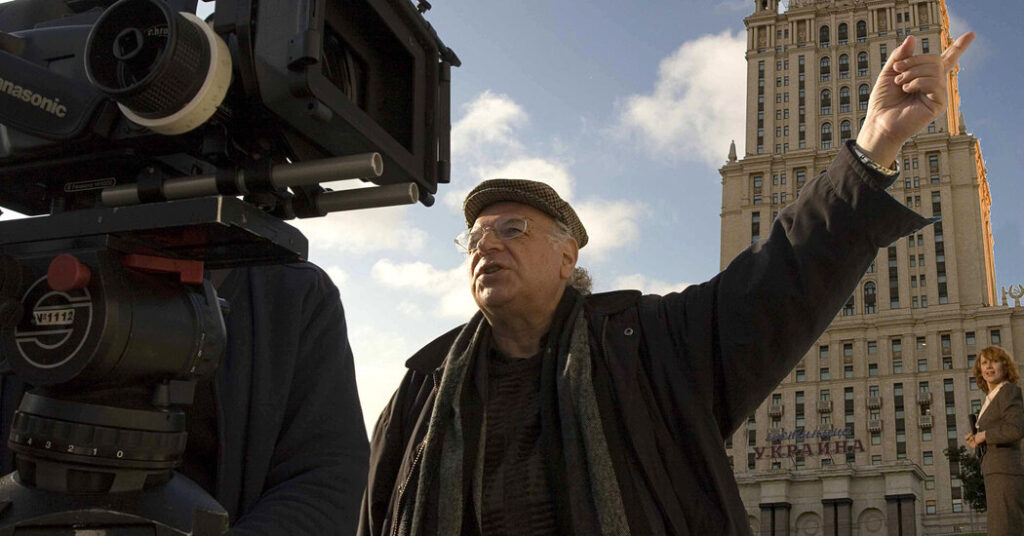
Slava Tsukerman, a Russian-born filmmaker whose 1982 feature, “Liquid Sky,” in which heroin-hungry aliens immerse themselves in the neon glow of Manhattan’s New Wave art scene, became a cult classic that helped reshape independent filmmaking in America, died on Feb. 28 at his home in Manhattan. He was 86.
His wife and longtime producer and collaborator, Nina Kerova, said the cause was heart failure.
Mr. Tsukerman finished his first film when he was still in college and made dozens throughout his life. But “Liquid Sky” was by far his best-known title.
The film centers on Margaret, a waifish model played by Anne Carlisle, and her circle of friends and frenemies as they vamp, dance and consume copious amounts of drugs in clubs and apartments around the city. Among her antagonists is Jimmy, an equally waifish model who is also played by Ms. Carlisle, as well as a long string of men who cajole, pressure and outright force Margaret into sex.
Watching over all of this are aliens perched in a spacecraft on the roof of Margaret’s apartment building. They, in turn, are being pursued by a German scientist named Johann, played by Otto Von Wernherr.
The aliens, like many of the film’s characters, have come to Manhattan in search of heroin. They soon find an equally available narcotic, a chemical produced in the human brain during orgasm, which the aliens extract by killing the unlucky climaxer.
Soon Margaret’s sex partners and assailants begin dying on top of her, as Johann races to save her from becoming their next victim. The action comes to a boil in a fashion shoot that doubles as a showdown between Margaret and Jimmy.
To critics then and later, the phantasmagoric plot was not the film’s strong point. Instead, it is the wave of imagery — Day-Glo face paint, bird-of-paradise outfits, herky-jerky dance moves — that make “Liquid Sky” a distillation of an era of New York nightlife.
“I wanted to put together all the myths of the time, like sex, rock and roll, drugs, aliens from outer space,” he told The Boston Hassle, a website, in 2018. “They’re all connected, because they all belong to the same world!”
The film captured a cultural scene poised on a knife edge, with punk and disco behind it and the AIDS crisis just around the corner. In that way it is stunningly, achingly prophetic, as Margaret’s partners die off, one by one.
It is also, on a metaphorical level, autobiographical: Mr. Tsukerman was a Russian Jew who emigrated first to Israel and then to New York, where he fell in with the city’s downtown demimonde, including Ms. Carlisle, a model in real life.
True to his belief that independent films should employ amateurs under the guidance of trained filmmakers like himself, he cast people he knew from the Manhattan art and fashion scenes. He wrote the script with Ms. Kerova, another veteran of the Soviet film industry, and Ms. Carlisle. Another Soviet émigré, Yuri Neyman, directed the cinematography.
Mr. Tsukerman began showing the movie at festivals in 1982 and released it commercially in 1983. The film, Janet Maslin wrote in The New York Times, “can hardly be for everyone.”
“But the right audiences are bound to appreciate the originality displayed here,” Ms. Maslin added, “not to mention the color, rage, nonchalance, sly humor and ferocious fashion sense.”
It became an immediate art-house favorite. Fans saw in its glam excess a fitting companion to other cult movies, like “The Rocky Horror Picture Show” (1975), and it played for years at theaters in New York, Boston and the District of Columbia.
“It came out of the blue when it opened,” the film critic J. Hoberman said in an interview. “It seemed so intrinsic to the scene going on, but he was not a part of it.”
Mr. Tsukerman made just a few films after “Liquid Sky,” but its influence on fashion, music and art reverberated for decades. He was among the first professionally trained directors to create and release a commercial film wholly outside the traditional studio system, and it became a model for many to come.
In 2018, the film collective Vinegar Sky released a digitally remastered edition of “Liquid Sky,” which brought a new generation of admirers to its unique encapsulation of New York in the early 1980s.
“I have a great nostalgia for the New York of the ’70s and ’80s,” Mr. Tsukerman told Vulture, an entertainment news website, in 2018. “There was creativity in the air, drifting in from the galleries in the art district and the incredible technical productions on Broadway and the whorehouses where you could find all manner of sexual activity. It all wafted downtown.”
Vladislav Markovich Tsukerman was born on April 25, 1939, in Moscow. His father, Mark, was a doctor who served in a Soviet Army field hospital during World War II. His mother, Mira, was a painter.
He studied at the Moscow Institute of Civil Engineering (now the Moscow State University of Civil Engineering) and began making amateur movies on the side. After he won a prize with one of them, he was admitted to the All-Russian State Institute of Cinematography, the Soviet Union’s premier film school, in Moscow.
Mr. Tsukerman became a prolific film and television director in the Soviet Union, focusing on science documentaries, but he chafed under Communist control. One of his films for TV was destroyed after one showing because, he later said, a single official did not like it.
The Soviets began to permit Jews to emigrate in the late 1960s. Mr. Tsukerman and Ms. Kerova married and moved to Israel in 1973 before settling in New York in 1976. They worked for the Russian-language section of Radio Liberty, an American-financed station that broadcast to the Soviet Union, while they worked on film projects, including “Liquid Sky.”
In addition to his wife, he is survived by a brother, Alexander.
Following the critical success of “Liquid Sky,” Mr. Tsukerman turned down offers from commercial studios to make a more mainstream movie about New York nightlife. Instead, he spent years working on a script about postwar Berlin but couldn’t get funding.
He made a documentary, “Stalin’s Wife” (2004), about the Soviet leader’s second wife, Nadezhda Alliluyeva, who died from a gunshot wound under questionable circumstances in 1932.
Mr. Tsukerman later wrote and directed “Perestroika” (2009), about a Russian scientist who returns home after years in the United States; it starred Sam Robards, Ally Sheedy and F. Murray Abraham. Both film s were produced by Ms. Kerova.
Though many fans of “Liquid Sky” may see the film as a nostalgic time capsule about the end of an era, Mr. Tsukerman said he had hoped to capture the birth of something new and hopeful.
“I thought that young people in this movement — like the hippies in the ’60s, and New Wave in the ’70s and ’80s — that’s really the people who created a new style, who changed their life, and the world,” he told The Boston Hassle. “And a new style of life was formed.”
Clay Risen is a Times reporter on the Obituaries desk.
The post Slava Tsukerman, Who Directed the Cult Classic ‘Liquid Sky,’ Dies at 86 appeared first on New York Times.