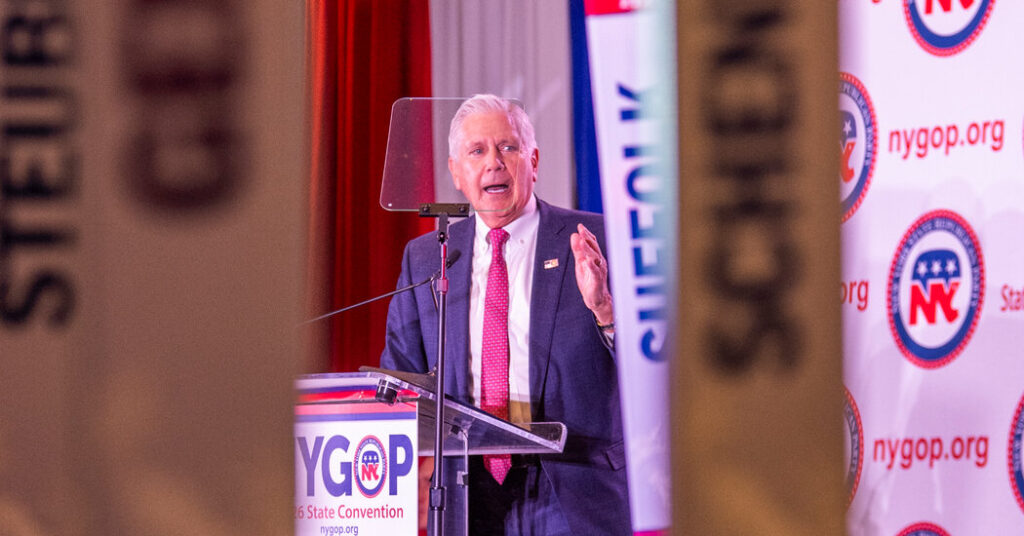
Republicans’ hopes of flipping the New York governor’s seat were dealt a blow on Tuesday when their candidate, Bruce Blakeman, was denied up to $7 million in matching funds because of an oversight in his filings.
The decision rests on a somewhat convoluted web of new paperwork deadlines and requirements. Last year, the State Legislature changed election law to require candidates for governor and lieutenant governor to run together on a single ticket. As a result, the Public Campaign Finance Board altered its process to require the lieutenant governor and the governor to jointly apply for matching funds.
But when Mr. Blakeman, who is currently the Nassau County Executive, filed his application for matching funds in December, he did so without listing a lieutenant governor — a seemingly understandable omission since he had not chosen one. When he did select his running mate, the Madison County sheriff, Todd Hood, Mr. Blakeman did not update his paperwork.
Both oversights were cited by the Democrat-controlled board, which voted 4 to 3 along party lines to withhold matching funds from Mr. Blakeman.
The absence of matching funds may be a daunting obstacle for Mr. Blakeman, who faces an uphill battle in his quest to unseat Gov. Kathy Hochul. The governor has a $20 million war chest, and her party maintains a commanding registration advantage over Republicans across the state.
A spokeswoman for Mr. Blakeman, Madison Spanodemos, said in a statement that the decision “reeks of corruption.” Referring to the Democratic chair of the board, who Ms. Hochul had appointed, she added: “With the race tightening and her poll numbers sagging, it’s no surprise Kathy Hochul’s handpicked appointee would vote to take away funds from Bruce Blakeman’s campaign.”
A spokesman for Ms. Hochul’s campaign, Ryan Radulovacki, defended the decision. “The onus is on each campaign to ensure they meet its requirements,” he said. “‘100% MAGA’ Bruce Blakeman doesn’t need any help from us to run an incompetent, losing campaign.” A spokeswoman for the governor’s office declined to comment.
Republican commissioners on the Public Financing Campaign Board saw more than a hint of conspiracy in the decision. They complained that board staff members did not flag the issue, despite communicating about other issues and application deficiencies. There does not appear to be any process for Mr. Blakeman, or any other candidate affected, to challenge the decision outside a lawsuit.
“We did know, and they didn’t know, and we didn’t tell them,” Commissioner Anthony Casale said of the looming disqualification, which was first brought to light in a report in Newsday. “And that’s the bottom line here. Somebody held back, somebody held back someplace.”
Democrats insisted that the rules were clear and that candidates were responsible for following them.
“I hate the idea of candidates being excluded from the program for failure for a ministerial failure,” said Commissioner Keesha Gaskins-Nathan, who voted to deny Mr. Blakeman funds. “But this is not a ministerial failure. This is a complete failure of compliance.”
Henry Berger, another Democratic commissioner, said the board could not bend the rules for anyone.
“There’s no ‘Bruce’ rule,” he said, suggesting that Mr. Blakeman’s errors should be a warning that all candidates for governor need to be aware of the law. “It’s a matter of the integrity of the program,” he said.
The meeting quickly devolved into partisan bickering.
“I understand how you’re going to vote, and that’s no surprise,” Mr. Berger said to Mr. Casale.
“Well, yeah, because it’s wrong, not because I’m a Republican, just because it’s wrong!” Mr. Casale replied. “So don’t sit there and pontificate to me.”
“Don’t pontificate to me!” Mr. Berger shot back.
The matching funds program was established as a way to help offset the power of big money in politics. The state offers a six-to-one match on eligible donations of up to $250 dollars, with statewide candidates eligible to receive up to $3.5 million for each of the primary and general election cycles.
This is the first year in which candidates for governor are eligible.
Ms. Hochul announced in February that she would not be accepting public matching funds, saying she was “proud to be able to decline taxpayer dollars that could be better used to fund programs that put more money in New Yorkers’ pockets.”
Good government groups pre-emptively criticized the board’s decision, warning it would undermine the public funding program at its outset. John Kaehny, the executive director of Reinvent Albany, called the move an “embarrassing display of self-defeating partisanship by the P.C.F.B.’s Democratic commissioners who totally ignored the spirit of the public campaign finance law and their own rules.”
Grace Rauh, the Citizens Union executive director, urged the Campaign Finance Board to consider the program’s mission rather than engage in partisan politics.
“Under these circumstances, the board should ensure that all campaigns affected by the new emergency rules have a meaningful opportunity to comply through a transparent process,” she said in a statement.
“Board members should not allow this matter to devolve into a partisan political and legal battle that undermines the public campaign finance program,” she added.
Grace Ashford covers New York government and politics for The Times.
The post Republican Candidate for N.Y. Governor Is Denied Public Matching Funds appeared first on New York Times.