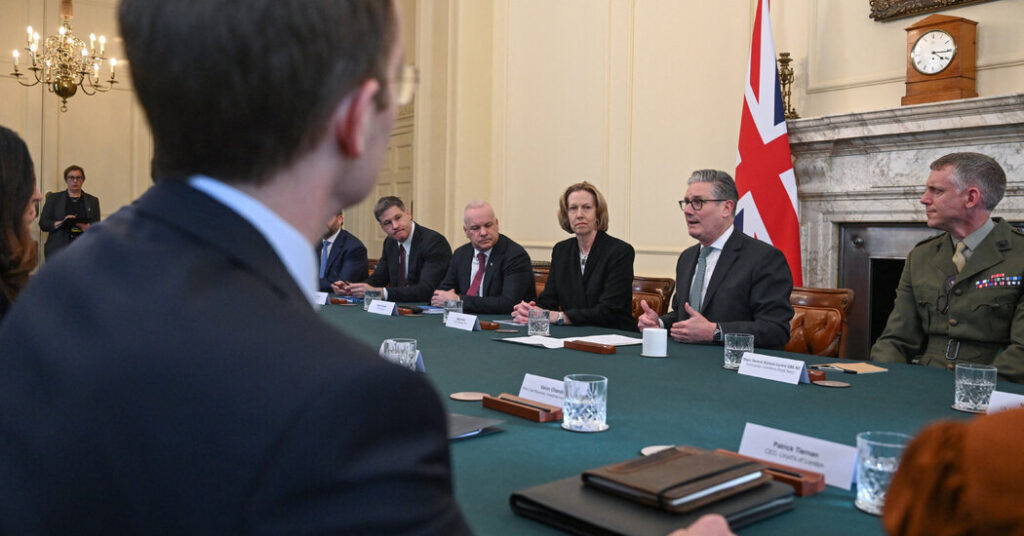
As the United States expands the number of strikes by bombers taking off from British territory, Prime Minister Keir Starmer has emphasized the same point. Britain, he says, is not helping America wage its war of choice against Iran.
But Mr. Starmer’s words are clashing with the images of powerful American planes waging war from a base in southern England. There are nearly two dozen U.S. bombers stationed at the base taking part in the campaign against Iran.
He is parsing a distinction between offensive and defensive. The bombers, Mr. Starmer has told President Trump repeatedly, are allowed to conduct only operations that protect British and allied interests across the Middle East.
Attacks on missile launchers like the ones that struck a British installation on Cyprus are allowed. But dropping bombs on Iran’s political leadership or its energy facilities is not.
Mr. Starmer and his top military officials say the difference is crucial. “We will take action to defend ourselves and our allies, and we will not be drawn into the wider war,” he told lawmakers in mid-March.
Politically, the British leader is eager to keep his country out of a costly and unpopular war without making Mr. Trump too angry. But the prime minister’s efforts to parse the distinction is increasingly clashing with the practical reality of modern warfare.
As the war in Iran has entered its fifth week, the American presence at R.A.F. Fairford base in England has steadily expanded. There are more than a dozen B-1 bombers and about half-dozen B-52 bombers taking off from Fairford and striking Iranian missiles, launchers and related sites, according to a group known as the Military Air Tracking Alliance, which has been following the arrival of the planes at British bases.
The group uses information from flight trackers, aviation communications experts listening to air traffic radio and spotters at the bases who track the incoming and outgoing planes. Two B-52 bombers known as “The Big Stick” and “Lucky 13” recently arrived at the base.
U.S. and British military officials, who spoke on the condition of anonymity to discuss military operations, also confirmed the approximate number of bombers at the base.
The buildup of planes at Fairford was previously reported by Air and Space Forces Magazine.
The planes are a key part of the Pentagon’s aerial armada. Last week, Adm. Brad Cooper, head of United States Central Command, said the B-52 bombers were “executing a high volume of strikes into Iran.”
The bombers are capable of delivering some of the most damaging munitions among the American aircraft flying over Iran. The B-1s can carry powerful bombs that can penetrate deep into the ground.
“Yes, there is a blurring of the distinction,” said Mark F. Cancian, a senior adviser at the Center for Strategic and International Studies in Washington and a retired Marine Corps colonel.
“The U.S. and U.K. are arguing that these are offensive strikes but with a defensive purpose,” Mr. Cancian said. “That meets a U.K. political requirement: The U.K. is helpful to the United States while still telling its people it is not directly involved in the war.”
Since the war began more than a month ago, Britain has come under increasing pressure to help the United States, its closest ally. Mr. Trump has lashed out at Mr. Starmer, accusing the prime minister of cowardice for initially refusing to allow the United States to use British bases for the war’s early strikes.
After the war began and Iran started retaliating at Gulf countries and beyond, Mr. Starmer shifted his position, saying that American bombers could take off from British bases, but only to defend interests around the region, not to conduct offensive strikes.
Then, two weeks later, when Iran effectively shut down shipping through the Strait of Hormuz, Mr. Starmer shifted again. The British government now allows American bombers to hit Iranian targets in an effort to keep the strait open to oil and gas shipments.
Mr. Starmer’s reluctance to fully join the president’s war is driven in large part by the deep resentment among many Britons about the government’s 2003 decision to back President George W. Bush’s war in Iraq. Mr. Starmer and his aides are well aware of polls showing the British public does not want to be swept into another war of America’s choosing.
At the same time, Mr. Starmer is under pressure to show that he is doing something to address the war’s effect on the price of gas and heating oil.
“It’s not our war, but it is our duty to protect British citizens,” Mr. Starmer said on Monday ahead of a closed-door meeting with business executives. He said the British public had “this sense that it is going to hit them and their families and their households” in the form of higher oil, gas and food prices.
“The U.K. was not critical for the U.S. to commence the war; however, the U.S. absolutely could not sustain this conflict without the U.K.’s support now,” said Calvin Bailey, a Labour lawmaker who currently sits on Parliament’s defense committee. “Because those bases allow the U.S. to use the strategic bomber force and their low-cost munitions, which mean that the war is more sustainable.”
Mr. Bailey, a former Royal Air Force and Air Force Special Operations Command officer, said that all of the American strikes had to follow U.K. rules on military targets.
“Based on my experience, aircrafts coming out of U.K. military bases have to follow international law,” he said.
The HMS Dragon, a British battleship, has deployed near its base in Cyprus. Every day, the British Ministry of Defense issues news releases with details of British military operations in the Middle East, describing them as aimed at defending British citizens and troops in the region.
On Sunday, the ministry said that its gunners “took out seven one-way attack drones” and that British “Typhoons and F-35 jets have continued their defensive missions overnight, including over Jordan, Qatar, Bahrain and the U.A.E.”
John Healey, the country’s defense minister, said that pilots with the Royal Air Force and Royal Navy “have now racked up nearly 900 flying hours in defense of Cyprus, Jordan, Bahrain, Qatar and the United Arab Emirates.” He added, “We have more jets in the region than we have had at any time in the last 15 years.”
For the American military, targeting Iran sites used to threaten British interests is more than just effective defense.
Such strikes are considered offensive by the U.S. Air Force because they “achieve strategic objectives,” according to official Air Force doctrine, which says they affect “the adversary’s strategy by creating dilemmas that impact their will and capacity to fight.”
Iran does not seem to recognize the distinction being made by Mr. Starmer.
The Iranian foreign minister, Abbas Araghchi, said on social media recently that Mr. Starmer was “putting British lives in danger by allowing U.K. bases to be used for aggression against Iran” and his country would “exercise its right to self-defense.”
Aric Toler and Jane Bradley contributed reporting.
Adam Goldman is a London-based reporter for The Times who writes about global security.
The post Offensive vs. Defensive: On Iran, the Distinction Matters for Britain’s Leader appeared first on New York Times.