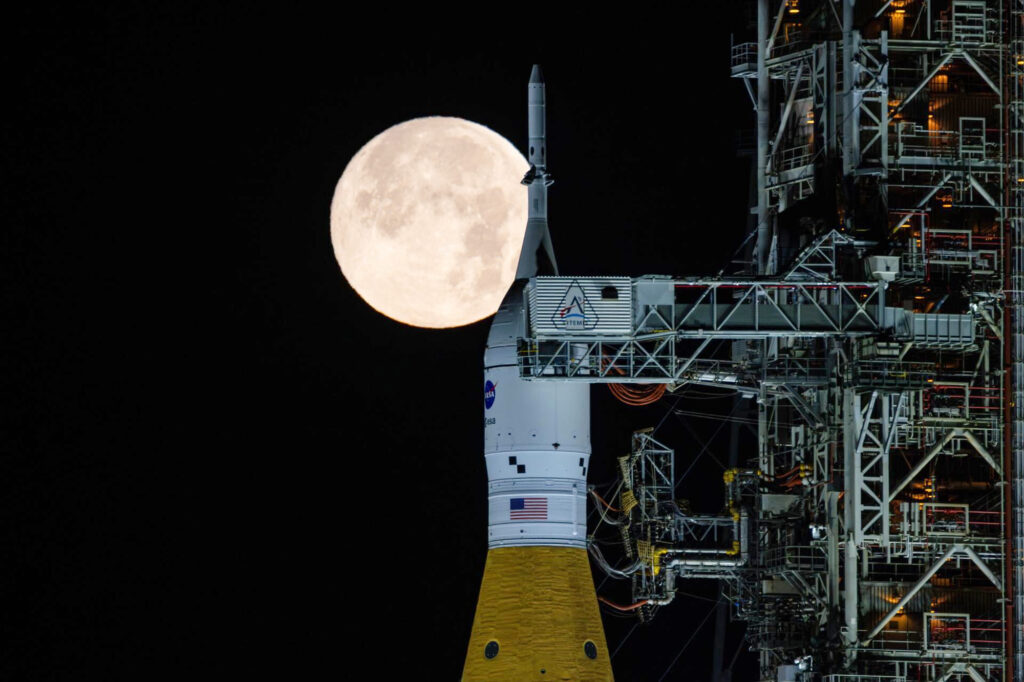
Humanity could soon return to the moon’s environs for the first time in half a century.
Under a mission scheduled to launch Wednesday evening, astronauts Reid Wiseman, Victor Glover, Christina Koch and Jeremy Hansen are set to trace a figure-eight around the moon aboard NASA’s Orion spacecraft — an endeavor known as Artemis II — making them the first people to travel this far since the Apollo missions of the 1970s.
A successful mission would mark a crucial step for the space agency that seeks to return to the moon’s surface. It would also validate technology that the space agency hopes will take missions even further.
“The goal is to shift the human space exploration venture from Earth-orbit to all points beyond,” said Harvard astrophysicist Jonathan McDowell. “Artemis II is the first time we’re sending people on that kind of voyage.”
Here’s what to know ahead of the launch of the 10-day mission from Kennedy Space Center in Florida:
What is the significance of Artemis II?
Astronauts have shuttled back and forth from the International Space Station for decades, forming a continuous human presence a few hundred miles above Earth. Now, NASA’s goal is to build an “enduring presence in deep space.”
The space agency hopes the suite of rockets and spacecraft underpinning the Artemis program will set the stage for annual visits to the moon’s surface, as well as more ambitious trips.
“This is the technology that, we hope, will allow astronauts to not only land on the moon but take humans to other planets, to asteroids,” McDowell said.
The program is projected to cost $105 billion over the past 20 years, according to an estimate from the nonprofit Planetary Society.
The first mission, Artemis I, was a 2022 test flight seeking to demonstrate that the systems could work without a crew. Artemis II brings humans aboard to demonstrate the spacecraft’s life support systems on a long-haul flight.
The crew would also notch a series of firsts. Glover, a trained engineer who is the pilot for this mission, would be the first Black man to travel as far as the moon. Veteran NASA astronaut Koch would be the first woman. Hansen would be the first Canadian.
Which systems are being used?
NASA will rely on the Space Launch System, or SLS — a massive rocket with two 17-story-tall engines, each carrying 3.6 million pounds of thrust — to punch through Earth’s atmosphere.
The boosters are designed to fall off and splash into the ocean in the style of NASA rockets from past decades. The central booster tower contains four space shuttle-style RS-25 rocket engines. SLS is built by a team of defense contractors that includes Boeing, Northrop Grumman and the Lockheed Martin-Boeing joint venture known as United Launch Alliance, along with numerous other companies.
With SpaceX’s Starship still being tested, SLS is the only rocket large enough and powerful enough to send the Orion spacecraft on its path, said Casey Dreier, chief of space policy at Planetary Society.
“SLS and Orion are the only tools NASA has right now to send people to the moon. … There’s no other option,” Drier said.
Orion is the spacecraft that houses the astronauts. Although it bears some similarity to capsules used in the 1970s, its design can house four astronauts, rather than just three, in a space that is 11 feet tall and 16.5 feet wide, according to public NASA materials. It also contains long-range communications systems that are improved from the spacecraft of decades past, experts say.
What happens when Orion leaves Earth?
After the solid rocket booster separates from the Orion spacecraft, the crew will orbit Earth twice. That will give the astronauts time to make sure the life support and communications systems are working while they are still relatively close to home.
The spacecraft’s upper-stage rocket will burn Orion into what NASA calls a “safe High-Earth Orbit” some 44,500 miles out, before separating. A final push from Orion’s propulsion system, known as the translunar injection burn, will put the spacecraft on track to leave Earth’s gravitational sphere — a first for any crewed mission since the Apollo ones.
The astronauts then take a four-day journey toward the moon, following a figure-eight pattern that peaks at more than 4,600 miles beyond the far side of the moon. The spacecraft will then slingshot around the moon and harness the gravitational force of the moon and Earth for its return journey. Once the spacecraft returns, it will splash down in the Pacific Ocean.
What are the challenges?
A successful journey around the moon would bring the four astronauts more than 230,000 miles from Earth. They could be vulnerable to radiation from the sun in the event of a big solar flare, McDowell said. Still, despite the dramatic scale of the journey, aerospace experts say they are most worried about what will happen when the astronauts leave and reenter Earth.
Chief among the fears is a disaster similar to the one affecting the Challenger space shuttle in 1986, when a rocket booster exploded shortly after takeoff, killing all seven crew members. The solid rocket boosters and engines used on the SLS have a similar design.
There are also concernswith the heat shield that protects the Orion spacecraft on its way back through the atmosphere. Although Artemis I was widely considered a success, the shield’s tough exterior suffered “extensive” unexpected damage in more than 100 places.
For that reason, “the most nail-biting part of the mission is likely to be the return to Earth,” McDowell said.
NASA has since worked to harden the heat shield while adjusting its planned angle of reentry to allow for a softer journey, he said.
How soon could astronauts walk on the moon?
The timeline that would put astronauts on the moon’s surface, has been repeatedly moved back.
NASA had planned the mission for 2024 before delays and a revamp of the Artemis program. Artemis III is scheduled for a 2027 mission in low Earth orbit designed to test systems and operations with landers being built by SpaceX and Blue Origin to prepare for a landing under Artemis IV in 2028.
The post NASA readies Artemis mission sending astronauts into orbit around the moon appeared first on Washington Post.