The flashiness of the future presidential library of a brash New York developer known for his love of gilded glitz was never in doubt. But the video rendering that President Trump’s library foundation posted online on Monday, showing a gleaming skyscraper in downtown Miami, raised a few eyebrows and dropped a few jaws.
Huge Trump lettering. A replica Air Force One. A golden escalator, and a golden statue of Trump raising a fist. A building with many more stories than any other around it.
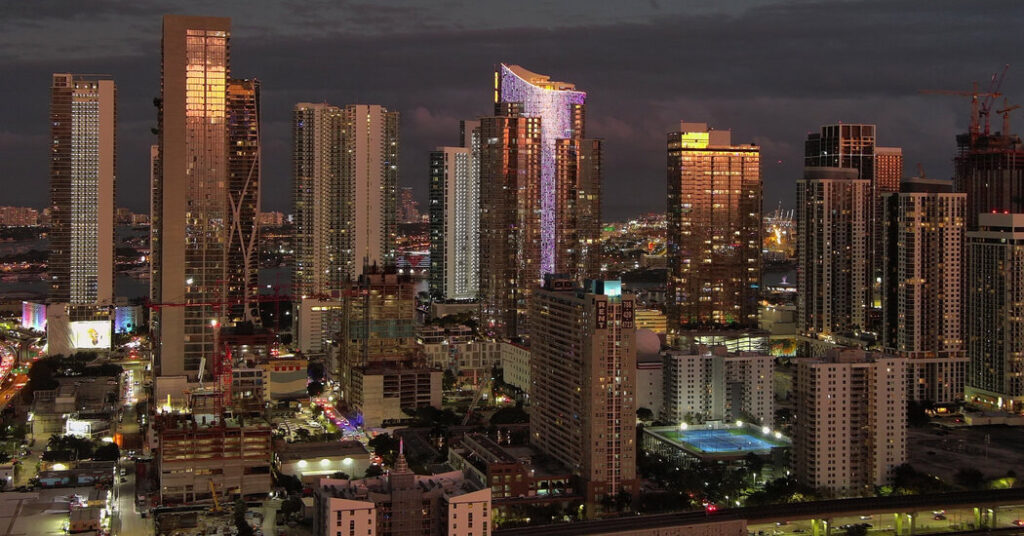
Details about the design were few, but the takeaway was clear: Mr. Trump plans to use the prime bay-view property that the state of Florida donated to him to maximum effect. His plans would reshape the Miami skyline to make his branded building impossible to escape.
On Tuesday, opinions on the streets of downtown Miami were decidedly mixed. Several people professed bafflement at the scope of the project, at least as depicted in the video.
“It’s grotesque,” said Dominick Auci, 64, a pharmaceutical scientist who lives near the proposed library site along Biscayne Boulevard.
Carla Prieto, a second-year international student at Miami Dade College who moved to the city two years ago from Spain, called it “ridiculous.”
“Why does it have to be the biggest building?” she said. “Is that to show he is the best of the best?”
She did not mind the idea of a library downtown where the public could learn about Mr. Trump’s presidencies. But, she added, “For me, this building is too much.”
Johnathan Cyprien, a 35-year-old real estate broker, lives in a three-bedroom condo walking distance from the proposed library. Though the project has drawn criticism, Mr. Cyprien said he views it apart from politics and strictly from a business perspective.
He called the glass tower a reflection of Mr. Trump’s big personality and his roots in real estate. Mr. Cyprien also thought it could be a promising addition to downtown, noting nearby cultural institutions such as the Pérez Art Museum Miami and the Phillip and Patricia Frost Museum of Science. The library site is also next to the Freedom Tower, where Cuban refugees who arrived in South Florida decades ago were given assistance.
“Donald Trump is someone who is focused on his name and legacy and his brand,” said Mr. Cyprien, a retired professional football player. “Trump is all about location, location, location. This project tells me that tourism will continue to grow. This will help downtown turn into a more lively place.”
Elliot Green, 34, an English tourist pushing his daughter in a stroller in search of a nearby park, said that the reaction to the tower was overblown.
“I think maybe because it’s Trump it’s getting more of a reaction than it should be,” Mr. Green said. “But that’s Trump, that’s what he does. He evokes emotion.”
He also evokes commerce. Though the property is currently a parking lot, nothing would preclude the building of condos, restaurants or a hotel. Under the terms of the transaction with the state, only certain “components” of the property would be required to house a presidential library, museum or center.
Already, there are moves underway to oppose the project.
“It’s gross,” said Marvin Dunn, a Florida historian and activist who sued the state last year over the project. “That thing would be an obstruction on the skyline of the city of Miami. I don’t think the people of Miami want that to be what people see as they approach the city from the sea.”
Last year, Dr. Dunn accused the board of trustees of Miami Dade College, a public institution that owned the 2.6-acre property, of failing to give the public sufficient notice before a meeting at which members conveyed the land to the state to deed to Mr. Trump’s library foundation. A judge ruled in his favor. Eventually, the board held another vote and approved the land transfer to the nonprofit foundation raising funds for the library.
On Tuesday, Dr. Dunn said he plans to sue again, this time arguing that the board had failed in its fiduciary responsibility to protect the school’s assets and had harmed its students.
He said video made it seem that the library might not fit on the property. “Where is the airplane going to go?” he asked of the Air Force One replica. A Boeing 747 is about 225 feet long.
The video rendering was created by Bermello Ajamil, an architectural firm based in Coral Gables, Fla. Willy A. Bermello, the firm’s principal, said in a statement that the library’s “strategic downtown location basically guarantees that more visitors will visit this destination than any other in history.”
Mr. Bermello declined an interview request, and the Trump library foundation did not respond to a request for comment.
The sheer size of the building depicted in the video, which appeared to include A.I.-generated images, might have surprised some people. But experts familiar with Miami’s zoning code knew from the start that the library property was incredibly valuable — worth more than $300 million, according to at least one estimate — in large part because of how much could be built on it.
The downtown site is near public transportation and lacks a parking requirement, a rarity for towers built in Miami. It is also in the heart of the city’s urban core, where the most dense construction is allowed.
Anne-Christine Carrie, an urban planner and planning consultant who is an expert on Miami’s zoning code, said that the city typically requires “transitional” building plans — that is, that buildings grow gradually in height. Construction of a skyscraper would likely “set a new standard” in downtown Miami, she said, “so that now everything could be just as tall.”
The Trump foundation would eventually have to file detailed plans for city approval. They would likely go before an architectural panel, Ms. Carrie said, and perhaps require additional review because of nearby archaeological findings. But Miami’s zoning code would otherwise appear to allow a skyscraper on the site, she noted.
Mr. Green, who as an English tourist was unencumbered by local rules and American politics, afforded an outsider’s perspective.
“Everything in America is over the top,” he said, “so I don’t see how this is any different.”
Audra D. S. Burch is a national reporter, based in South Florida and Atlanta, writing about race and identity around the country.
The post Miami Imagines Itself With Trump’s Glitzy Library at Center Stage appeared first on New York Times.