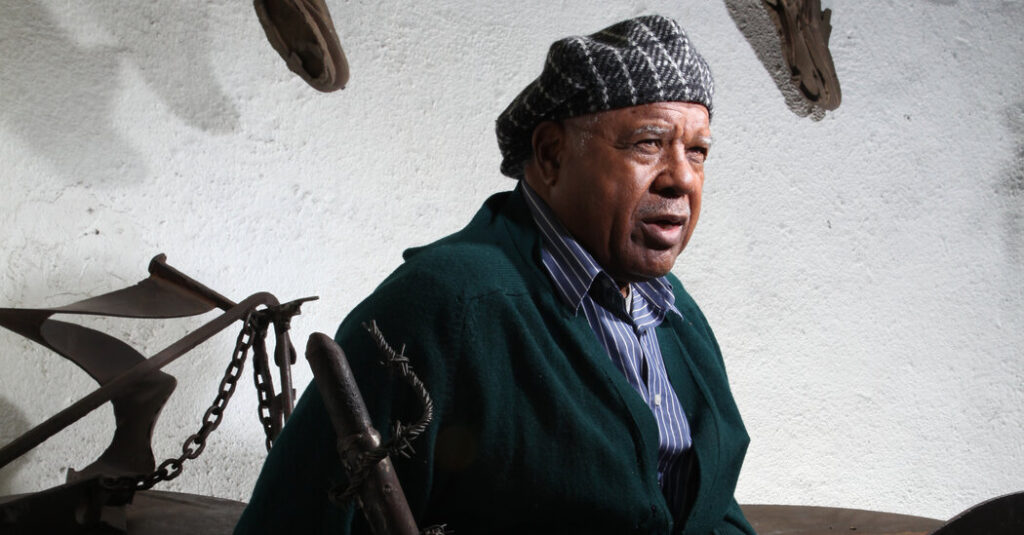
Melvin Edwards, a celebrated sculptor who was known for an explosive group of improvisational, wall-mounted steel pieces called Lynch Fragments that welded pure abstraction to the realest of real-world references, died on Monday at his home in Baltimore. He was 88.
His death was confirmed by Alejandro Jassan, a spokesman for Alexander Gray Associates, the gallery that represents him.
Mr. Edwards made the very first of his breakthrough series of artworks in 1963. In it, an asymmetrical group of forms, both recognizable and abstract, emerges from a pipe-like opening: blobs of flux, bars that resemble tools, blade-like triangles. On the left, in front of the longest, most menacing triangle, hangs a battered length of chain trailing a misshapen lump of steel.
The piece is striking in the feeling of power and energy it evokes simply by holding together so many disparate shapes, depths, directions and associations.
Chains evoke violence, but also labor, connection and, sometimes, salvation. “If your car is broken down in the Jersey woods,” Mr. Edwards pointed out in 2000, “you’re happy to see them coming with the chains.”
Similarly, although the piece is clearly in conversation with other American modernist sculpture, it also reflects Mr. Edwards’s interest in West African sculpture and metalwork.
The work’s ostensibly hopeful title, “Some Bright Morning,” was drawn from a violent threat to a Black family in Florida that was recorded in Ralph Ginzburg’s 1962 book, “100 Years of Lynchings.” But Mr. Edwards made it clear that he had many incidents of anti-Black violence in mind, including the shooting death of Ronald Stokes by members of the Los Angeles Police Department that had recently taken place at a Nation of Islam mosque.
The title of the series “came about a little later,” he said in a 2014 interview with Bomb magazine. “But I realized I was developing a body of work.”
It was important, however, that the artwork not be “stuck in formalist criticism,” he added. “I wanted to make you think about why I made the work. For me, the whole thing about modern art is you can invent your own game and all the rules. It’s just a matter of, does it come out vital as work?”
Still, not wanting to be stuck in formalism didn’t mean giving up on it altogether. At a time when many Black artists felt caught between communities that insisted on explicitly political work and an art world that had little room for Black artists whatever they did, giving his series a name as specific, and arresting, as Lynch Fragments created room for Mr. Edwards to be as concrete, or as abstract, as he liked.
“One of my discussions within the Black art community,” he said, “was with people who said, ‘Abstraction can’t be Black.’ Well, I don’t know why not. It always was.”
Over the years, Mr. Edwards made more than 300 Lynch Fragments — using horseshoes, railroad spikes, padlocks, screws, machetes and springs, among many other pieces of found and scrap metal — incorporating references to work, play, violence, the natural world, endurance and sexuality. He also made kinetic sculpture and large-scale public commissions that combined minimal, geometric silhouettes with earthy details and, for a period in the 1960s and 1970s, high-concept installations of loose chain and barbed wire.
Running through all of it was the same compression and intensity found in “Some Bright Morning.” In 1993, the New York Times critic William Zimmer compared a row of 70 Lynch Fragments installed on a wall at the Neuberger Museum of Art in Purchase, N.Y., to “a string of bullet holes made by an outsized antiaircraft gun.”
Indeed, it may have been the work’s formal energy that allowed Mr. Edwards to grapple with such intense subject matter — and his willingness to draw on historical and cultural context that infused his aesthetic choices with such force.
“I make fine art,” he said. “But I don’t have to do art for art’s sake.”
Melvin Eugene Edwards Jr. was born in Houston on May 4, 1937, the eldest of four children of Thelmarie Felton and Melvin Eugene Edwards Sr.
In 1944, his father got a job working for the Boy Scouts of America and moved the family to Dayton, Ohio, where Melvin attended an integrated school, studied life drawing and liked to visit the Dayton Art Institute.
“When the guards were in the other room,” he recalled in 2022, “we would bang on the harpsichord and run. But what that means is, I knew later on what a harpsichord was.”
In 1949, the family returned to Houston to live with Melvin’s paternal grandmother, Cora Ann Nickerson. (He would later name his first kinetic sculpture, “Homage to Coco,” after her.) As a young man, he was an athlete as well as an artist. His father, an amateur painter, gave him an easel when he was 14, and he pored through art and anatomy books sent from California by an aunt and uncle, Modie Bell and Clive Huddleston.
But he also needed to move. “I love to run five yards and knock the hell out of somebody,” he said in 2022. “That means I was a football player.”
Like his father, he played on the state-champion team at Phillis Wheatley High School in Houston. In 1955, after two weeks of Navy Reserve training in San Diego, he went to live with Ms. Bell and Mr. Huddleston in Los Angeles, where he studied, and played football, at Los Angeles City College, while working various jobs. In 1965, he earned a Bachelor of Fine Arts degree from the University of Southern California. (He played football there, too.)
In 1960, he married the painter Karen Hamre, a fellow U.S.C. student, and they soon had a daughter, Ana, followed by twins, Allma and Margit.
Though he had been working as a painter, and had begun exhibiting, Mr. Edwards switched to steel as soon as he learned to weld.
“I think what attracted me about it was I always liked work that had dynamics to it, that had or implied strength or aggressiveness,” he told Bomb. “My thinking had already turned to abstraction, not in a purist sense, but in a sense that you could work beyond just imitating the figure as a basis for what you were doing.”
In 1967, Mr. Edwards moved his family to New York, where he met peers like the painters William T. Williams and Sam Gilliam, and learned from older artists like Romare Bearden.
As he and Mr. Williams became friends, Mr. Williams was struck by a realization: Mr. Edwards “was probably one of the great sculptors of the 20th century,” he said in an interview, “and more than that, he was an extraordinary human being.”
Mr. Edwards moved on from the Lynch Fragments to other politically charged varieties of sculpture, like the loose chain and barbed wire he showed in his 1970 solo exhibition at the Whitney Museum of American Art, and he began influencing younger artists, including David Hammons.
“That was the first abstract piece of art that I saw that had cultural value in it for Black people,” Mr. Hammons said of the Whitney show. “I couldn’t believe that piece when I saw it because I didn’t think you could make abstract art with a message.”
In New York, Mr. Edwards’s marriage to Ms. Hamre ended, and she returned to California with their daughters. He began a relationship with the poet Jayne Cortez in 1969; they married in 1975.
With Ms. Cortez and a group of art teachers, he took the first of many trips to Africa in 1970, traveling from Ghana to Nigeria. Later, he would spend time teaching and studying metalwork in Zimbabwe, and eventually he and Ms. Cortez would buy a house in Dakar, Senegal.
In 1971, he was asked to participate in a group show at the Whitney, but he withdrew his work after the museum declined to include in the exhibition catalog his essay about its history of ignoring Black artists.
The next year, he was appointed to the faculty at the school of arts at Rutgers University, where he taught until retiring in 2002.
In 1978, while installing a row of Lynch Fragments for a retrospective at the Studio Museum in Harlem, Mr. Edwards realized that he had not exhausted the possibilities of the series and took it up again.
Writing in The Nation in 2017, the critic Barry Schwabsky described Mr. Edwards as “one of those artists who keep getting noticed for having been overlooked.”
His career did have larger-than-usual ups and downs: a solo museum exhibition in Santa Barbara when he was just starting out, but then no solo show at a commercial gallery until 1990, when the dealer Clara Sujo took him on; a Studio Museum retrospective in 1978, but little critical response.
But as the painter James Little said in an interview, Mr. Edwards “was a very generous, jovial, optimistic man that just stayed in the fight.”
Through the 1980s, while continuing to teach, he focused on public commissions and traveled extensively, including to Cuba.
Eventually, Mr. Edwards won more lasting recognition. He had major retrospectives at the Neuberger Museum at the State University of New York in 1993, and at the Nasher Sculpture Center in Dallas in 2015. He exhibited at Dia: Beacon in upstate New York and in New York’s City Hall Park through the Public Art Fund. He was featured by the influential curator Okwui Enwezor in the 2015 Venice Biennale. He began showing with the Alexander Gray gallery in 2010, and he has been collected by dozens of museums. A traveling retrospective that began in 2024 at the Fridericianum in Kassel, Germany, and continued to the Kunsthalle Bern in Switzerland was recently on display at the Palais de Tokyo in Paris.
Mr. Edwards’s survivors include his wife, Diala Touré.
“I have no illusions that what I do will change things much,” he told Bomb magazine in 2014. “I just wanted to be sure I didn’t get caught not expressing what I thought was important to me.”
Ash Wu contributed reporting.
The post Melvin Edwards, Sculptor Who Wove Black History Into Art, Dies at 88 appeared first on New York Times.