Mayor Zohran Mamdani wasn’t born when the nightlife impresario Michael Dorf cooked up his first “downtown Seder” in early 1991, fusing a performance vibe with a Passover meal to create a kind of art-meets-afikoman alternative to the traditional holiday celebration.
More than 30 years later, Mr. Mamdani was the first guest to speak at this year’s iteration of Mr. Dorf’s event on Monday night, giving a brief speech — and hearing it from a pair of hecklers, as his appearance drew criticism from some quarters and a last-minute cancellation of a featured performer.
It was not a completely surprising turn of events: Mr. Mamdani has struggled to earn the trust of some the city’s Jewish residents, in part because of his consistent criticism of Israel before and during his campaign last year. More recently, social media activity from his wife, Rama Duwaji, after the Hamas-led attack on Israel on Oct. 7, 2023, has also drawn scrutiny.
“Shameful!” one attendee shouted at the start of the mayor’s speech, while another interrupted the speech even as Mr. Mamdani spoke about rising antisemitism and the fears some Jewish New Yorkers feel when “synagogues that once felt like sanctuaries now require armed protection.”
The mayor did not seem bothered.
“We know that if there was complete decorum anywhere that we were, that we would have to ask ourselves if we had left the city that we love,” Mr. Mamdani said, responding from behind a small lectern plastered with actual matzo and getting a laugh from the crowd. “And it is important to be here and to acknowledge that this is what it means to love and to lead the place that we call home.”
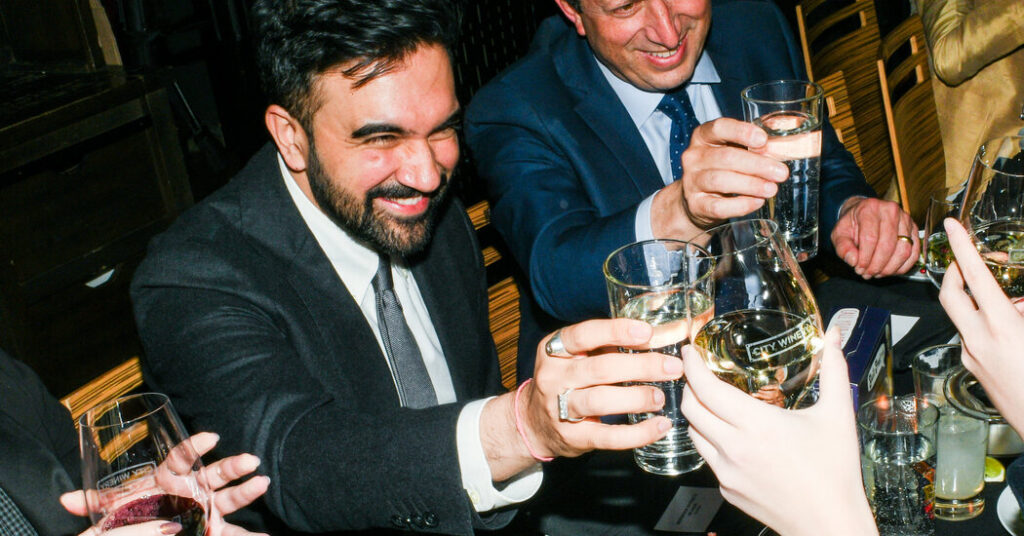
The mayor left via a side door at City Winery, Mr. Dorf’s club near the Meatpacking District of Manhattan, immediately after his remarks. And the outbursts were largely an outlier at the Seder, which drew a packed crowd of some 350 people and was held just before Passover, which begins on Wednesday.
The evening also featured Amichai Lau-Lavie, a progressive rabbi, sending wishes from a bomb shelter in Jerusalem; George Floyd’s brother, Terrence, speaking about racism; and — naturally — Al Franken singing “Go Down, Moses” in a shower from the Upper West Side (clothed, thankfully, and on video).
That mix of serious and less so was consistent throughout, assisted by ample red wine for the audience — four glasses, per Passover tradition — and historical asides about the celebration itself, including the “Freakonomics” co-author Stephen J. Dubner noting that Moses “didn’t really have that much going for him” at the time of the Exodus.
But, Mr. Dubner added, “he turns out to be a really good hire.”
“God did a good job,” he quipped.
One notable gap in the programming was the Israeli-American comedian Modi Rosenfeld, who pulled out of the event on Monday, posting on Instagram that he had not been informed that the mayor was appearing.
The musical connections of Mr. Dorf, who came to fame as the founder of the venerated music venue the Knitting Factory, helped provide a jolt. There was an energetic performance from the Israeli star David Broza, singing about peace. Jesse Malin and the British singer Yola also performed, the latter expressing her love of New York’s culture and food.
“I’m from England,” she joked. “You know we struggle.”
Most of Mr. Floyd’s remarks were solemn, as were many by Don Lemon, the former cable news host who was arrested in January by federal agents, accused of violating the rights of worshipers in a Minnesota church during an anti-ICE protest. Mr. Lemon, who said he was raised Baptist, was tasked with reading the four questions of Passover, traditionally asked by the youngest person at the table.
“I’m 60 years old, so if I’m the youngest person in the room …” he said, smiling. “Maybe I am, I don’t know.” (He was not, as this 50-something reporter can attest.)
Mr. Lemon spoke at length about freedom, talking about people “sitting in detention centers” and “governments that decide who gets to speak and who disappears.”
“Freedom, as I know, is not guaranteed,” Mr. Lemon said.
Several other political leaders of the city — including Julie Menin, the New York City Council’s first Jewish speaker, and Brad Lander, the former city comptroller — also spoke.
Mr. Lander, a congressional candidate, has, like the mayor, been a critic of Israeli policies and Israel’s prime minister, Benjamin Netanyahu. And on Monday, he both criticized the bombing of Iran by Israel and President Trump and mourned the Oct. 7 attacks, saying he personally has felt “broken in ways that it is hard to imagine really being put back together.”
After the Seder, Mr. Dorf said that he had appreciated the mayor’s remarks and his appearance, though he conceded he had gotten some “hate mail” about the event. All of which, he suggested, was part of the mix of introspection and expression that so often informs Passover.
“My family’s Seder and many, many Seders over the next two days, around the country, are going to have very strong opinions about what is happening in the world,” Mr. Dorf, who wore a matzo-decorated vest and tie, said. “And the worst thing that can happen at a Seder table, especially within one family, is for them to not talk.”
Sally Goldenberg contributed reporting.
Jesse McKinley is a Times reporter covering politics, pop culture, lifestyle and the confluence of all three.
The post Mayor Mamdani Attended a Hip Seder. Some Guests Weren’t Thrilled. appeared first on New York Times.