Justice Samuel A. Alito Jr.’s father was a baby when he and his mother left their home in Italy bound for New Jersey, where he later became a U.S. citizen.
Justice Ketanji Brown Jackson’s ancestors’ passage remains unknown, but her relatives were enslaved in Georgia, becoming citizens only through the bloodshed of the Civil War.
Chief Justice John G. Roberts Jr.’s great-grandparents emigrated in the late 1800s from a mining town in what is now Slovakia, bound for Pennsylvania coal country. In the United States, the couple had a son — the chief justice’s grandfather. Albert Podrasky was born before his parents were naturalized, but he was nevertheless an American, guaranteed by the nation’s principle of birthright citizenship.
The three are among the nine justices who will hear arguments Wednesday over whether to allow the Trump administration to end that promise of birthright citizenship. The landmark case will test whether the Constitution guarantees citizenship to all babies born on U.S. soil, including the children of undocumented immigrants. It could potentially redefine what it means to be an American for generations to come.
With the case approaching, The New York Times scoured passenger ship manifests, census records, voter registration lists and naturalization petitions and interviewed scholars and genealogists in an effort to better understand the nine Americans who will decide the issue.
The justices’ stories show how the nation’s changing laws and attitudes toward newcomers have guided waves of immigration, determining who is allowed to become a citizen and contribute to the American story.
The last time the court considered the issue was more than 100 years ago, deciding in 1898 that a man of Chinese ancestry, born in San Francisco to noncitizen parents, was a U.S. citizen.
The current justices’ immigration histories span much of the American experience, from colonists who arrived before the nation’s founding, to Black people forced into slavery on Southern plantations, to immigrants who flocked to the United States from all across Europe and found jobs as laborers and factory workers.
In each case, these newcomers paved the way for a descendant to reach the privileged pinnacle of the country’s civic life. These nine men and women will now sit in judgment of citizenship for their fellow countrymen.
Samuel A. Alito Jr.
Italian heritage
Justice Alito, whose family emigrated from southern Italy in the early 1900s, is the court’s only first-generation American. His father came as an infant with the justice’s grandmother in 1914, and according to family lore, his mother’s family came after a storm destroyed their crops.
Both families settled among other Italian immigrants in Trenton, N.J. By the early 1920s, when more restrictive immigration laws were put in place, more than four million Italians had come to the United States.
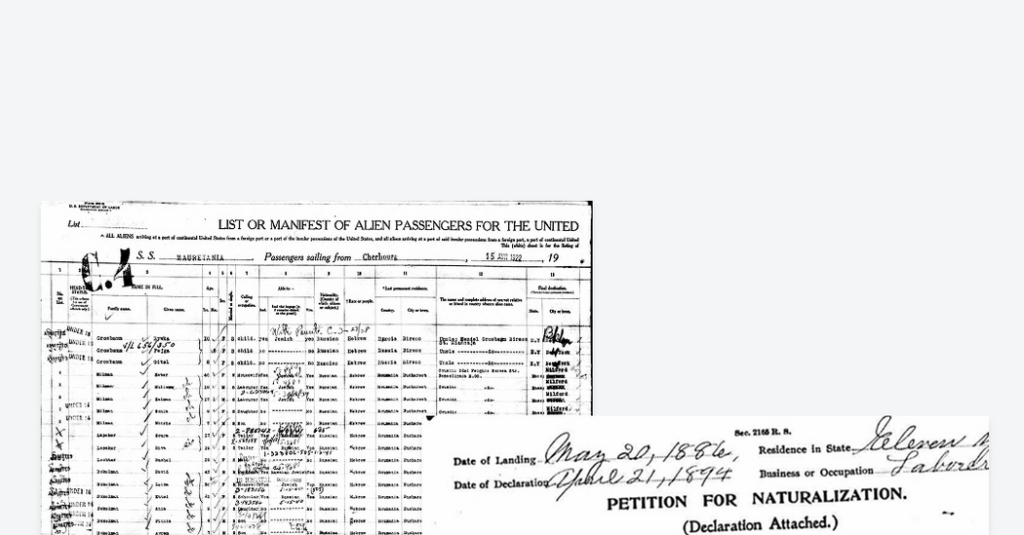
Justice Alito’s paternal grandfather, Antonio Alati — later Anglicized to Anthony Alito — left Italy in 1913, sailing to Philadelphia aboard a ship called the Ancona. He found work as a repairman for the city’s streets and lived with his wife and four children, including Salvatore — Anglicized to Samuel — Justice Alito’s father.
Here is his petition for naturalization.
Since 1790, minors have been automatically naturalized when their parents are naturalized. Justice Alito’s father, Samuel A. Alito Sr., was 10 years old when his father was naturalized.
Census records show that by 1940, he too was a citizen.
His father’s draft card, signed in October of the same year, also reflects that he was a citizen. It lists his birthplace as Trenton, instead of Italy. Such inaccuracies are not uncommon in immigration records, sometimes making it harder to track family stories.
Samuel A. Alito Sr. was a high school teacher before spending more than 30 years as the director of the New Jersey Office of Legislative Services, a nonpartisan role in which he drafted legislation and worked on redistricting.
Justice Alito has often cited his father as a driving force in his life. When he was nominated to the Supreme Court, he said that he wished his father had lived to see it. He called him “an extraordinary man who came to the United States as a young child and overcame many difficulties and made many sacrifices” for his children, and a man who taught him to “revere” the legislative process.
Justice Alito has spoken of his pride in his Italian heritage. He frequently travels to Italy to teach and give speeches. He has described taking his children to the village where his father was born, a rocky, arid place dotted with olive trees. There, he went to the parish church where he said a pastor helped him find his father’s birth record.
Amy Coney Barrett
French, Irish and German heritage
Justice Barrett grew up in a suburb of New Orleans, the oldest of seven children. Both of her parents had grown up in the area, and her family’s immigration history reflects the mix of cultures in the Mississippi River Delta.
Justice Barrett’s maternal ancestors arrived from France as the population of New Orleans ballooned from under 10,000 in 1800 to more than 150,000 by 1860. Her background also includes relatives on her mother’s side who came to the United States from Ireland, as well as paternal ancestors from Germany.
Justice Barrett’s maternal great-great-grandfather, Firmin Daste, was 24 years old when he left Bordeaux, France, in 1859, to sail to New Orleans.
At the time, the city was a hub for immigrants, with more than 50 percent of New Orleans being foreign born in 1850. By the 1900 census, Mr. Daste was 65 years old and managing the French Society Hospital, which was created to serve the heavily immigrant French community.
Justice Barrett’s paternal great-great-grandfather, Terence McAdam, was born in Ballyconnell, Ireland. He and his wife, Margaret, married in Ireland in 1867 before they came to New Orleans. He went through the process to apply for naturalization and took the oath of citizenship in 1878.
Mr. McAdam worked in New Orleans as a longshoreman. By that time, Irish immigrants had a well-established community in the city, where many men worked on the docks at the Port of New Orleans.
Justice Barrett has made immigration a part of her own family’s story. Two of her seven children — Vivian and John Peter — were adopted from Haiti.
Neil M. Gorsuch
Irish, German and British heritage
Justice Gorsuch’s ancestors include British colonists who arrived in Maryland before the American Revolution and fought for independence, becoming some of the nation’s first citizens upon the country’s founding. Others were among the millions of German and Irish immigrants who came in the 19th century, often fleeing poverty.
Those ancestors arrived in the country before a series of federal limits on immigration that began in the 1880s, with restrictions on Chinese laborers, followed by literacy tests for migrants and, later, quotas.
Charles Gorsuch was born in England in 1642 and died in Maryland in 1716. He is listed in records as a planter with several tracts of land in Baltimore County.
Justice Gorsuch’s great-grandfather, Joseph J. McGill, the son of an Irish immigrant, helped establish Justice Gorsuch’s deep family ties to Colorado and the American West. Census records show he moved from New York City to Colorado in the 1890s and married Margaret McGill, an Irish immigrant. Mr. McGill worked at the fire department in Denver.
Justice Gorsuch grew up in Denver, then moved to the Washington, D.C., area, after President Ronald Reagan nominated his mother, Anne McGill Gorsuch Burford, to become the first woman to lead the Environmental Protection Agency.
Ketanji Brown Jackson
African heritage, ancestors enslaved
On her father’s side, Justice Jackson’s family can be traced to a 700-acre Georgia plantation owned by a man named John H. Rutherford. Documents from 1860 show he enslaved 65 people, ranging in age from a 6-month-old to an 80-year-old.
Like the nearly four million Black Americans enslaved at the time, Justice Jackson’s ancestors became American citizens with the passage of the 14th Amendment to the Constitution in 1868. The 14th Amendment is at the heart of the case the court will hear on Wednesday.
In 1867, after the Civil War ended, Justice Jackson’s great-great-great-grandfather, Olmstead Rutherford, entered into a sharecropping agreement with John Rutherford, according to research by the Boston-based nonprofit genealogical group American Ancestors, which traced Justice Jackson’s roots. Here is that contract.
Such contracts between white landowners and formerly enslaved Black people were common and perpetuated inequality and poverty.
That same year, Olmstead Rutherford registered to vote in Georgia, joining thousands of Black men at the polls. That right was enshrined in the Reconstruction amendments of the Constitution, which also forbade slavery — and guaranteed citizenship.
Justice Jackson’s parents, Johnny Brown and Ellery Ross, both attended segregated schools in Miami in the 1950s and 1960s. They were part of a generation that grew up in the Jim Crow South, as states enforced laws that created a racial caste system.
“In my family, it took just one generation to go from segregation to the Supreme Court of the United States,” Justice Jackson said in remarks at the White House in April 2022.
Elena Kagan
Russian-Jewish heritage
Justice Kagan can trace her roots to the former Russian empire. Three of her four grandparents immigrated to the United States in the early 1900s, setting themselves on the path to citizenship before restrictive laws made coming to America more difficult in the 1920s.
Born in Bialystok, Irving Louis Kagan left Europe in 1907. He came as part of a wave of Jews fleeing persecution in what was then Russia and is now Poland. He resettled in Brooklyn, where he worked as a salesman.
Born in Russia, Justice Kagan’s maternal grandmother, Esther Bokelman, left Europe from a port in France at just 12 years old with her mother, father and three siblings.
The family settled in Philadelphia in the 1920s, where Justice Kagan’s great-grandfather worked as a grocer. Her grandmother became a naturalized citizen in 1943 when she was a 32-year-old mother of two.
Justice Kagan’s parents, Robert and Gloria, were the first in their families to go to college. Robert served as a tenants’ rights lawyer. Gloria became an elementary school teacher.
Her parents died before she was confirmed to the court, but Justice Kagan said she could feel their presence and that she would not be a justice “if not for their love and sacrifice and devotion.”
Brett M. Kavanaugh
Irish heritage
Both sides of Justice Kavanaugh’s family immigrated to the United States from Ireland, arriving in the mid- to late 1800s.
They were among a wave of Irish immigrants to the United States at that time. From 1820 to 1860, people from Ireland accounted for more than a third of all immigrants into the United States. Irish newcomers often faced discrimination, but Justice Kavanaugh’s family arrived before strict laws made it difficult to enter the country.
Justice Kavanaugh’s paternal great-grandfather, Patrick Kavanaugh, immigrated from Ireland in 1878. He found work as an iron molder at a metalworking factory in Connecticut. Census records show that by 1910, Patrick and his wife, Mary — the daughter of Irish immigrants — were living in New Haven with their six children, including Justice Kavanaugh’s grandfather, Everett.
Michael Murphy, Justice Kavanaugh’s maternal great-great-grandfather, left Ireland in the 1860s for the United States. He settled in New Jersey, where he worked as a carpenter.
Justice Kavanaugh grew up in the suburbs of Washington, D.C. His mother, Martha G. Kavanaugh, worked as a teacher before going to law school when he was 10 years old. She became a prosecutor before serving as a Maryland state court judge.
In his opening remarks at his confirmation hearings, Justice Kavanaugh called his mother “a trailblazer” who had taught him that “judges don’t deal in abstract theories; they decide real cases for real people in the real world.”
John G. Roberts Jr.
Slovakian, Irish and British heritage
Both sides of Chief Justice Roberts’s family can be traced to Pennsylvania coal country. His parents both grew up in Johnstown, a small city about 60 miles east of Pittsburgh.
His father’s ancestors arrived from England in the mid-1800s, just before the Civil War, to work in what was then a coal mining boomtown.
The chief justice’s paternal ancestors came from Leigh, England, a mining town near Manchester. His great-great grandmother Mary Linskey had fled her native Ireland to England during the Great Famine. In 1863, she and her husband Richard Glover boarded a ship, the Hecla, bound for the United States.
They crossed the Atlantic Ocean to escape poverty. Census records show that by 1870 they had settled in Pennsylvania.
Chief Justice Roberts’s maternal great-grandfather, Jacob Podrasky, immigrated in 1886 from what was then the Szepes region of Hungary — the present-day town of Kluknava in eastern Slovakia — joining other immigrants who came to Johnstown. Newcomers from Eastern Europe often faced prejudice and harsh living conditions, rejected by the town’s residents.
Jacob Podrasky and his wife, Helen, were not yet citizens when their son Albert, the chief justice’s grandfather, was born in 1893. However, under the 14th Amendment, Albert was a birthright citizen because he was born on U.S. soil. That guarantee is the key question that Chief Justice Roberts and his colleagues will consider on Wednesday.
Jacob Podrasky became a citizen by swearing an oath of allegiance to the United States on Oct. 4, 1900.
His wife, Helen, was automatically naturalized on that date. At the time, a woman’s citizenship hinged on her husband’s.
The chief justice’s parents both grew up in Pennsylvania, then married in 1952 and lived outside of Buffalo, where his father, Jack Roberts, worked as an executive for Bethlehem Steel. Three years later, their son, John, was born.
Sonia Sotomayor
Puerto Rican heritage
Justice Sotomayor’s family roots can be traced back generations on the island of Puerto Rico. The island was colonized by the Spanish beginning in the early 1500s, but Spain ceded it to the United States in 1898 after the Spanish-American War. In 1917, President Woodrow Wilson signed the Jones-Shafroth Act, which granted all Puerto Rican residents U.S. citizenship.
Justice Sotomayor’s parents, Celina Baez and Juan Sotomayor, were born U.S. citizens on the island. They were among the thousands of Puerto Ricans who came to the mainland either during or immediately after World War II.
The justice’s father and his relatives left the island to escape economic hardship.
In 1944, Justice Sotomayor’s mother moved to the mainland at 17, arriving in Florida after enlisting in the Women’s Army Corps, the women’s branch of the Army during World War II. Ms. Baez was one of more than 150,000 women who served in noncombat roles. Many Puerto Ricans served in the military during the war.
Ms. Baez settled in New York City, where she met and, in 1946, married Mr. Sotomayor, a tool-and-die worker.
After she finished her Army service, Justice Sotomayor’s mother worked as a nurse in the Bronx. “I have often said that I am all I am because of her, and I am only half the woman she is,” Justice Sotomayor said about her mother when President Barack Obama nominated her to the Supreme Court in 2009.
Clarence Thomas
African heritage, ancestors enslaved
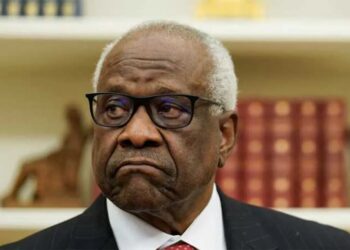
Justice Thomas’s roots extend for generations in the coastal lowlands of Georgia. He can trace his ancestry to formerly enslaved people who bought land of their own and registered to vote after the Civil War.
He was born in Pin Point, a hamlet founded in 1896 by formerly enslaved people. Although Reconstruction had promised equality to Black Americans — guaranteeing citizenship and outlawing slavery — Southern states instituted racist laws that legalized discrimination. Raised by his grandparents in Savannah, Justice Thomas has said he experienced segregation and racial bigotry as a child in the South.
Justice Thomas’s great-great-great grandfather Sandy Wilson appears to have been enslaved on a plantation in Liberty County, rural farmlands south of Savannah, according to estate records first cited in the biography “Judging Thomas: The Life and Times of Clarence Thomas.”
A ship manifest from the 1830s shows enslaved people, including Mr. Wilson, were brought from Georgia to Charleston, South Carolina.
After the Civil War, Mr. Wilson registered to vote in 1867 as a free Black man. Mr. Wilson was one of more than 460,000 Black people who became citizens in Georgia with the ratification of the 14th Amendment.
By the 1870 census — the first one in which Black Americans in the South were counted as citizens — Mr. Wilson was living with his wife and children and working as a farmer.
Justice Thomas was raised by his grandfather, Myers Anderson, who sold fuel oil. Born in 1907 in Savannah, he was a central figure in Justice Thomas’s life. The justice has often credited his grandfather’s strictness and strong work ethic for propelling him to succeed. He has also written of the pain of living under segregation, saying that in the 1950s and 1960s, “Blacks steered clear of many parts of Savannah, which clung fiercely to racial segregation for as long as it could.”
Justice Thomas has said the stain of slavery and his experiences with segregation in America helped shape his conservative judicial philosophy, in which he has often focused on self-reliance and individual achievement.
Produced by Jenni Lee. Photo editing by Greg Kendall-Ball. Ann E. Marimow contributed reporting.
Methodology
To understand the family immigration and migration histories of the Supreme Court justices, The New York Times began by examining their speeches and interviews, including from their confirmation hearings and nomination announcements. We also examined biographies, memoirs and other books about the justices.
We then built family trees for each justice, using a variety of records, including census documents, ship manifests and arrival certificates, naturalization petitions and certificates, birth and death records, marriage certificates, voter registration information, Freedmen’s Bureau records, military service records and draft cards, records of pre-Revolutionary War land ownership and probate files. We also used online genealogical websites, including Ancestry and FamilySearch, among others, to locate government records and filed public records requests with state and national archives. Where possible, we used multiple documents to corroborate each relative’s history.
We then examined how laws and immigration policies affected each justice’s ancestors, interviewing academic and legal experts. We also looked at historical records and academic literature, along with newspaper archives, to piece together the conditions for newly arrived immigrants and migrants during each period and at each location.
The justices’ trees were reviewed by Sarah J. Dery and Hallie Kirchner, genealogical researchers at American Ancestors. The researchers also provided additional genealogical records.
We also presented our research to the justices through a court spokeswoman. They declined to comment.
Abbie VanSickle covers the United States Supreme Court for The Times. She is a lawyer and has an extensive background in investigative reporting.
The post In Supreme Court Justices’ Histories, a Story of Immigration in America appeared first on New York Times.