There was a time more than a decade ago when I thought about Cesar Chavez, the United Farm Workers founder, almost every day. I pored through files and listened to him speak on hundreds of hours of tapes as I wrestled with writing a biography that captured his complexity and contradictions, his remarkable achievements as well as his profound flaws. The revelations earlier this month about his sexual assaults on young girls and women were shocking — but not altogether surprising.
He was never the secular saint he was successfully marketed as for so many years. That was why, long after he died in 1993, the most knowledgeable and logical potential biographers shied away from the subject. I knew enough to share their trepidation, but I decided that he was too significant to be rendered one-dimensional by the hagiography. Many destructive behaviors were well-documented and well-known, including the traumatic emotional abuse Mr. Chavez inflicted on people who had once been his closest allies. For many years, no one wanted to talk about that, either. Yet the record was there in the hundreds of boxes and tapes at the Walter P. Reuther Library in Detroit. Mr. Chavez had ordered it all preserved, understanding, perhaps, that it documented his place in history.
But the sexual abuse accusations remained hidden from public view until now. An investigation by the Times reporters Manny Fernandez and Sarah Hurtes uncovered extensive evidence that Mr. Chavez groomed and abused girls and women.
I had heard plenty about his adultery, but nothing about sexual assaults. My overwhelming reaction to the new revelations was sadness, at the tragic coda to a story already full of heartbreak. I was not surprised that people who might have been in a position to know what happened either didn’t know or didn’t want to know — or, if they did know, they looked away. That was the ethos of the movement, intrinsic to both its success and ultimate downfall: “La causa” superseded everything else.
That is why reckoning with the Chavez legacy requires reckoning with the movement as well — a movement that once gave hope and inspiration to so many but withered away long ago.
In the last decade of his life, when Mr. Chavez had effectively dismantled the first successful union for farmworkers, he discovered people would pay money for his imprimatur. He refashioned himself as an entrepreneur. The union waned, the movement became moribund, but the Chavez name gained more and more currency and became shorthand for “Latino icon.”
He turned himself into a brand. After his death, the union and his heirs perpetuated and exploited the brand. They raised money off the Chavez name and an older generation’s romantic memories of boycotting grapes and marching in protests.
As Latino political power grew and Latino voters became a more significant constituency, so did the strength of the Chavez brand. Politicians pandered to Latino voters by displaying photos of Mr. Chavez in their offices, though many knew little about the victories in the fields that were by then ancient history.
When the Mexican actor and filmmaker Diego Luna released a biopic about Mr. Chavez in 2014, the secretary of labor, Tom Perez, introduced it at a political-star-studded premiere in Washington. Lamenting how little was known about what Mr. Chavez had actually accomplished, Mr. Perez said, “Most people can say, ‘Oh, he helped grape farmers,’ but they can’t really get to the next sentence.”
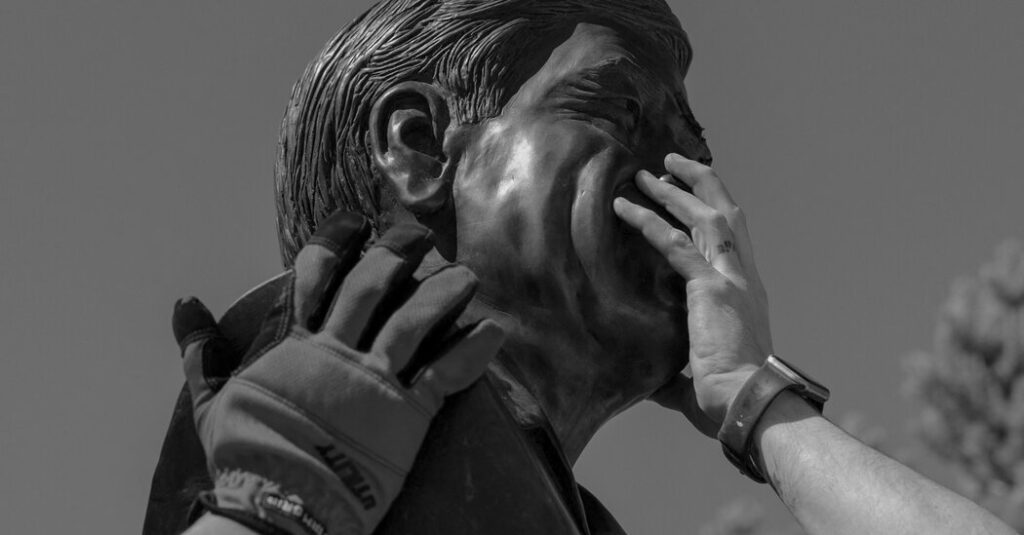
They still can’t. The speed with which the statues of Mr. Chavez are coming down and the street names are changing reflects the degree to which he had become little more than an opportunistic path to Latino political and economic power. Place a bust in the White House, name a street, put his face on a postage stamp, christen a Navy ship. But when the brand becomes toxic, it’s easy to throw it out.
The United Farm Workers union led the parade. For years, it bannered Mr. Chavez’s name across its site, although his name had long since ceased to have meaning for the farmworkers the union was supposed to be organizing.
“Please donate to continue Cesar Chavez’s dream for farmworkers” read the appeal for contributions, more than three decades after he died. Recently, the U.F.W. not only removed those references; it scrubbed Mr. Chavez’s name from the page that explained the vision of the union he founded.
Mr. Chavez did a lot of good — and a lot of bad. The revelations about his sexual abuses add a significant chapter that resonates in the post-#MeToo era. But the contradictions were there from the start; the commitment and passion that Mr. Chavez inspired and that helped achieve remarkable gains more than half a century ago also stifled dissent and marked those who raised questions as traitors.
In his determination to control the union and the movement, Mr. Chavez accused loyal workers of being spies, Communists and thieves. He preached nonviolence while condoning a “wet line” run by his cousin that beat up Mexicans trying to cross the border illegally. He perjured himself to justify firing the farmworker leaders who should have been the future of the union.
He also gave hope and opportunities to thousands of workers who had never thought they could achieve dignity in their jobs, or find work outside the fields. He taught a generation of people how to organize for social justice. He showed that the poorest people with the least protection could band together to overcome the most powerful industry in California. That, in turn, inspired Chicanos in U.S. cities to demand rights. Those lessons continue to be needed.
As his name disappears, farmworkers remain conspicuously absent from the conversation, except as a convenient substitute for the hastily renamed holiday on his birthday. No one should pretend that naming a street Farmworkers Boulevard or creating Farmworkers Day to honor workers who do not get holidays will do anything for people still toiling in the fields under increasingly difficult conditions — or for the Latinos being kidnapped off the streets of Los Angeles.
Miriam Pawel is the author of “The Crusades of Cesar Chavez: a Biography,” “The Union of Their Dreams: Power, Hope, and Struggle in Cesar Chavez’s Farm Worker Movement” and the forthcoming “California Dreams: The Making and Remaking of the University of California.”
The Times is committed to publishing a diversity of letters to the editor. We’d like to hear what you think about this or any of our articles. Here are some tips. And here’s our email: [email protected].
Follow the New York Times Opinion section on Facebook, Instagram, TikTok, Bluesky, WhatsApp and Threads.
The post I Wrote a Cesar Chavez Biography. This Is How His Secrets Stayed Buried. appeared first on New York Times.