Jared Isaacman was in his office in mid-January, barely a month into his job as NASA administrator, when his cellphone rang.
“Jared, I want to check in with you,” said President Trump, as Mr. Isaacman recounted the conversation. “Are we doing something in the 2028 window for Mars? What do you think about the nuclear rocket?”
Mr. Isaacman’s agency is on the verge of one of the most momentous space landmarks of the modern era: the launch of Artemis II, a mission that is set to propel astronauts farther from the planet than any human beings have traveled in history as they loop around the moon. And yet the president was instead focused on what would come next.
Mr. Trump, who turns 80 this year, grew up in the days of Apollo, when spacefarers voyaged to another world and fired imaginations back on the one they left behind. Mr. Trump, however, wants to top the achievements of Apollo 11 and its brethren. A moon base! A nuclear rocket! A trip to Mars! And whatever it will be, it has to be huge, and it has to get started before he is due to leave office in January 2029.
The man who slaps his names on buildings and dreams of adding his face to Mount Rushmore hopes to make history by pushing space exploration to new heights, literally and figuratively. No president since NASA’s glory days under John F. Kennedy and Lyndon B. Johnson has pressed the space agency as hard as Mr. Trump.
The upcoming launch of Artemis II will be the first step in the journey. Four astronauts are scheduled to fly to the moon as soon as Wednesday, the first humans to travel there in the more than half a century since the end of the Apollo program.
In an interview, Mr. Isaacman said the president’s goals were driven by a constellation of national security, commercial, resource and technological interests, as well as his preternatural instinct for grand undertakings.
“The president knows the importance of taking on big, bold endeavors and he does it across all of the important technological domains,” Mr. Isaacman said. “So when he talks to me about returning to the moon, he doesn’t talk about a repeat of Apollo. He says, Do we build a moon base? What does the lunar economy look like? We’re not just going to plant the flag.”
In fact, Mr. Isaacman said, Mr. Trump has made clear that humans need to stay. “What I have heard him say many times is, ‘Make sure when we go back that we are not going for the brief Apollo program,’” Mr. Isaacman said. “He specifically said, ‘We better be doing more than getting rocks this time.’”
Liz Huston, a White House spokeswoman, said in a statement that the president is “building on the transformational achievements” of his first term. “With President Trump’s America-first policies, the United States will lead humanity into space and enter a new era of groundbreaking achievements in space technology and exploration.”
Mr. Trump was not exactly a space aficionado before coming to office. He is not known for waxing romantically about watching Neil Armstrong and Buzz Aldrin land on the moon in 1969 when he was 23 years old.
When a 10-year-old boy asked Mr. Trump about space in 2015 during a campaign stop in New Hampshire, the candidate seemed indifferent. “Right now, we have bigger problems — you understand that?” he said. “We’ve got to fix our potholes.”
But along the way, he became persuaded that fixing potholes was not exactly the same as reaching for the stars. Just weeks before the 2016 election, his campaign’s surrogates pledged “a new vision” for America’s space program.
“During the campaign, he saw the linkages between space and the larger ‘Make America Great’ grand vision,” said Scott Pace, the director of the Space Policy Institute at George Washington University, who served as executive secretary of the National Space Council, which Mr. Trump reconstituted in his first term.
Mr. Kennedy set the goal of reaching the moon not out of love of exploration, but to compete with the Soviets. Once Americans won the space race, the public and presidents largely lost interest.
Richard M. Nixon scrapped the final three Apollo moonshots and shifted resources into building a workmanlike space shuttle. Ronald Reagan kicked off the development of a permanent crewed space station, which Bill Clinton transformed into a joint venture with the Russians. George H.W. Bush and George W. Bush each set sights on returning to the moon and then going to Mars, but neither got far. Barack Obama wanted to land astronauts on an asteroid, a vision that went nowhere.
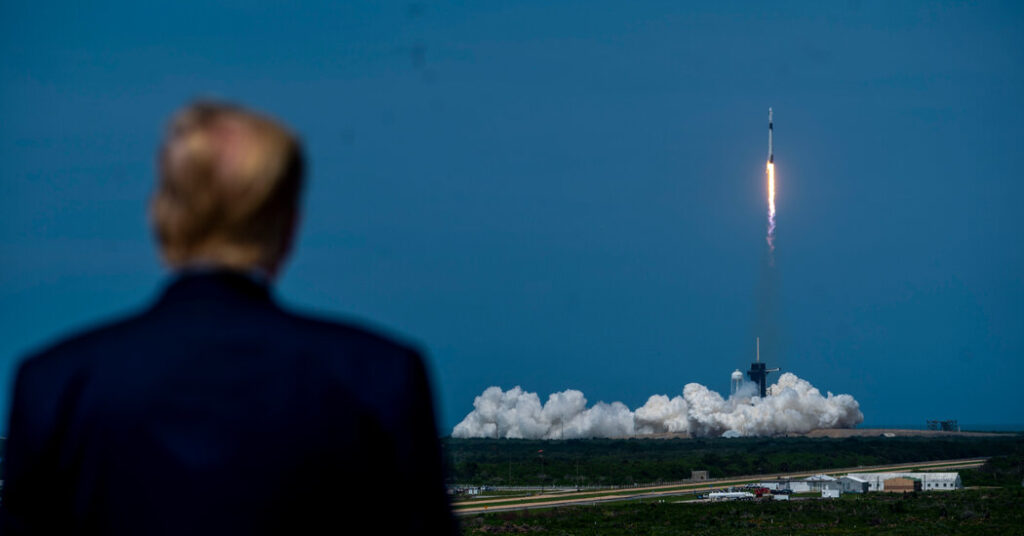
Mr. Trump, however, came to see space as a place to make a mark. He invited Mr. Aldrin and Michael Collins, Mr. Aldrin’s Apollo 11 crewmate, to the White House for the 50th anniversary of their historic flight, and put Mr. Aldrin in the gallery for his State of the Union address in 2019. He flew to Florida to personally witness the SpaceX launch in 2020 as Elon Musk’s company helped restore NASA’s ability to send astronauts to the International Space Station from its own soil.
Whether the president will remain attentive to Artemis II is an open question. As the launch date got pushed further off, Mr. Trump did nothing to call attention to the upcoming mission. Even though its four astronauts were in the gallery for his State of the Union address in February, Mr. Trump did not acknowledge them nor mention their forthcoming journey. Nor has he said much about Artemis in the days leading up to this week’s scheduled launch.
With China making great advances in space, and Mr. Musk pushing to go to Mars, Mr. Trump in his first term adopted the idea of returning to the moon as a step toward eventually reaching the red planet. He likewise decided to establish a Space Force in “a typically Trumpian way,” as former Vice President Mike Pence put it in his memoir; Mr. Trump mused out loud during a speech to Marines about creating a new branch of the armed forces focused on the heavens, and then made it a reality.
“There’s no question this president loves competition and loves to win,” said Steve Crisafulli, a former Florida House speaker who served on Mr. Trump’s space council in the first term. “This is one of those things that he gets to say that he’s winning, and rightfully so.”
While new presidents often switch space priorities when they take office, Joseph R. Biden Jr. kept both the Artemis program and the Space Force during his tenure.
But some supporters of space exploration worry that Mr. Trump’s support for the big splashy programs come at a cost. The Trump administration last year proposed cutting NASA funding by 24 percent, which would have terminated more than 40 missions.
Congress ultimately included billions of dollars for the Artemis program as part of Mr. Trump’s giant tax-cut-and-spending measure last year, and in January, lawmakers rejected most of the other proposed budget cuts in another spending measure. Even so, nearly 4,000 NASA employees are leaving as part of federal downsizing.
Cady Coleman, a retired astronaut who went to space three times and spent six months aboard the space station, said she remained concerned by the exodus of experienced people from NASA. “I just hope that Trump understands that and understands the devastation of not letting really good people do their jobs,” she said.
But she added that astronauts have faith in Mr. Isaacman, a billionaire pilot who paid to fly himself into orbit aboard SpaceX’s Crew Dragon capsules twice. “He’s just a great person for this job and he brings incredible skills,” Ms. Coleman said.
Mr. Isaacman had a bumpy ride to NASA’s executive suite: Mr. Trump pulled his nomination after falling out with Mr. Isaacman’s patron, Mr. Musk, then months later renominated him as the president and the billionaire reconciled. Now, Mr. Isaacman said, he is confident that he has the president’s backing, pointing to a new space policy signed the same day that the new administrator himself was sworn in. “I have immense support,” he said.
Mr. Isaacman said that it made sense to re-evaluate programs that have ballooned in cost, but expected to have what he needs for Artemis and other priority missions. And he predicted that the Artemis program would reinvigorate global support. “I have no doubt when we launch, it will captivate the world’s interest in NASA again,” he said.
But NASA faces uncertainties about the schedule of its moon program after Artemis II. Keeping the world captivated could depend heavily on Mr. Trump’s ongoing commitment.
“As something as technically challenging as spaceflight is, you have to have the White House and the president acting as the spokesman for it,” said Harrison H. Schmitt, one of the last two men to step foot on the moon as part of the Apollo 17 mission in 1972 and one of only four moon walkers still alive today. “There’s just no question about that.”
Peter Baker is the chief White House correspondent for The Times. He is covering his sixth presidency and sometimes writes analytical pieces that place presidents and their administrations in a larger context and historical framework.
The post For Trump, Moon Mission Is a Ticket to Greater Goals, and His Own Legacy appeared first on New York Times.