Richard Remigio sauntered up a set of metal stairs with a beer in his hand to address a crowd of mourners gathered in a courtyard on H Street. Some people wore all black while others giggled amongst their friends, but they had all come to remember a life cut too short.
“You were a very complicated entity in our lives. We loved you, but we hated you. We adored you, but we also loathed you,” he said to a crowd at Gallery O on H over the weekend. “Will I miss you? Of course not, I will never miss you.”
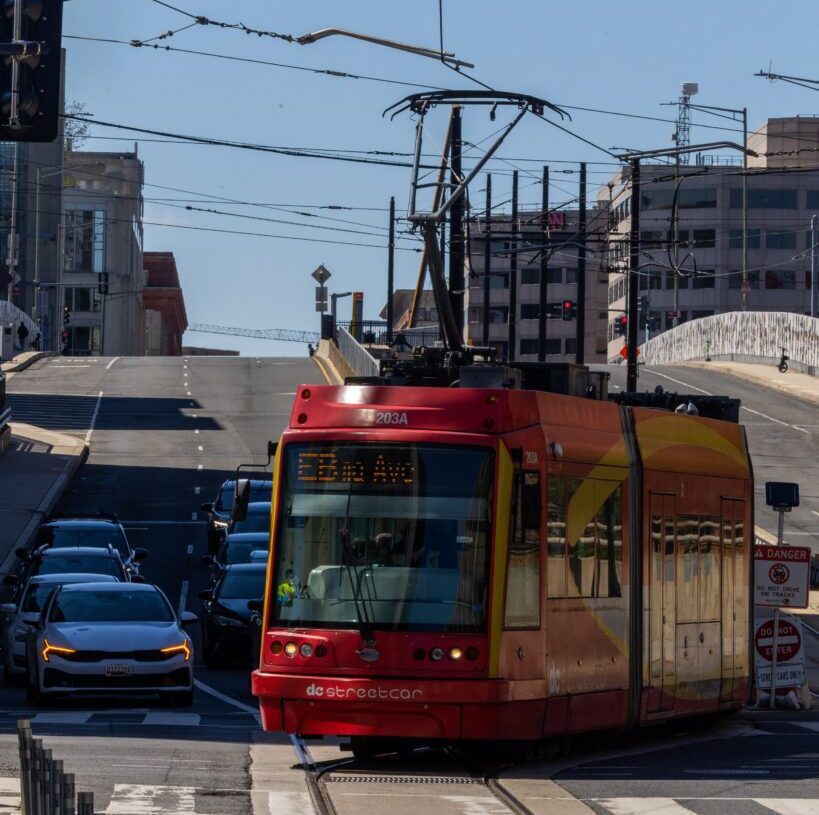
Remigio was among those gathered to eulogize D.C.’s Streetcar, which is taking a final run Tuesday after just a decade of operation plagued by high maintenance costs and low ridership. Mayor Muriel E. Bowser (D) has said a “next generation” electric bus service could replace it in the future.
The bright red trolley that runs a 2.2-mile track along H Street from Union Station to the edge of the RFK Stadium site never amounted to its promised sprawling 40-mile footprint. But the streetcar quickly became the unofficial mascot of the corridor for some.
The streetcar moves about 2,000 people each day, according to data from the District Department of Transportation. That’s just a fraction of the parallel D20 bus route, which had more than 10,000 daily riders on weekdays in February.
The department said in a statement that it is working to design a transit network that avoids duplicative services. “DDOT acknowledges and appreciates the contributions of riders, employees, and community members who have supported the D.C. Streetcar during its decade of service,” the statement said.
While this iteration of a streetcar only ran for a decade, the District has a long history with tram transport. Streetcar service in D.C. started in 1862 as horse-pulled trollies operated by private companies. Technological advances paved the way for cable cars and the electric conduit system, before the local government ultimately pushed the streetcar out in favor of bus service in 1962.
Interest in trams piqued again in the 1990s, spurring a plan to bring back a robust city streetcar system. After significant delays, the $200 million H Street line opened in 2016. It took more time to plan and construct the streetcar than the line actually ran.
Efforts to extend the streetcar were dramatically scaled back before it opened, and the system never grew beyond the first route.
D.C. Council Chairman Phil Mendelson (D) said the streetcar could have been more successful with better planning as well as additional connections to transit to lure more riders — including a turn into Union Station and a terminus stop across the Anacostia River at the Minnesota Avenue Metro station. But at a certain point, he said, the streetcar was not worth saving with injections of more cash.
The district annually spends $12 million on the streetcar, DDOT said Monday. Officials have previously said it would have cost $100 million to extend the line to Benning Road Metro, east of the river. The streetcar was the last form of free public transportation in the District, but cost DDOT an average of $12.91 per rider in fiscal year 2025, the agency said.
“I’m just amazed at the zeal with which former District elected officials were promoting hundreds of millions of dollars in spending, and then spending more, and then spending on top of that,” Mendelson said at a news conference Monday. “I’d like to say lessons learned, but I don’t know who learned them.”
Standing outside the Union Station stop on Saturday, Jake McQueen and his wife, Reagan, waited about a half-hour for the streetcar to pick them up. The pair are self-described train enthusiasts, and have ridden streetcars all over the world, from Ohio to Amsterdam. But they hadn’t yet gone on the D.C. line.
They stepped on for a joyride, their first and last, before heading to the Cherry Blossom Kite Festival on the National Mall.
“We had to come see it before it’s gone,” McQueen said.
Though the original plan for multiple, connecting lines didn’t come through, the H Street route spurred development along the corridor. Main Street Director Anwar Saleem said trains revolutionized America — and the streetcar was a catalystto revitalize H Street.
“It did just what it was supposed to do to a certain degree for H street,” Saleem said. “A lot of development … would have never taken place without the streetcar.”
Saleem, who rode the District’s old streetcar as a young boy, said politicians didn’t fight hard enough to expand the latest, ultimately leading to its demise. “If you’re gonna build a streetcar, you got to build it responsibly,” he said. “I think we really missed the mark, and somebody should really take the blame for that.”
The streetcar’s stop at Union Station makes it an easy grab for tourists arriving by train, bus or the Metro. Among some locals, though, the track was often little more than a punch line.
To sell home just how slow the trolley is, dozens of runners bolted down H Street on Saturday, constantly looking over their shoulder to keep tabs on their big, red opponent in a “beat the streetcar” run — seeking one last chance to humiliate the D.C. Streetcar in a foot race.
Looking timidly across the road before the run, Hayden Anderson said he had raced the streetcar before and lost. He’s lived on H Street for three years, falling asleep to the train whistle each night. He’s never known life in the city without the streetcar.
But he said the train is too slow to use daily, often getting stuck behind double parked cars because the line doesn’t have its own dedicated right of way. Anderson gets around faster by biking.
Confidently, he said he was prepared to lose Saturday’s race — and he did. “It’s a little embarrassing,” Anderson said. “This thing is so slow.”
To his credit, the streetcar took 14 minutes and 51 seconds to finish the 2.2-mile line, noticeably faster than the typical 20 minute-run. The tram driver cheekily admitted he knew about the race, but insisted he didn’t give the car any more gas than normal.
Leaned over catching his breath at the top of the hill at the end of the race, Samuel Littauer said it took more effort to win than he had expected.
“One of the benefits of living in D.C. is our public transit system provides people ways to get around. We need to keep expanding that network so that people are less dependent and restricted by single modal transportation,” he said at a pub after the race, holding a deck of old D.C. Streetcar playing cards.
The trolley is once again being put out to pasture, but there’s still hope harbored that it will make a comeback in the future, especially with the Washington Commanders’ planned stadium project on the old RFK site.
On Sunday, after pouring a drink out in honor of the streetcar’s short run, an impassioned crowd at Gallery O on H thrust their fists in the air and chanted, “We’ll be back. We’ll be back. We’ll be back.”
Jenny Gathright contributed to this report.
The post D.C.’s Streetcar is making its final stop, leaving a mixed legacy appeared first on Washington Post.