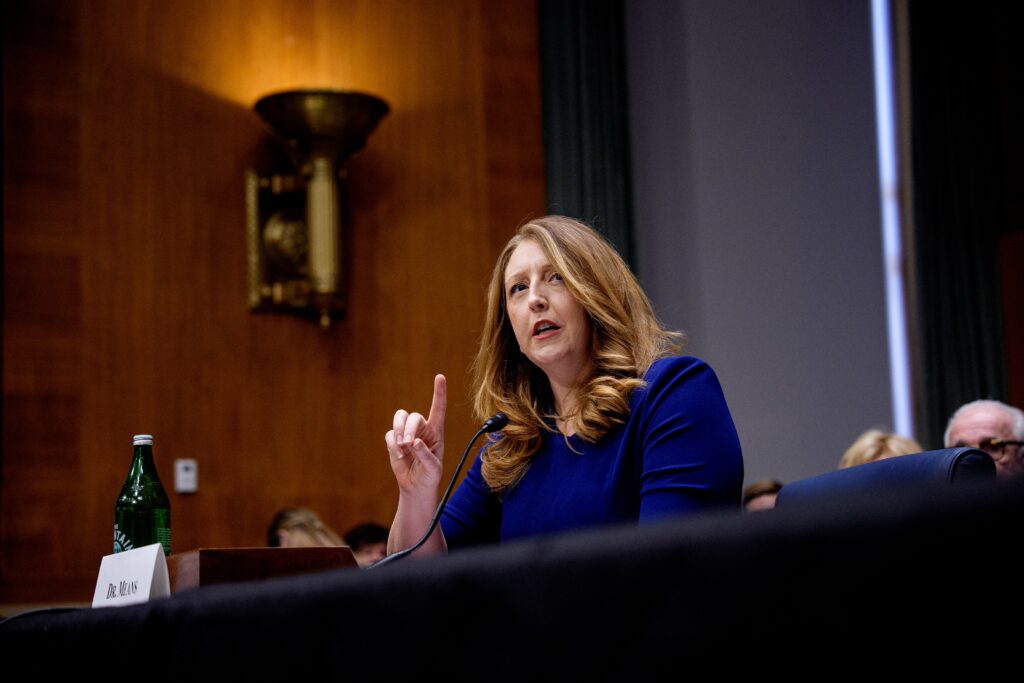
In his March 25 op-ed, “The danger of letting a mystic lead public health,” Marc Short advocated eliminating the position of surgeon general altogether because he believes Casey Means, the current nominee, to be unqualified. If Means’s record and polling are poor, wouldn’t it make more sense to find a more qualified candidate with expertise in many of the health issues that Americans face today?
C. Everett Koop, the surgeon general appointed by President Ronald Reagan, warned the American public about the hazards of active and passive smoking and worked to improve the lives of both infants with birth defects and people with disabilities.
Vivek Murthy, the surgeon general appointed by Presidents Barack Obama and Joe Biden, made significant contributions to the areas of obesity, the opioid crisis, substance abuse and the Ebola and Zika viruses.
A poor choice for surgeon general shouldn’t make the position itself unnecessary any more than a poorly performing president should mean electing no future presidents.
Ellen Korb, Silver Spring
I was executive director of a nonprofit that represents the U.S. Public Health Service where I got to know what a competent and energetic surgeon general can do for our country. I also learned that the USPHS cannot easily be replaced with civilian government employees with the same results.
The officers in the Commissioned Corps of the U.S. Public Health Service are members of one of our country’s uniformed services. They have served alongside their military colleagues for more than 200 years, risking their lives to provide care for the wounded.
Federal law is extremely clear: “The Surgeon General shall be appointed from the Regular Corps [of the USPHS] for a four-year term by the President by and with the advice and consent of the Senate. The Surgeon General shall be appointed from individuals who (1) are members of the Regular Corps, and (2) have specialized training or significant experience in public health programs.” Granted, not every surgeon general has been of the caliber and stature of Luther Terry or C. Everett Koop, but more of them would be if the president followed the law and chose the surgeon general nominee from the ranks of the USPHS.
Public Health Service officers also do not receive overtime pay when they deploy. When the hours they routinely work are taken into account, any unfavorable cost comparison with government civilians dwindles fast.
Our country greatly benefits from the incredible work ethic and expertise of the officers of the U.S. Public Health Service. And we need a qualified surgeon general who comes from their ranks.
James Currie, Alexandria
America’s top doctor can and should have a beneficial influence on our public health. C. Everett Koop’s legacy is a prime example. In the 1980s, there was more fiction than fact available to the general public about HIV/AIDS. The country needed nonjudgmental, legitimate prevention information. Koop saw this as an unequivocal public health crisis requiring immediate attention and concern for all Americans. Working with the Centers for Disease Control and Prevention, I helped develop and market the America Responds to AIDS campaign. Central to this effort was Koop’s “Understanding AIDS” brochure, which was mailed to all 107 million households in the country. The campaign succeeded in promoting HIV/AIDS awareness and helped change attitudes and prevention behaviors. This enlightened approach and leadership is exactly what we need for today’s surgeon general.
Yolan Laporte, Fairfax
The writer is a former executive vice president at Ogilvy & Mather.
I survived meningitis in 1954. Not everyone my age did.
Regarding the March 25 online article “5 things you need to know about meningitis”:
One evening after dinner in April 1954, I told my mother I did not feel well and she put me to bed. Later, when my parents came to check on me, I was unconscious. They called the family doctor, and even at that late hour he came to our house. He examined me and called for an ambulance. It took me, in a coma, to Kings County Hospital in Brooklyn.
I had meningitis. I was placed alone in a room, under quarantine, because it is highly contagious. My parents, who were not allowed in the room, were told to be prepared for my death. After a week, I awoke, but I could neither walk nor talk. I remember, and still appreciate, the nurses who worked with me to recover those functions.
Finally, about a month later, I was able to go home. I could not go back to finish first grade, but I survived meningitis. Not everyone did. While I was alone in my hospital room, I was told there was a boy about my age in the next room who also had meningitis. We were both under quarantine, so we never met. But having shared this common ordeal, I hoped we would meet when we were both well and able to leave the hospital. When it came time for me to leave, I asked and was told that the other boy had died. I still think about him. Do what you have to do and protect yourself. Every parent should get their child vaccinated.
Henry Brownstein, Littleton, Colorado
Cheers to 50 years of Metro
The March 29 Metro article “Metro turns 50” presented how the transit system helps locals attend D.C. events, celebrations, medical appointments, and avoid rush-hour traffic tie-ups for those en route to the office. My first ride on Metro was for a medical appointment, but I also used the Metro in the early ’80s to visit Smithsonian museums and attend political demonstrations. Today, I choose to avoid the stress of driving and paying enormous fees for parking by riding Metro instead. I also use public transportation to repudiate greenhouse gas emissions and air pollution caused by driving a gas-powered car or truck.
For 50 years, Metro has brought commerce to the nation’s capital. It deserves credit for providing a key that unlocks the glorious city for all.
Gail B Landy, Gaithersburg
The post Casey Means does not have what it takes to be surgeon general appeared first on Washington Post.