There’s a small place where Canada and the United States can still be best friends.
This place is largely unaffected by the political turmoil that has occurred since President Trump was re-elected: the unraveling of decades of closeness between the allies driven by threats to annex a “51st state” and impose punitive tariffs on Canadian industry.
That place will be a space capsule the size of a small RV that is launching soon from Kennedy Space Center in Florida and is set to journey around the moon and back.
If all goes to plan, a spacecraft carrying four astronauts will lift off as soon as Wednesday as part of the NASA mission Artemis II, the first to send humans around the moon since 1972. But unlike earlier missions, the three NASA crew members will be joined by Jeremy Hansen, a Canadian Space Agency astronaut raised on a farm in Southern Ontario.
That a Canadian will be onboard is a milestone for the country, making it only the second, after the United States, to send an astronaut so deep into space.
But the achievement comes at an awkward moment as Canada’s relationship with the United States continues to break down.
“We’re seeing an increase in protectionism, concerns about sovereignty, geopolitical stability,” said Lisa Campbell, president of the Canadian Space Agency. “But really, we all share the same fragile planet and we need to take care of it. We need to help one another.”
Tensions between the United States and Canada have reoriented Ottawa’s focus to the Arctic, where military capabilities are dependent on space technology such as missile warning radars and weather satellite systems. Both countries jointly operate NORAD, an Arctic defense alliance formed in 1958 to address northern aerospace security.
But Canada’s space officials are mostly looking past the conflict in this moment.
“Space is a bridge that brings countries together,” said Ms. Campbell, adding that the prevailing mood at the agency is excitement for Mr. Hansen, a mission specialist on the 10-day flight. “We’re extraordinarily proud,” she said.
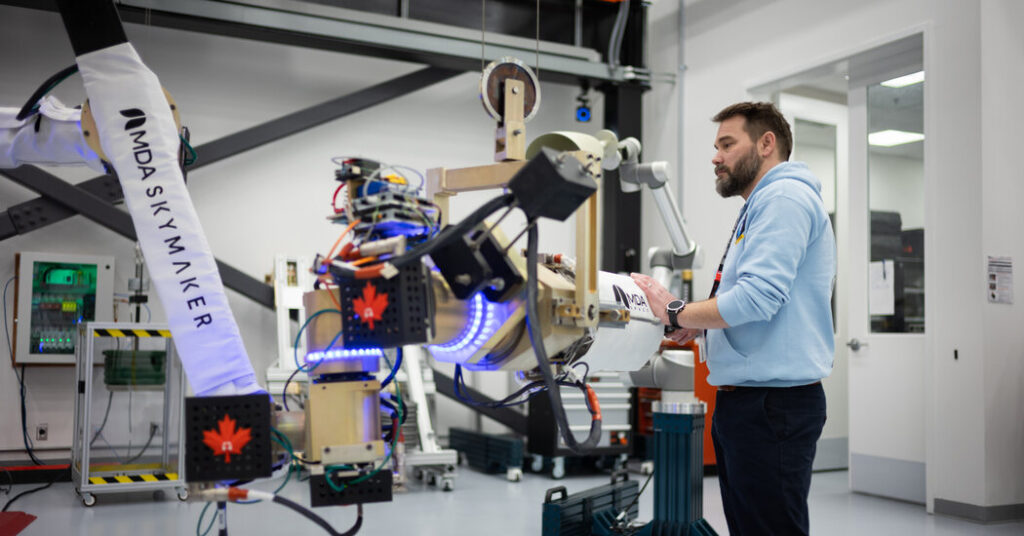
Canada secured its ticket to the moon by negotiating a deal with NASA to provide a robotic system, resembling an arm, to Gateway, a planned American space outpost that was to orbit the moon.
“People are surprised that Canada has an extensive space capability,” said Mike Greenley, the chief executive of MDA Space, the firm leading the Canadarm3 project.
The robot, Canadarm3, was being designed to support astronauts during spacewalks and aid repairs in lunar orbit. NASA announced in late March that Gateway had been suspended and suggested contributions from Canada and other nations could be repurposed.
At public events leading up to the launch, Mr. Hansen, 50, has reminded the public that Canada earned its place on the Artemis flight, occasionally softening his comments with signature Canadian modesty.
“Canada did get more than its fair share of the volume on this mission by assigning me to this,” Mr. Hansen said at a news conference in September, referring to his height (at 6 feet 2 inches, he’s the tallest member of the crew). “I’m getting a little bit conscious about my size.”
But throughout, he has emphasized the crucial role that Canada plays in space exploration.
In the early 1970s, the country negotiated an agreement similar to the Artemis deal, pledging to supply an earlier Canadarm for NASA’s space shuttle program.
That deal secured a space shuttle seat for Marc Garneau, who in 1984 became the first Canadian in space. Since then, eight other Canadian astronauts have flown on 17 space missions with NASA. One of those was Chris Hadfield, who became the first Canadian to spacewalk and a commander of the International Space Station. The next Canadian astronaut in line for a space mission, Joshua Kutryk, is preparing for a six-month stint on the I.S.S.
In late January Prime Minister Mark Carney of Canada delivered a rousing speech at the World Economic Forum in Davos, Switzerland, in which he warned of a “rupture” in the world order. Though he did not mention Mr. Trump by name, Mr. Trump retorted in his own Davos address, repeating his belief that “Canada lives because of the United States.”
In space, the dependence for survival will be mutual.
Sailors at sea is a metaphor that captures the necessity of collaboration, said Scott Pace, director of the Space Policy Institute at George Washington University.
“You’re trying to operate in an incredibly hostile environment that wants to kill you,” Dr. Pace said. “The last thing you need is to have conflicts with the people that are on your ship.”
On land, some Canadian space enthusiasts will be biting their tongues.
Mr. Trump’s threats had the effect of creating a national unity campaign marked by Canadians boycotting American products and cross-border travel, with many adopting the hockey phrase “elbows up” to describe their defensive posture toward the United States.
Some Canadian social media users have jabbed at whether American immigration officials will allow Mr. Hansen to return from orbit. And among the country’s space watchers, some were nervous about how Mr. Trump’s return to office would affect Artemis II.
Chris Gainor, a space historian based in Victoria, British Columbia, wondered if Mr. Hansen would be swapped off the flight in favor of another American astronaut as a “poke in your eye” to Canada.
“Fortunately, I’m wrong about that,” he said.
Other Canadian experts have long expressed concerns about underinvestment in spaceflight. The country has a modest space budget of 834 million Canadian dollars, or $609 million. That puts it last among the 10 countries in the Organization for Economic Cooperation and Development’s Space Forum for spending as a percentage of gross domestic product, according to a report by the Royal Bank of Canada.
In 2018, a group of about 70 Canadian aerospace companies, universities and industry groups banded together for a campaign to lobby the government for more funding. The campaign called for Canada to step up its contributions and not rest on the laurels of past achievements, such as being among the first countries, other than the United States and the Soviet Union, to operate its own satellites.
Canada also finds itself fully reliant on the United States to launch spacecraft, in contrast to NASA partners like Japan and the European Space Agency, which fly homegrown rockets.
That could soon change.
In March, Canada announced it was investing around $145 million to lease a commercial spaceport in Nova Scotia. The spaceport will support defense and military needs and other national interests, the government said.
“Instead of just depending on others for it, we realized that we needed to do it ourselves,” said Stephen Matier, the founder and chief executive of Maritime Launch Services, which operates the site.
“Now we’ve had a sea change,” Mr. Matier said. “Sovereign launch is really an important piece of the story going forward for Canadians.”
Mr. Hansen will play a big part in writing that story.
“As Canadians, we can be very proud because we answered the call,” Mr. Hansen said at a news conference in September, responding to a journalist’s questions in French. “If Canada can fly to the moon, just imagine what we can do next.”
Vjosa Isai is a reporter for The Times based in Toronto, where she covers news from across Canada.
The post Canada Charts a New Path in Space, and With the U.S. appeared first on New York Times.