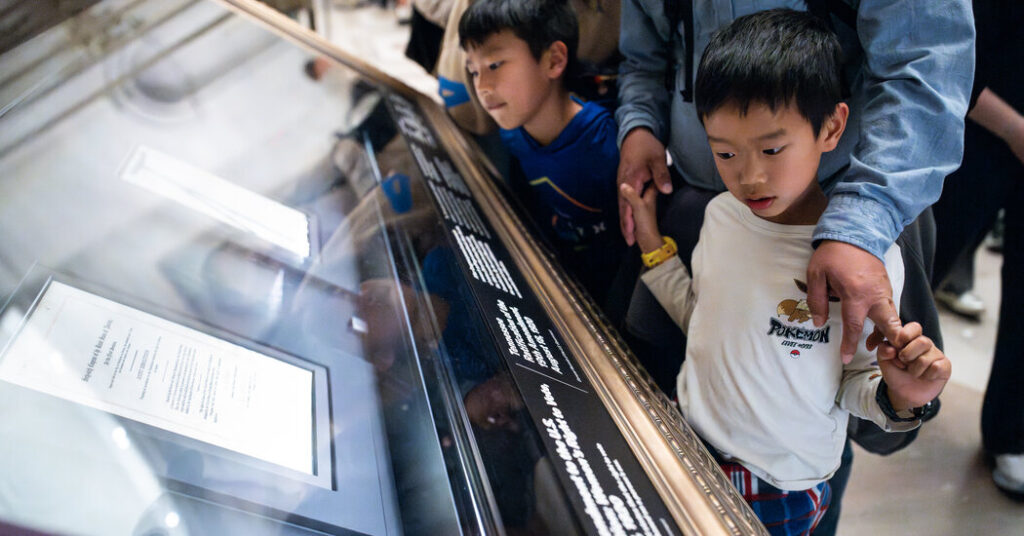
The National Archives has added the Emancipation Proclamation and the 19th Amendment to the grand central rotunda of its headquarters in Washington, the first additions to its permanent display of founding documents in nearly 75 years.
The new installation had been announced during the Biden administration, with the goal of having them on view before the 250th anniversary of the Declaration of Independence this July.
After logistical delays and changes in leadership during the Trump administration, they were quietly installed last week in new marble cases a few steps away from the Declaration, the Constitution and the Bill of Rights.
The installation came with no public fanfare. Patrick Madden, the chief executive of the National Archives Foundation, a private group that raised roughly $3 million to cover the costs, called it a “soft launch,” which would allow for an evaluation of conservation issues as well as the impact on the flow of the more than a million people who visit the rotunda each year.
So far, Mr. Madden said in an interview, traffic is moving smoothly and reactions have been positive.
“This space is inspirational, and designed to be,” he said of the rotunda, whose domed interior features allegorical murals of the founding fathers. “We all know that history isn’t static, and adding these iconic documents adds to the story about how our nation continues to progress.”
The additions were spearheaded starting in 2023 by Colleen Shogan, then the archivist of the United States. Together, Dr. Shogan said in a news release at the time, the new documents would help tell “a more complete story of our nation’s ongoing pursuit of a more perfect union.”
The Emancipation Proclamation, signed by Abraham Lincoln in 1863, in the middle of the Civil War, said that enslaved people in Confederate states “henceforward shall be free.” The 19th Amendment, adopted in 1920, said that states could not limit voting based on sex, laying a constitutional foundation for women’s equal voting rights.
The additions come amid continuing leadership changes at the archives. Dr. Shogan, a Biden appointee, was fired by President Trump in February 2025, shortly after he returned to office. No reason was given. But Mr. Trump had clashed with archives leadership over classified documents he retained after the end of his first term.
President Trump named Marco Rubio, the secretary of state, as acting archivist, and appointed James Byron, the chief executive of the private Richard Nixon Foundation, to run the archives on a day-to-day basis.
Mr. Rubio recently resigned as acting archivist, in keeping with a federal law limiting the length of time someone can hold the post temporarily.
On March 2, Mr. Trump nominated Bradford Wilson, a constitutional scholar with a long résumé at conservative institutions established to challenge the dominance of liberal ideas in academia, as permanent archivist. No date for confirmation hearings has been set.
Mr. Byron announced last week that he will be leaving on April 3. The National Archives declined to respond to questions about who would oversee the archives after his departure.
Trump Administration: Live Updates
Updated
- Trump’s Miami presidential library video draws mixed reactions.
- Trump’s executive order on NPR and PBS is unlawful, a judge rules.
- A federal judge orders construction stopped on Trump’s ballroom project.
Adding something new to the rotunda is no small task. The Declaration and Constitution arrived under military escort in 1952, following a long negotiation with the Library of Congress, their former custodian.
The marble-clad cases for the Emancipation Proclamation and the 19th Amendment, which weigh 5,000 pounds each, were hauled in with help from a crane.
The brass frames were cast from the same molds used for the cases of the Declaration, Constitution and Bill of Rights. Inside, the documents are nested in an airtight case with humidity controls, inside a second case that regulates temperature.
In the past, the documents have been brought out for shorter periods, including an annual display of the Emancipation Proclamation for Juneteenth. “That is probably the one document where I’ve seen people have an emotional reaction to seeing the actual document,” Mr. Madden said.
In an email to archives employees last week announcing his departure, Mr. Byron hailed “enormous progress toward a more efficient, effective, and mission-focused National Archives.” He also praised initiatives like the release of hundreds of thousands of documents relating to the assassinations of John F. Kennedy and the Rev. Dr. Martin Luther King Jr.
Mr. Byron made no reference to the addition of the Emancipation Proclamation or the 19th Amendment to the rotunda. But he did highlight another project for the 250th anniversary, the Freedom Plane, a special Boeing 737 that is currently taking nine priceless documents from the Founding Era to institutions across the country.
The Freedom Plane exhibition, currently at the Atlanta History Center, has drawn long lines. Historians say that response shows a widespread hunger for history, which doesn’t begin and end with the events of 1776.
Annette Gordon-Reed, a professor of Harvard and the current president of the Organization of American Historians, said the new additions to the rotunda emphasize the living nature of the Declaration.
“The Declaration has been a vehicle for extending full citizenship rights to Americans who did not possess them in 1776,” she said.
Jennifer Schuessler is a reporter for the Culture section of The Times who covers intellectual life and the world of ideas.
The post At the National Archives, the Declaration Gets More Company appeared first on New York Times.