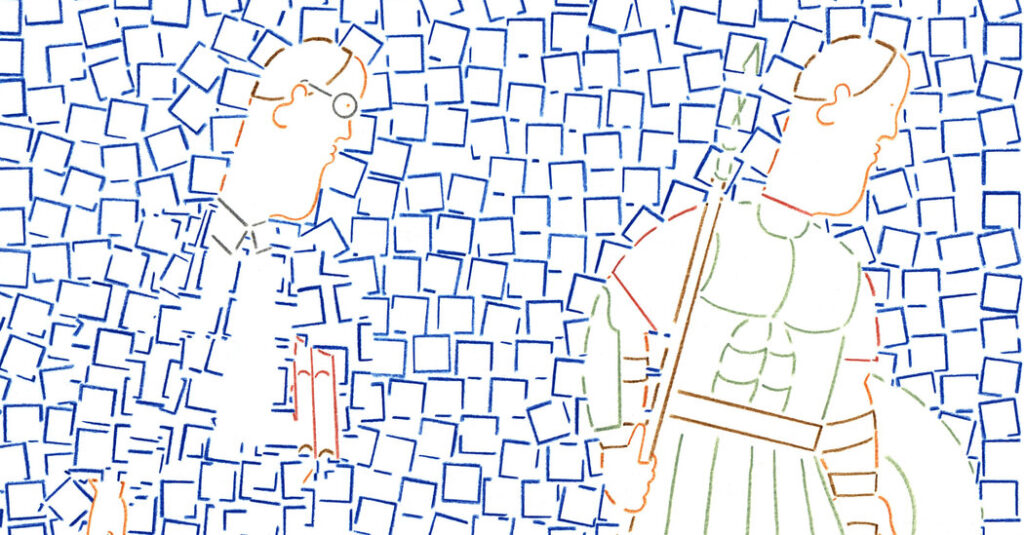
SON OF NOBODY, by Yann Martel
Say what you will about the decline of the Greek and Roman classics in American education — and there’s a lot to be said, given the depressing disappearance of classics departments around the country — it’s been a very good decade for classical fan fiction. Recent years have seen a flotilla of novels that give the myths of the ancient Mediterranean a self-consciously contemporary spin, often by retelling the tales through the points of view of marginal characters.
Madeline Miller’s 2018 best seller, “Circe,” takes a lesser figure from Homer’s “Odyssey,” a sorceress who turns men into pigs (a redundant metamorphosis, as one classicist friend of mine likes to say), and puts her squarely at the center of an adventurous life story. The distinguished British writer Pat Barker, who won the Booker Prize for a trilogy of World War I novels, has turned her attention to the Trojan War in a series narrated by that mythic conflict’s female characters. New iterations of Ariadne (seduced and abandoned by Theseus), Rhea (mother of Romulus and Remus — never mind that she-wolf) and even Hera, long-suffering consort of the philandering Zeus, suggest that there are plenty of new bottles for the old classical vintages.
But then, authors have been reimagining the Greek classics since — well, since ancient Greece. You thought Helen of Troy ran away with Paris and thereby started the Trojan War? Think again. In Euripides’ play “Helen,” first performed around 412 B.C., it’s only a phantom who runs away with the dishy Trojan prince; the real Helen has been spirited away to Egypt, where she pines for her lawfully wedded husband, Menelaus — and mourns her tattered reputation.
The same playwright was, in fact, the first author to reimagine the war from the viewpoint of its traumatized female characters: His “Trojan Women,” a harrowing antiwar drama still regularly performed today, gives the moral victory to the fabulously eloquent wives, mothers and daughters of the defeated Trojans, while presenting their male oppressors as ethically vacant and gratuitously cruel.
It’s no surprise that so many of these reworkings, from the Greek tragedians to today’s authors, have had a distinctly feminist twist. Given that mythic heroism is the province of aristocratic men, displacing the action (and the subjectivity) of the stories onto once-sidelined female characters can have a bracing, even democratizing effect.
But in the latest revisionist treatment of the ancient texts, the focus is on class rather than gender. Yann Martel’s new novel, “Son of Nobody,” is about the discovery of a lost Trojan War epic whose protagonist is no semi-divine princeling, like Achilles in the “Iliad,” but rather a lowly foot soldier named Psoas, who has a beef with his highborn superior officers. This downmarket and decidedly un-Homeric casting allows the tale, and Martel’s novel, to ask: “What is it that makes a hero a hero?”
If the novel derives its subject matter from Homer, it owes its structure to Vladimir Nabokov. Its pages are split between translated fragments of the epic, called the “Psoad,” and an extensive commentary, in the form of footnotes, by one Harlow Donne, an ambitious graduate student who claims to have discovered it. Nabokov’s 1962 masterpiece “Pale Fire” similarly showcases an academic and his obsessive relationship to a literary work, presenting the text of the eponymous poem as well as accompanying notes. As the commentary proceeds, it sheds less and less light on the poem and more and more on the apparently deranged commentator.
So, too, with “Son of Nobody,” in which Donne’s discussion of the work alternates between scholarly exposition (“the ‘Psoad,’ like the ‘Iliad’ and the ‘Odyssey,’ was composed in the dactylic hexameter”) and increasingly intimate autobiographical musings, primarily on his failures as a husband and a father. We learn early on that Donne has left behind his Canadian home, along with his wife and precious young daughter — Helen, naturally — for a yearlong fellowship at Oxford’s Magdalen College.
Those failures culminate disastrously toward the end of the novel, at precisely the point when the plot of the “Psoad” reaches a bloody climax. That timing is no accident. Throughout his commentary, Donne means us to see parallels between two “sons of nobody”: the lowly Psoas, who has abandoned his family in Greece to fight a war that serves the interests only of corrupt nobles and royals, and the lower-middle-class Donne himself, who has left home to tell the ancient soldier’s tale, only to find himself breathing the rarefied air of Oxford and answering to a snooty don given to, it must be said, rather clichéd forms of condescension. (“Not from Princeton, Harvard or Yale,” he sniffs when Donne arrives.)
Martel, best known for his 2001 best seller “The Life of Pi,” has set himself no small challenge in taking on Homer, academia and family tragedy; the results are a mixed bag. His portrayal of academic life will leave real professors wincing, if not giggling. “It’s not my Homeric scholarship they want me for,” Donne gravely assures his daughter when explaining why he was chosen for a prestigious (real-life) program at Oxford, “so much as my knowledge of ancient Greek.” This is a little like a mathematician explaining that she’s been recruited to the Institute for Advanced Study in Princeton because of her command of algebra. And, despite the obvious research that Martel put into his novel, there are too many gaffes about Homer and Greek epic to persuade any expert.
But Martel’s fiction within a fiction, the “Psoad,” has genuine charm at times, with ingenious touches throughout. I loved a passage in which the poem’s narrator describes brilliant mosaics that depict the vibrant life of Troy on its famous walls — fragments of which, after the city’s brutal fall, can be found back in Greece, “hawked in any market,/some, if you wished, at a premium, see here,/splashed with Hector’s very blood (seller’s honor).” It’s a genuinely poignant note.
Martel (or is it Donne?) can also bring a witty freshness to standard elements of Homeric narrative. Some of his similes achieve distinction: Marveling at a well-paved pathway through enemy territory, the narrator notes that “a road such as this, in the midst of scrub and brush/was like a pearl necklace strung around a pig’s neck.”
The author has a nice feel for what classicists call “vaunting” — heroic trash talk. Psoas’ grueling tale reaches an unexpectedly satisfying climax when the plebeian foot soldier goes head-to-head with a haughty Trojan prince named Mestor, who has been taunting him throughout the action. Mestor hurls some slyly updated Homeric insults at his lowborn foe, unaware that, for once, he’s dissing the wrong commoner: “What is that braying I hear? Is that Psnotnose,/the hunchback with the limp and the greasy face/covered in spots, scars, pimples and clogged pores?” The narration of their confrontation, which uses other features familiar from Homeric verse — such as stock phrases, repeated ominously like the knelling of a terrible bell — has real power.
And yet the novel itself never does. The great problem with “Son of Nobody” is that the book’s central device — that is, the twinning of the lost ancient epic and the modern story of its discoverer’s life challenges, each meant to ennoble a “son of nobody” and make you feel for him — is wholly unpersuasive.
In large part, this is because Donne’s ongoing narration of his disintegrating marriage — which, let’s remember, is supposed to be a mirror of the Trojan War — is so banal, so soggy with earnest platitudes, that it can’t support the weight of the analogy to the epic conflict. “What do you do when it’s just not working,” the scholar sighs in one of his footnotes, “no matter how many times you both say sorry after the meandering, unproductive arguments and try again? When you’ve read the relationship books and seen the counselor and all that. … How do you rebuild a city whose treasure and trust lie in ruins?”
As for Donne’s daughter, Helen, the prime object of his increasingly wrenching guilt, she is never developed to the point that you care about her enough to mind her fate, and remains little more than a mouthpiece for utterances meant to hammer home a familiar point. “So what’s the ‘Iliad’ about, Daddy?” Donne recalls her asking him. “Do they shout and fight? … So it’s like you and Mommy.” Well, no. In the end, the author’s desire to equate the domestic and the world-historical results in trivializing both.
In the final pages of “Son of Nobody,” the hapless Donne, pondering the reasons the “Psoad” had been lost in the first place, attributes its disappearance to hostile critical reception of the poem’s “condemnation of unfair privilege and its radical call for egalitarianism.” This phrase will strike contemporary ears as a worthy one, and I suspect it will contribute to a genial reception of Martel’s new project. As will, perhaps, Donne’s thoughts on the relationship between classical pagan thought and Christianity, between archaic epic and the Gospels — religious reflections that will remind many readers of the eclectic philosophizing that helped make “Life of Pi” so popular.
To my mind, the elements of the earlier novel that would have been worth expanding on in the new one are of a different sort. An important theme of “Pi” is the difference between reality and imagination, and how the latter is constantly transforming, if not replacing, the former. This theme shows up in “Son of Nobody,” too. Throughout the novel, Donne reflects on the ways poetry and fiction transform “life” both ancient and modern — marriage, children, war, death — to the point where they “make facts unnecessary.”
This argument turns out to be self-serving, to say the least. From early on in “Son of Nobody,” there are accumulating hints that you should be wondering about the “facts” of Donne’s own story — and, indeed, about the “Psoad” itself. Think back to Prince Mestor’s taunt about Psoas’ “clogged pores” — an unlikely insult in the Bronze Age. Words like “dorm room” and “dynamics” also appear in the poem’s text, along with references to animals no Greek of that era would have known about (camels, wildebeests, chameleons) and to personal names that are, perhaps, too good to be true. (Golon of Epicus?) So who is the real author of the “Psoad”?
Admirers of “Life of Pi” will recognize in Harlow Donne an avatar of the earlier novel’s hero, who artfully spins an alluring fable from a harrowing real-life tragedy. But the revelation that the story Pi has been narrating was just that — a psychologically necessary fantasy — comes as a jarring yet satisfying climax. In “Son of Nobody,” because you’re hip to the gimmick more or less from the start, it has no real impact.
I, for one, wish that Martel had been less earnest, ditching the radical egalitarianism for some more playtime in the Nabokovian sandbox. Or, perhaps, the Euripidean one. What happens, the ancient playwright’s “Helen” asks, when a real person gets trapped in a myth? Had “Son of Nobody” been less focused on family drama and class consciousness, it might have explored, with greater rigor and ingenuity, the implications of some very old questions — about truth and falsehood, narrative and identity — that its story flirts with but never really engages. That would have been epic.
SON OF NOBODY | By Yann Martel | Norton | 334 pp. | $29.99
The post An Unearthed Trojan War Epic, With a Novel in the Footnotes appeared first on New York Times.