Jimmie Wilson is president of the JADA Foundation.
Millions of Americans have increasingly turned to GLP-1 medications to lose weight and improve their health. These drugs have transformed treatment for obesity and diabetes and helped countless patients. But their popularity has also fueled a thriving market for unregulated copycat versions.
Most patients have no idea how risky these knockoff drugs can be. I learned the hard way.
Last year, I decided I wanted to lose some weight. I was healthy overall, but I had heard how effective and easy it was to take a GLP-1. I asked my doctor about options and was prescribed a compounded injectable combining tirzepatide — the active ingredient in Lilly’s Zepbound — combined with vitamin B12. The prescription was filled by a local compounding pharmacy in Lexington, Kentucky.
Within weeks, I was suffering from acute liver failure.
The symptoms began with severe fatigue, itching and pain. Blood tests revealed that my liver enzymes had skyrocketed. Nothing in my medical history indicated what was about to happen. Seemingly overnight, my liver began shutting down.
Doctors told me my only chance of survival was a liver transplant.
I underwent emergency transplant surgery soon afterward. While I still don’t know exactly what happened to me, pathology reports later confirmed extensive liver-cell death and damage consistent with severe drug-induced injury.
What I didn’t know — and even many doctors may not know — is that compounded drugs and name brand drugs are not the same. I made the choice to use a compounded drug because I was told it would be cheaper. I was unaware of the trade-offs. Compounding pharmacies operate without oversight from the Food and Drug Administration. This means that the drugs they make aren’t inspected or tested like branded medicines.
I’m still recovering, and I am lucky to be alive. But what happened to me shines a light on the growing shadow market for compounded weight-loss drugs.
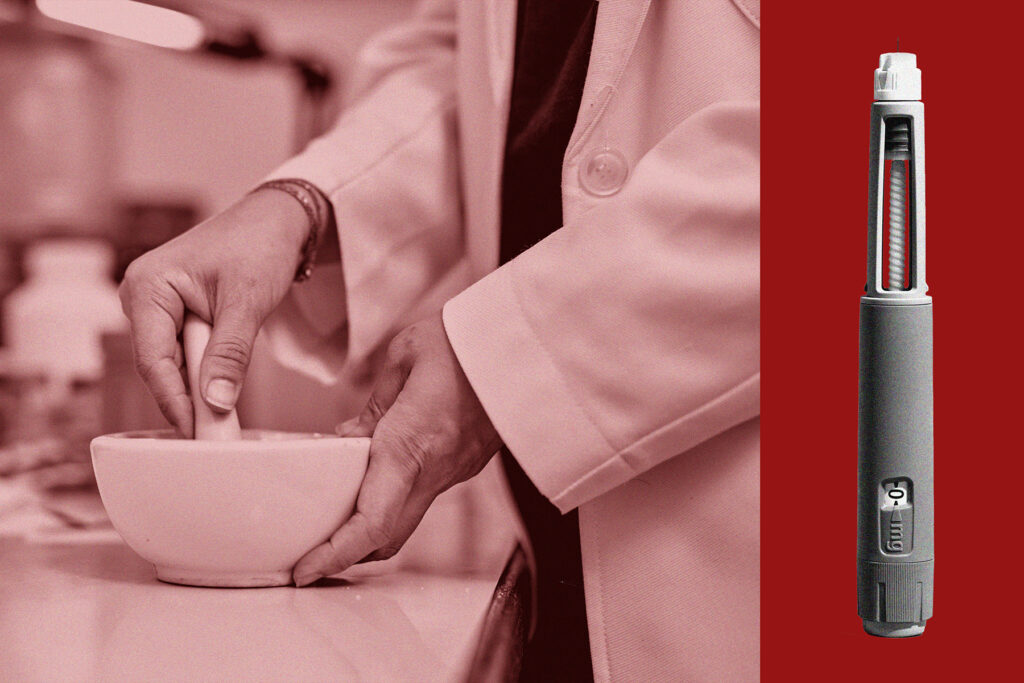
Compounding pharmacies exist to make custom formulations for patients who can’t take branded medications for medical reasons, such as a patient who is allergic to a dye in a medicine. These pharmacies were not intended, nor are they equipped, to safely mass-produce drugs such as tirzepatide.
Many of these pharmacies rely on active pharmaceutical ingredients (API) sourced from unregulated overseas suppliers. In my case, we later learned that the pharmacy obtained its API from China, where many of these ingredients are produced in facilities not registered with or inspected by the FDA.
FindMany compounders have also begun adding substances such as vitamin B12 to these drugs. In their glossy marketing, they claim B vitamins minimize side effects common to GLP-1’s. However, there is a deeper profit motive at play. The mass compounding of branded medicines is illegal, but in adding B12, these pharmacies are trying to exploit a regulatory gray area.
Though patients are frequently told of the benefits, we are not informed of the risks. That’s because the FDA has never evaluated whether compounded GLP1’s with B12 are safe or effective. Patients taking a GLP-1 mixed with B12 are thus unknowingly participating in a massive experiment, except these pharmacies aren’t required to report the effects.
Recently, Eli Lilly, which makes Zepbound, conducted its own analysis of tirzepatide mixed with B12. Its study found that when combined, the two drugs create an impurity, the consequences of which have not been studied. This raises serious concerns for patients injecting these products into their bodies. Is it safe? Is the drug still effective?
These concerns recently prompted action in my home state of Kentucky. In February, state lawmakers introduced “Jimmie’s Law,” legislation designed to strengthen oversight of drug compounding and improve safeguards in the pharmaceutical supply chain.
The bill would empower Kentucky’s Board of Pharmacy to ensure compounded medications are produced safely and in sanitary environments. Facilities that make these drugs would have to be licensed, inspected and held to higher standards.
Other states should follow Kentucky’s lead.
All patients should be able to trust that the medication they buy is what it is purported to be. And when medications — particularly injectables — are produced and sold without proper safeguards, the consequences can be catastrophic.
The FDA has taken notice. Last month, Commissioner Marty Makary announced a crackdown against companies marketing unapproved copycat weight-loss drugs.
But the fight is far from over.
The drug that nearly killed me wasn’t bought off the street, it was prescribed by a doctor and sold as a safe and legitimate medicine. Patients should never have to wonder whether their prescribed medications were mixed in a poorly regulated lab or produced with untested, unregulated ingredients.
I got a second chance. The next patient may not.
The post America’s weight-loss drug boom has a dangerous blind spot appeared first on Washington Post.