Lindsay Lieberman is an attorney in Washington, D.C.
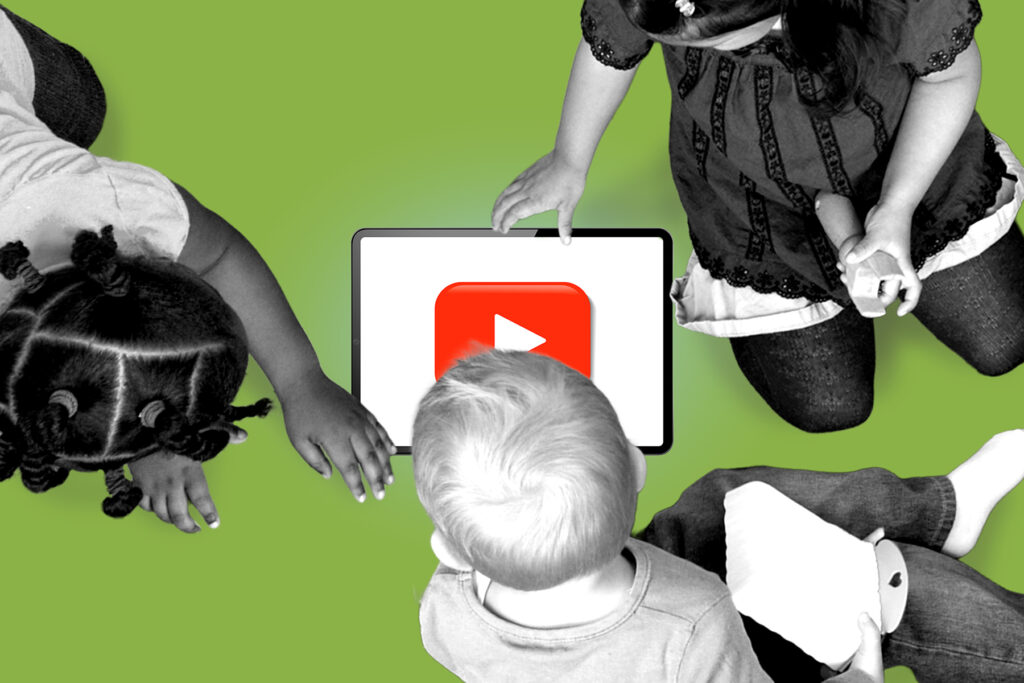
When my husband and I enrolled our daughter in kindergarten in a Washington, D.C., public school, we imagined a classroom filled with books, art supplies, building blocks and conversation. What we didn’t expect was our 5-year-old coming home reciting pharmaceutical ads from YouTube and asking to watch “KPop Demon Hunters” after seeing clips in class.
We were shocked. Why, we wondered, are internet platforms designed for entertainment and advertising making their way into D.C. Public Schools kindergarten classrooms? We’ve been asking that question since the beginning of the school year, and we’ve done some research to learn more.
In the city’s public schools, we learned, even the youngest pupils now regularly use tablets and digital learning platforms during the school day. Under the District’s Empowered Learners Initiative, kindergartners share devices at a 3-to-1 ratio, while older elementary students are issued an individual Microsoft Surface Go.
But once a screen enters the classroom, it rarely stays limited to “educational” use. The introduction of classroom devices opens the door to the broader internet, including platforms such as YouTube that were never designed for young children or for classroom use.
As parents, we are concerned that too much technology is being introduced in school too early, not only because platforms like YouTube do not belong in classrooms, but also because growing evidence suggests that screens in school may undermine the best way young children learn.
Earlier this year, neuroscientist Jared Cooney Horvath testified before the U.S. Senate that after decades of research and more than $30 billion invested in educational technology, or ed-tech, there is little evidence that routine classroom device use improves learning outcomes.
Large international studies show similar results. Data from the Organization for Economic Cooperation and Development’s Program for International Student Assessment, as well as the Trends in International Mathematics and Science Studyand the Progress in International Reading Literacy Study, show that students who spend more time using screens in class perform worse in reading, math and science. U.S. data shows that even modest daily classroom screen exposure is associated with lower reading comprehension.
This is not because teachers are doing anything wrong. It is because the tools themselves are misaligned with how children learn.
Cognitive science has long shown that young children learn best through sustained attention, repetition, conversation and hands-on engagement. Early literacy development, in particular, depends on language-rich interaction and the physical act of writing.
Research consistently finds that reading on paper leads to better comprehension and retention than reading on screens, and that taking notes or forming letters by hand strengthens memory and understanding more than typing.
Digital environments encourage the opposite: rapid task-switching, constant stimulation and shallow processing. Even when the content is identical, students are more likely to skim and retain less on a screen than on paper.
For older students, that trade-off may sometimes be manageable. For 5- and 6-year-olds learning to read, it should stop us in our tracks.
There is also a broader policy issue.
DCPS has made substantial investments in ed-tech, spending tens of millions of dollars annually on devices, software and infrastructure. These investments seemed necessary during the covid-19 pandemic. But now that classrooms are fully in-person again, is continued reliance on these tools driven by evidence or by the momentum of prior spending?
The District of Columbia spends more per student than any other city in the country. Families like ours have to wonder whether those dollars are being used in ways that genuinely support how young children learn.
As parents, we encourage DCPS to take several concrete steps:
- Prioritize screen-free instruction for literacy and numeracy in early grades, where hands-on and language-rich learning is most critical.
- Redirect a portion of EdTech spending toward instructional aids, classroom materials and experiential learning opportunities.
- Establish guardrails around digital content, including strict limits on access to platforms such as YouTube and other algorithm-driven media during the school day.
- Provide families with clear transparency about how much classroom time involves screens, what content children are exposed to, what data is collected and how it is used.
Our children will grow up in a digital world. They will learn to use technology. But first, they need to learn how to think, read, focus and connect with others.
Those skills are not built by staring at a computer screen. They are built in classrooms filled with conversation, books, movement and human interaction — the very things Americans risk losing if we continue to bring the attention economy into kindergarten class.
The post Why is my kindergartner watching ‘KPop Demon Hunters’ in school? appeared first on Washington Post.