There are many signs of President Trump’s deterioration, but on one front he has indisputably grown sharper and faster.
He’s at his peak when maligning the dead.
He used to be more shambolic about it. After John McCain’s death in August 2018, the aspersions that Trump cast on the Arizona senator were feeble and fitful, with Trump’s summary judgment — “I never was a fan” — coming more than six months later. That statement was as needless as it was tactless. Trump had made his disdain for McCain clear all the way back in 2015, when he mocked McCain’s five and a half years as a prisoner of war, suggesting that winners don’t get captured and tortured.
Trump was quicker to kick Colin Powell’s corpse. The highly decorated general and former secretary of state died in October 2021; Trump’s public condemnation of him came within about 24 hours. He memorialized Powell’s “big mistakes on Iraq,” and he accused Powell of disloyalty to fellow Republicans, which really meant a refusal to genuflect before Trump. Trump measures people not by what they’ve done for others but by what they’ve denied him. He uses the narcissist’s yardstick.
And he whacked Robert Mueller with it, rejoicing over the former F.B.I. director’s death almost simultaneously with the news of it a week ago Saturday. “Good,” Trump exulted in a social media post. “I’m glad he’s dead. He can no longer hurt innocent people!”
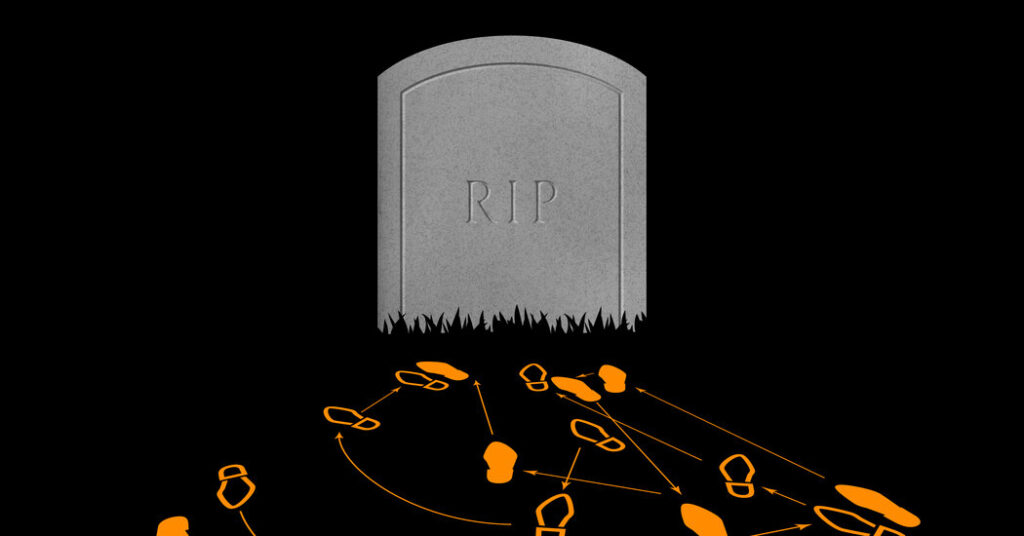
On McCain’s and Powell’s graves, Trump did a lazy waltz. On Mueller’s, a jitterbug.
And we’ve already moved on. We always do. That’s the thing about Trump’s moral grotesqueness — there’s so much of it that no one instance, no single episode, can hold our attention for long. He maxes out our memories, the new depravity quickly overwriting the old depravity on our hard drives.
But let’s not let purge his denigration of Mueller just yet. For several reasons, it warrants more than a fleeting wince.
A common thread runs through the lives of McCain, Powell and Mueller. All three were military veterans. All three saw combat. And all three received Bronze Stars and Purple Hearts for their service and injuries in Vietnam — the place that Trump avoided with a physician’s note attesting to his ostensibly debilitating bone spurs.
Is Trump shamed by their examples? He’s surely baffled by their choices. Trump wouldn’t risk a paper cut unless there was multi-million-dollar payoff on the far side of the nick. And he has privately referred to Americans killed in wars as “suckers” for having put their lives on the line, according to reports — which he has called “fake news” — by several news organizations.
It’s as if he needs desperately to feel superior to those soldiers, to cast their strength as weakness, their courage as folly, lest his own cowardice be exposed. And so he disparaged McCain, Powell and Mueller, talking smack about them even (especially?) when they could no longer talk back.
His pronounced venom for Mueller no doubt reflects his particular interest in discrediting his work as a special counsel investigating Russian interference in the 2016 presidential election. Mueller’s inquiry bedeviled Trump for much of his first term in the White House, and when, in 2019, Mueller released a report saying that he could not determine definitively that the Trump campaign had — or had not — conspired with Russia, Trump falsely claimed complete exoneration, putting the phrases “witch hunt” and “Russia hoax” in heavy rotation.
Trump’s spinning of Mueller’s report was his dress rehearsal for his rewriting of what happened on Jan. 6, 2021. It required the transformation of Mueller from earnest public servant to vengeful monster, and Trump was hardly going to abandon or halt that project upon Mueller’s death.
It’s always about Trump, it’s all about Trump and his rants about the recently departed are hardly confined to those in government. In December, after the beloved movie director Rob Reiner and his wife were fatally stabbed in their Los Angeles home, Trump attributed their deaths to their political opposition to him. He wrote in a social media post that Reiner perished “due to the anger he caused others through his massive, unyielding, and incurable affliction with a mind crippling disease known as TRUMP DERANGEMENT SYNDROME.” It was appalling. And it was quickly forgotten.
That’s why I’m revisiting it. That’s why I’m mentioning Mueller. Trump wants us to become inured to his offenses because that inoculates him from any consequences. He wants to degrade us — he wants to degrade everything — because he’s a more fitting ruler with freer rein if his kingdom has been leeched of all decency.
He’s a hypocrite, of course, as are the lickspittles around him. After Charlie Kirk’s death, they freaked out about any stray whisper of the uglier parts of Kirk’s legacy — it was untimely, unseemly, cruel — but they shrug at Trump’s sadism. They ignore his souring of Kirk’s memorial itself, where Trump said flippantly that he hates his enemies. All of that they recast as boldness. Or they claim that it’s harmless: It’s just Trump being Trump. It’s a presidential perk, like winged swag from Qatar, a tacky ballroom and incompetent underlings.
No. It’s more than that, and it’s worse than that. It’s a retreat from empathy, generosity, kindness. And it’s telling. The way we respond to death says everything about who we are. If we can’t extend the dead a bit of grace, it’s because we’re graceless.
Forward this newsletter to friends …
… and they can sign up for themselves here. It’s published every Monday.
For the Love of Sentences
The newsletter’s two-week break created a backlog of terrific sentences to showcase, so I’ll let this section go on longer than usual to accommodate as many as possible.
In The Atlantic, Gilad Edelman confronted his nocturnal rattle: “Regular snoring becomes more likely as you age. For me, the condition seems to have emerged about five years ago, in my early 30s, although it’s hard to pinpoint the precise beginning because I was asleep for it.” (Thanks to David Hyman of Jupiter, Fla., for nominating this.)
In The Guardian, Sarah Dempster scoffed at the simplistic wicked-city-versus-wholesome-country vision of the new show “The Madison,” about the Clyburn family. “As we suffer yet another aerial shot of the Clyburns clomping Hobbit-like through swaying fields of gold, the penny drops: Montana is The Shire,” she wrote. “N.Y.C., of course, is Mordor. ‘When was the last time you saw a sunset?’ Stacy asks her huffy, screen-addicted granddaughters. ‘Can’t remember? No, me neither.’ Well, obviously you can’t, because Manhattan doesn’t have sunsets; it has the Eye of Sauron, glowering over everyone’s avocado starters.” (Rasma Haidri, Askoy, Norway)
In The Boston Globe, Christopher Muther squawked at all the feathers in Demi Moore’s Oscar gown: “It appeared that a murder of crows had crash landed in her décolletage and then tried to escape at the hem.” (Susan Ashbrook, Boston)
In The New Yorker, John Seabrook noted that while the cockapoo is one of the modern dog world’s seemingly infinite poodle mixes — in its case, poodle plus cocker spaniel — it eschewed the usual suffix: “Cockadoodle was apparently a bit too on the noodle.” (Jim Fagin, Manhattan)
In The Times, Alexandra Jacobs experienced Liza Minnelli’s new memoir, “Kids, Wait Till You Hear This!,” as somewhat less than stimulating: “It’s Liza with a zzz.” (Louise Klein, Landenberg, Pa.)
In a separate review of a new book by Luke Barr, Alexandra fused fiction and food: “ ‘The Secret History of French Cooking’ is an enticing title, conjuring both Donna Tartt and apple tart.” (Jenny Bowser, Braintree, Mass., and Steve Fischer, Cambridge, Mass.)
Also in The Times, Helen Shaw spotted a surge of Sophocles in the theater: “In the first few months of 2026, Antigone is visiting New York four times, in four different stage adaptations. (Her omnipresence is like a rush of white blood cells — there’s an infection somewhere in the body politic.)” (Patrick Henry, Waite Park, Minn.)
Kwame Anthony Appiah pondered a poignant role reversal: “One of the ordinary sorrows of life is to watch a parent, in whose arms we were once so small, grow smaller in ours.” (Jane Kulow, Charlottesville, Va.)
And Robin George Andrews, with clever understatement, connected a meteorite’s destruction of a German abode’s roof to a larger pattern: “The newly aerated house in Koblenz is the latest building to fall victim to one of these rocky vandals from beyond.” (MaryAlice Cowan, Houston)
OK. I could hold off on Trump for only so long.
In The Guardian, Marina Hyde responded to Trump’s complaint that Keir Starmer was no Winston Churchill: “Boohoo for you, pal. We’re having to deal with the Cheeto F.D.R., so everyone’s making sacrifices.” (Elena Rozbicka, Warsaw)
In The Financial Times, Ivan Krastev noted Trump’s apparent inability to think long-term: “He’s like a director who does not shoot films but only trailers for movies that will never be made.” (Nick van Praag, Vienna)
In The Economist, James Bennet fashioned a musical metaphor for Trump’s shortsightedness: “This is a president who was willing to commit America to war like a jazz musician settling down at a piano, confident he would find the right keys at the right moments.” (Marsha Perelman, Philadelphia)
Also in The Economist, a recent article mulled a mathematical oddity: “Although president Donald Trump says he has ‘destroyed 100 percent of Iran’s military capability,’ the 0 percent that remains is playing havoc with the global economy.” (Alan Stamm, Birmingham, Mich., and Paul Rodger, Calgary)
In his newsletter, Moral Clarity, Andrew Weinstein sounded an alarm over the Trump administration’s marginalization of a crucial class of experts: “Career diplomats are not ornamental. They are the institutional memory of American statecraft — the people who negotiate cease-fires, secure the release of political prisoners, and build coalitions that kept our troops out of wars. They are the ones who can tell the difference between a miscommunication and a mobilization. When you remove them, you are not trimming fat. You are severing nerves.” (Chester Gittleman, Roslyn, N.Y.)
In The New York Times, Phil Klay chronicled our commander in chief’s ludicrous euphemisms, such as “little excursion,” for war: “In President Trump’s America, there may be only two genders, but our military adventures can identify however they please.” (David Schulz, San Francisco, and Jocelyn Olcott, Durham, N.C., among many, many others)
And Carlos Lozada charted America’s pivot under Trump, from trying to spread freedom and nurture stability to playing the bully and looking for booty. “In place of the Pax Americana we are seeing a sort of Lax Americana,” he wrote, later adding: “If Pax Americana meant fostering an enduring American peace, Lax Americana means America getting a piece of the action. The world’s policeman is on the take.” (Chip Hitchcock, Watertown, Mass., and Sarah Towle, Missoula, Mont., among others)
To nominate favorite bits of recent writing from The Times or other publications to be mentioned in “For the Love of Sentences,” please email me here and include your name and place of residence.
What I’m Reading, Doing and Listening To
-
It’s a mystery to me how books that were conversation starters years ago belatedly catch my notice and jump to the head of the line, but that just happened with “Fates and Furies,” a 2015 novel by Lauren Groff. It’s the story of a marriage, told first from the husband’s and then from the wife’s point of view, and it’s streaked with allusions to Shakespeare and Greek mythology. It’s also polarizing, which I guessed as I read it and then confirmed, midway through the book, with a glance at the reviews of it on Goodreads. Yowza. Its many impassioned detractors deem it pretentious and self-indulgent. I can see why. But Groff has an extraordinary talent for capturing her characters’ streams of consciousness, which are mesmerizing rivers indeed. And few books have left me so delighted by their author’s sorcery with the English language. Groff’s metaphors are often brilliantly fashioned. She rummages cunningly through a boundless vocabulary for the perfect words. And she can turn “a sentence into a small hurricane,” as Janet Maslin wrote in her review of “Fates and Furies” in The Times. I was swept up by the winds.
-
If you happen to be near Elon, N.C., on April 9, I’ll be speaking at Elon University about the country’s political divisions and dysfunction — and where I see signs of hope. There’s more information here.
-
I was checking out a recent episode of The Bulwark Podcast, hosted by my friend Tim Miller, when I happened to click on “Tim’s playlist” and was delighted to find prominent mention of the song “Fake Empire,” by The National. A subsequent text exchange with Tim confirmed that he, like me, is a big fan of that band. “Fake Empire” is among my favorites of theirs, up there with the similarly lovely “I Need My Girl” and the rollicking riddle of “Bloodbuzz Ohio,” on which the lead singer Matt Berninger’s brooding baritone is especially rich and deep.
On a Personal Note
I never fully trust that they’ll come back — not the lilac blossoms on the tulip magnolia beside my driveway, not the pink and red flowers on the camellias near them, not the puffs of white on my weeping cherry, not the confetti of deep purple high on a redbud in the back yard. Maybe a change in weather patterns will queer their usual cycle. Perhaps one or more of them has spent its glory: Plants, like people, eventually fade away.
But a few weeks ago, slightly ahead of schedule, those colors returned. And they meant more to me than they usually do. I needed spring. Needed its beauty. Needed the reassurance that for all that goes wrong in this ravaged world of ours, nature stands ready to nurture us and to dazzle us — if we let it.
On television just then there were other hues: the orange of flames shooting up from the streets of Tehran and Beirut; the gray and black of clouds of smoke rising high and spreading wide. Those didn’t mark a natural change in seasons. They signified death.
I won’t use this space and this moment to weigh in on whether that killing is warranted or on the likelihood that its benefits will outweigh its costs. I’ve shared some of my thoughts about that in several of my exchanges with Bret Stephens in the Times Opinion feature The Conversation, including the most recent one, the edition before it and the edition before that.
Here and now I want only to make a specific observation, about a consequence of the missiles and the mayhem that’s too seldom mentioned. While the most harrowing casualties are the human beings slain, maimed, displaced from homes and exiled from communities reduced to rubble and ash, there is also the destruction of other kinds of habitats, other forms of life. There is scalded land. Sullied water. Contaminated resources. Toxins that will linger long after the last blast.
Those who wage war often say they do so in the service of future flourishing. Sometimes that’s honest. Sometimes that’s even wise. But it doesn’t expunge the present sorrow. War turns gardens into graveyards. It stamps out nature’s gifts. Here’s a prayer that peace — whenever and however it comes — brings fresh growth and a kaleidoscope of beauty.
The post Trump Will Gladly Do the Jitterbug on Your Grave appeared first on New York Times.