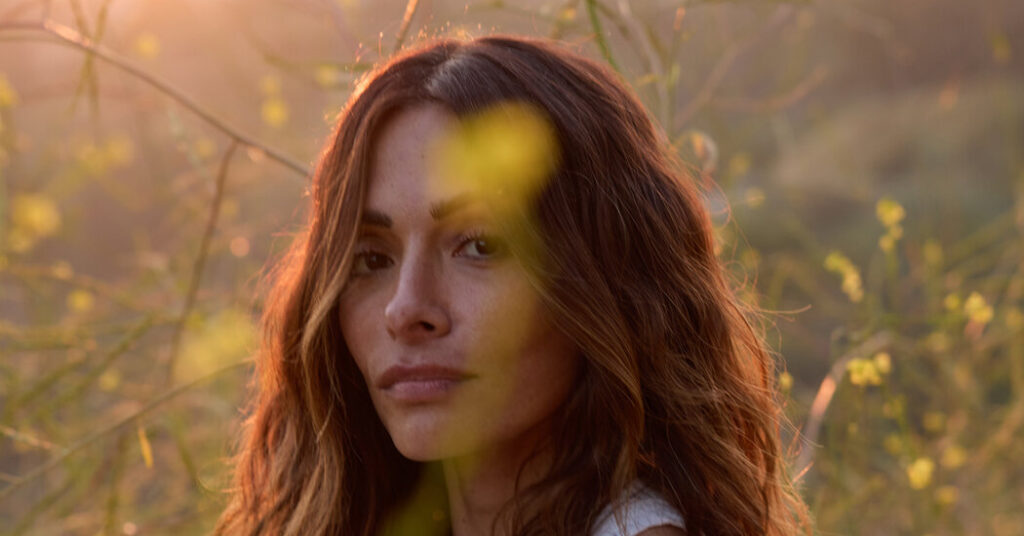
Sarah Shahi has done a lot of therapy.
There was the therapy she sought in her early 20s to unpack childhood trauma; the advice she doled out to tipsy strangers at Hollywood parties in her 30s; the counseling that accompanied her divorce at 40; the guidance she offers in her new self-help memoir, “Life Is Lifey,” released in January.
And there is the wisdom she dispenses as Gabriela Torabi, a psychologist riding out the end of the world in a billionaire-funded bunker, on “Paradise.”
Inhabiting Torabi on the Hulu drama, which wraps up its second season on Monday, felt like “a natural thing that was in my skin from being in therapy for 20 years,” Shahi said. “I do get therapists who will write to me and say, ‘You are so believable.’”
When we met earlier this month for coffee on Ventura Boulevard, not far from Shahi’s home in Sherman Oaks, she was off duty: glasses, light makeup, baggy pants and an oversized Eazy-E graphic T-shirt. She has “Selvaggia,” an Italian word for “wild,” tattooed on her upper arm and wore a beaded bracelet that spelled “Mom” on her wrist.
Her children call her casual style “gas station fashion,” she said. But even in her stripped-down state, she had an effortless aura.
As we waited for our drinks, the actress, 46, peppered me with queries about my life and offered unsolicited tips on her favorite San Fernando Valley spots, including an exuberant review of a nearby outdoor mall. “You have to go there when you leave this interview,” she said.
That’s typical, said Sterling K. Brown, her “Paradise” co-star.
“There is a sincere desire to see joy in the world around her,” he said in a video interview. “Not just her own joy, but to unlock that joy in the people that she comes in contact with.”
Born Aahoo Jahansouzshahi in the suburbs of Fort Worth, Texas, Shahi changed her Persian first name in second grade after being relentlessly bullied. Longing to fit in, she considered going by Vicki, like the robot in the ’80s syndicated sitcom “Small Wonder,” but her mother wasn’t convinced. Then one day Shahi heard the song “Sara” by Jefferson Starship on the radio.
“I was like, I’ll take it, bingo,” she said, between sips of an iced coconut latte. “It could have been ‘Come On Eileen,’ and I would have been Eileen Shahi.”
Shahi’s parents fled Iran in the late 1970s during that country’s revolution. In Tehran, her father worked in the U.S. Embassy and had been targeted by the new government, Shahi said. Her mother had watched her best friend die after being shot at a protest.
Shahi still has family in Iran. “It’s really tragic what’s happening over there,” she said, adding, “I just want things to change from a humanitarian standpoint. No one deserves to be living like that.”
Shahi’s parents sought stability in Texas. Her father found work as a taxi driver, and her mother opened an interior design business — she practiced her English by watching episodes of “All My Children.”
But Shahi’s father, who died when she was 35, was abusive and an addict, she said. When she was around 5 or 6, he held a gun to her head while he was high. “Even now, I can feel it,” she said, closing her eyes and pressing her temple.
The incident spurred her mother to get Shahi out of the house, and they lived intermittently in women’s shelters, she said. Her mother divorced her father when Shahi was 10. (Shahi also has a brother and sister.)
“She’s always been such a warrior,” Shahi said about her mother, “and instilled in me from a very young age, ‘You better stand on your own two feet.’”
During those turbulent years, Shahi took solace in Nancy Drew books and Julia Roberts movies. She spent her teens performing in show choir and competing in pageants. At Southern Methodist University, she studied English with a plan to be a broadcast journalist — a career that seemed more feasible than her dream of becoming an actress.
During her freshman year, a theater pal suggested Shahi try out for the Dallas Cowboys cheerleaders to get more performance experience. She auditioned and made the cut, despite never having cheered or danced beyond a lone hip-hop class as a child. “When they say ‘ignorance is bliss,’ I was the living definition of it,” she said.
In 1999, the Robert Altman-directed romantic comedy “Dr. T & the Women” shot in Dallas and used the actual cheerleaders in scenes with Kate Hudson, who played a Cowboys cheerleader in the film. On set, Shahi “formed this really beautiful little friendship” with Altman, she said, and when he learned she wanted to be an actress, he encouraged her to move to Los Angeles. A few months after the film wrapped, she quit cheerleading and moved into a tiny apartment near the Hollywood Walk of Fame.
Roles came quickly. They included guest parts on network shows like “Alias,” “Frasier,” “ER” and “Supernatural,” and a memorable episode of “The Sopranos,” in which Shahi played a Las Vegas stripper who has a peyote-fueled fling with Tony Soprano. Bigger parts followed on series including “The L Word,” “Fairly Legal,” “Person of Interest” and “Chicago Fire.”
Her breakout lead role came in a show that grew entangled with her personal life. In 2020, Shahi signed on to star in “Sex/Life,” an erotic Netflix series about a woman named Billie who is in a stable marriage but can’t stop dreaming about an ex-boyfriend and the alternate life she might have had.
After the show’s production paused during the Covid-19 pandemic, Shahi found her life imitating her art. She had married the actor Steve Howey (“Shameless”) in 2009, and they had three children together. But after years of quiet frustration, Shahi concluded that “I need to be courageous and go after the life I want.”
“I think it’s a success to be with somebody for 18 years,” she added. “I think it’s equally courageous when two people have the guts to say, ‘I love you, but this isn’t serving either of us.’”
She filed for divorce in May 2020 and, when filming resumed, Shahi eventually began dating her co-star, Adam Demos, who played the man Billie lusts over. (There was no overlap between the romances, Shahi has said, and she and Demos have since broken up.)
“Working with her was like working with a raw nerve,” said Jessika Borsiczky, a “Sex/Life” executive producer. “She was accessing all of these extremes that the character went through very deeply.”
“Sex/Life” ran for two seasons. While it wasn’t a critical hit, Shahi heard from female viewers who saw themselves in Billie — and in Shahi’s personal journey.
“I kind of became the poster child for unhappily married women,” Shahi said. Realizing others took solace in her liberation is partly what made her want to write a book, she said, which is designed to give women a road map to prioritize themselves.
Her current part on “Paradise” is less relationship focused. (Although her character did share a steamy shower scene with Brown’s in Season 1.)
In Season 2 of the twisty series, Torabi toughens up as she confronts the tech billionaire known as Sinatra (Julianne Nicholson) and goes head-to-head with a rogue Secret Service agent (Nicole Brydon Bloom). In the coming third season, currently in production, Shahi hopes to explore Torabi’s “darker side.”
“I’m attracted to playing messy people,” she said. “I’m like, ‘OK, so when does she kill Sinatra and take over the bunker?’”
When the cameras aren’t rolling, the actress is more straightforward. “She’s the most open book you can ask for,” Brown said. “A day with Aahoo is always a good day on set.”
Shahi will next appear as the deputy chief of staff to the president in the sequel to the romantic comedy “Red, White & Royal Blue,” and her dream projects include starring in an opera and a western. But she’s not stressed about the future.
“Some of the most impactful, most successful moments of my life happened when I wasn’t trying,” she said.
A Roberts-esque smile spread across her face as her inner therapist came out. “If you just have the courage to get to the other side of fear,” she said, “life is rewarding.”
The post Sarah Shahi Plays a Therapist on ‘Paradise’ and Nearly Everywhere Else appeared first on New York Times.