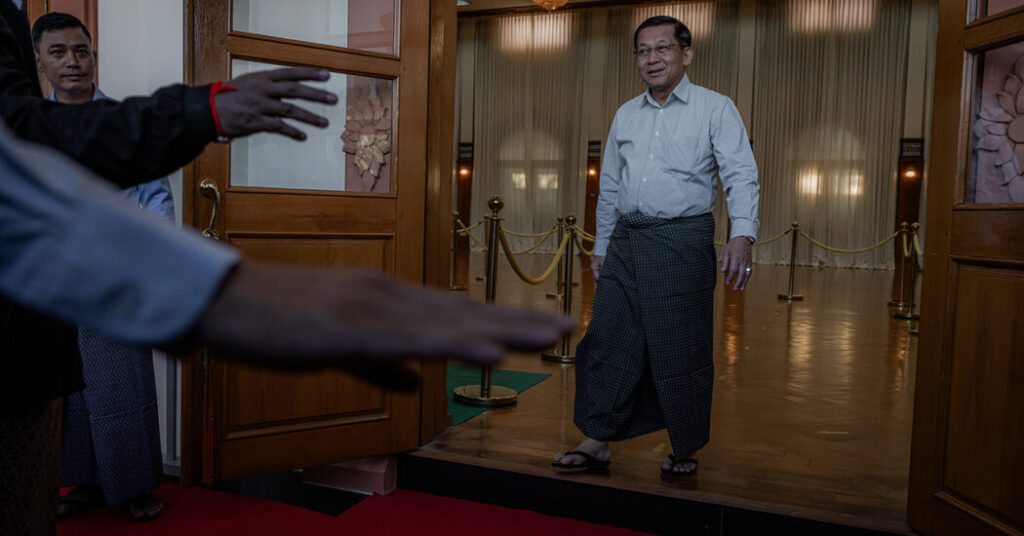
Myanmar’s military ruler, Senior Gen. Min Aung Hlaing, stepped down Monday as commander in chief and was put on the path moments later to become the next president of the war-torn country.
The moves are part of a well-orchestrated plan that will allow the career officer, who is 69 and widely reviled in Myanmar, to become its next civilian leader, taking the place of the Nobel Peace laureate Daw Aung San Suu Kyi, whom he ousted in a coup five years ago. She remains imprisoned in an unknown location.
The former general was one of three people nominated to become vice presidents. One of them — almost certainly Mr. Min Aung Hlaing — will be chosen president and the other two will become vice presidents when Parliament convenes for a final vote next month.
It is widely believed that he has coveted the presidency for many years.
To become president, he was compelled to give up the post of commander in chief because the country’s military-drafted Constitution requires that the positions of president and commander in chief be held by different people. The Constitution allows the army to select its own leader, guaranteeing that the military does not come under civilian control.
The new commander in chief will be Gen. Ye Win Oo, 60, the junta said. He is a loyal ally of his predecessor and oversaw the notorious interrogation centers where thousands of political prisoners have been tortured since the coup, said U Naung Yoe, a former army major who defected after the coup and now helps other defectors.
“Now that Min Aung Hlaing will be president and Ye Win Oo is commander in chief, it seems that the two of them together will continue to destroy the country,” he said. “There is nothing good to expect for the country, only worsening conditions lie ahead.”
Myanmar has been ruled by the military for the past six decades, except for a brief period of democratization that ended with the Feb. 1, 2021, coup.
In a speech Friday at Myanmar’s annual Armed Forces Day celebration, the general claimed that the military, known as the Tatmadaw, is the protector of the nation.
“I solemnly affirm that the Tatmadaw has faithfully discharged its sacred duties, unfailingly upholding the welfare of the nation and its people above all considerations throughout successive epochs,” he said.
However, in 15 years as military chief, he was ruthless in suppressing the civilian population, including leading what is widely considered a genocide against the minority Muslim Rohingya people, staging a coup against the elected civilian government, killing unarmed protesters and bombing civilians with fighter jets.
The country has been embroiled in civil war for the past five years as a loose alliance of armed pro-democracy rebels and ethnic groups fight to overthrow the military. The military retains control of the major cities, where residents have largely escaped the violence but face high inflation, shortages, power blackouts and joblessness.
In recent developments:
-
Although Myanmar also faces aviation fuel shortages because of the Iran war, the military has continued bombing targets in civilian areas. In one of its deadliest airstrikes, it also bombed a prison camp in Rakhine State on March 12, killing 116 captured junta soldiers, according to Khaing Thu Kha, a spokesman for the rebel Arakan Army.
-
The United Nations World Food Program said Friday that victims of the devastating earthquake that struck Myanmar a year ago Saturday are also facing greater food shortages because of the Iran war. “Half of all families remain only marginally food secure — surviving day to day and unable to absorb even the smallest shock,” the agency said.
-
The nonprofit group Justice for Myanmar urged Thailand last week to investigate the purchase of a $3 million luxury property in the name of Mr. Min Aung Hlaing’s daughter-in-law. The group charged that the money came from corrupt sources and the purchase was an attempt to circumvent international sanctions against the general.
Over the years, Mr. Min Aung Hlaing has given himself many titles, including acting president and Great Hero of the Union of Myanmar.
Seeking legitimacy, the junta held elections in December and January, but they were neither free nor fair. Opposition parties were banned, their leaders were imprisoned and voting was conducted only in military-held areas. Not surprisingly, the military holds an overwhelming majority of seats in the new parliament. This month’s parliamentary sessions are the first in more than five years.
The post Myanmar’s Military Leader Moves One Step Closer to Becoming President appeared first on New York Times.