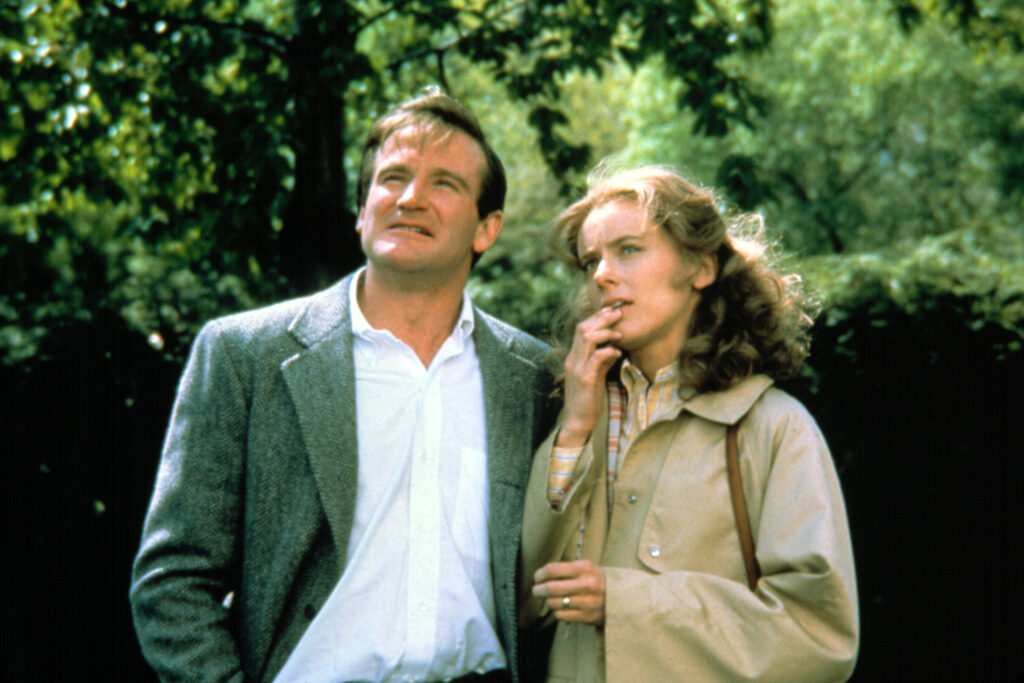
Mary Beth Hurt, a stage and screen actress whose expansive range included Tony-nominated starring roles as a headstrong New York theater actor, a bourbon-swilling Southerner and an awkward British housewife, died March 28. She was 79.
The cause was Alzheimer’s disease, said her daughter, Molly Schrader. Ms. Hurt had moved into a Manhattan assisted-living center in January 2023.
Appearing in more than 30 movies and a dozen Broadway plays, Ms. Hurt demonstrated a capacity to surprise audiences with her versatility and nuance. She conveyed a character’s inner life with just a single gesture or action, whether by delivering a musical laugh as an auburn-haired coquette in Molière’s “The Misanthrope,” revived at Circle in the Square Theatre in 1983, or dejectedly wiping a wineglass ring off a table as an alcoholic mother in Andrew Bovell’s “When the Rain Stops Falling,” which ran at Lincoln Center in 2010.
On-screen, she was perhaps best known for her roles in the Woody Allen drama “Interiors” (1978), as an aspiring writer and the glum younger sister of Diane Keaton, and “The World According to Garp”(1982), as a college professor unfaithfully married to Robin Williams.
Ms. Hurt had a “remarkable ability to change her looks almost as easily as other actors change their expressions from a smile to a smirk,” New York Times film critic Vincent Canby wrote in 1981. “She’s a complete sort of a actress, the kind that movies can well use.”
While her first husband, Oscar-winning actor William Hurt, found stardom as a Hollywood leading man, Ms. Hurt’s film career was largely limited to supporting roles. Not that she cared: There were more interesting parts on the stage, she said, and she was busy enough raising two children with her second husband, filmmaker Paul Schrader, who directed her in “Light Sleeper”(1992), “Affliction” (1997) and “The Walker”(2007).
“I’m not very ambitious,” she told the Times in 1986. “I probably could have a more successful career if I would actively campaign for it.” Plus, she added, “I’m not striking or beautiful. I’m small, I have a voice that sounds like a child’s and I don’t look great in a bikini — and all of these things play a part.”
To colleagues and collaborators, however, Ms. Hurt was among the finest actors of her generation. Glenn Close, who arrived on Broadway as Ms. Hurt’s understudy, often cited her as an inspiration, and David Hare, who directed her in his play “The Secret Rapture,” hailed what he described as her “sort of improvisatory gift, a willingness to make the performance fresh every time.”
Ms. Hurt demonstrated her range from the very start of her New York stage career, appearing in two very different off-Broadway roles in 1973: as Celia, the heroine’s witty cousin in “As You Like It,” and Uncle Remus, a G.I.-murdering 98-year-old in “More Than You Deserve,” a musical comedy set during the Vietnam War.
That part was “so off-the-wall,” she told the Times, “that people said, if she can do that, she can do anything.”
Ms. Hurt went on to play a succession of beguiling, independent-minded young women, including Marina in “Pericles, Prince of Tyre” and Anya in “The Cherry Orchard.” She received her first Tony nomination in 1976, as the title character in a New York Shakespeare Festival production of “Trelawny of the ‘Wells,’” which transposed the 19th-century backstage comedy to turn-of-the-20th-century New York.
Five years later, she received her second Tony nomination for her featured role in Beth Henley’s “Crimes of the Heart,” a black comedy that won the Pulitzer Prize for drama and ran for 535 performances. She was nominated again for another hit, Michael Frayn’s “Benefactors” (1985), in which she starred as a former nurse, Sheila, unhappily married to a London journalist.
“The obvious way of doing Sheila is to go for the character’s vulnerability,” Frayn told the Times. “But Mary Beth makes Sheila quite resilient — she makes her a relatively cheerful and capable character. She doesn’t come on as pathetic. It’s an ingenious and absolutely astonishing performance.”
It was also a stark departure from the performance Ms. Hurt gave in “Crimes of the Heart,” when she donned heels, a miniskirt and a red wig to play Meg Magrath, a vivacious would-be singer — played by Jessica Lange in a 1986 movie adaptation — who returns to her dysfunctional family’s home in Mississippi.
Audiences were shocked by her transformation for the part, as were friends who knew her well. According to Ms. Hurt, it took 10 minutes for George Roy Hill, her director in “Garp,” to recognize her onstage.
Yet the character “was a lot of me in high school,” Ms. Hurt told the Times, recalling the “sense of rebellion” she had felt while dreaming of escape from her small Midwestern hometown.
“It’s very strange to be from Marshalltown, Iowa, and say you want to be an actress,” she continued. “You know you’ll be laughed out of town by your contemporaries, so I didn’t say it for a long time.
“But I sensed a need to branch out in Meg, which at first made her do mischievous things and later destructive things. I knew that feeling well — except that I was lucky, I got to leave.”
Inspired by Jean Seberg
Mary Beth Supinger (her first name is sometimes styled as one word, Marybeth) was born in Marshalltown on Sept. 26, 1946.
Her father was a packaging engineer for Maytag, and her mother was a homemaker, “a very anxious woman with a razor-edge nervous system,” according to Ms. Hurt. Some of her mother’s mannerisms, including a habit of keeping wadded-up tissues in her pocket, later found their way into Ms. Hurt’s performance in “Benefactors.”
When Ms. Hurt was 10, she was shocked to see her former babysitter star in a Hollywood movie. It was Jean Seberg, a fellow Marshalltown native, who had been cast in “Saint Joan” after a national talent search.
The film, and Seberg’s subsequent success in Hollywood and overseas, helped inspire Ms. Hurt to try acting herself, although she said that Seberg’s death in 1979 — deemed a probable suicide — had “a subliminal effect” on her career, increasing her anxieties around stardom and fame. (She later played Seberg in a 1995 docudrama, “From the Journals of Jean Seberg.”)
Ms. Hurt studied communication and theater arts at the University of Iowa, received a bachelor’s degree in 1968, and continued her acting studies at New York University. In 1971, she married William Hurt. They separated near the end of the decade and divorced in 1982.
“Sometimes you love a man in spite of [his] neurosis, sometimes because of it — and with Bill, it was the latter,” she told the New York Daily News. “He’s an extremely tortured man, but a very nice one, and he never beat me.” (Hurt was accused of domestic violence by several former partners, including actress Marlee Matlin. He died in 2022.)
After making her film debut in “Interiors,” Ms. Hurt landed a rare starring role in director Joan Micklin Silver’s melancholy “Chilly Scenes of Winter” (1979), as a married woman whose ex-lover (John Heard) is obsessed with winning her back.
The film, based on an Ann Beattie novel, bombed, and producers angrily noted that the studio had changed the title to “Head Over Heels” and marketed the movie as an upbeat romantic comedy. It received a warmer reception when it was rereleased three years later with its original title and a different ending.
Ms. Hurt also appeared in M. Night Shyamalan’s “Lady in the Water” (2006) and in two films by Martin Scorsese, “The Age of Innocence” (1993) and “Bringing Out the Dead” (1999). Both were written by Schrader, the screenwriter for Scorsese’s “Taxi Driver,” who said he was battling a cocaine addiction and had “self-immolated,” setting his life on fire with help from an incendiary combination of drugs, alcohol and failed relationships, when he met Ms. Hurt in 1982.
“Mary Beth saved me,” he told the New Yorker in 2023. They married in 1983, and Schrader said that his suicidal tendencies went away after they had children, Molly and Sam.
The family lived in Europe, Napa and New York, where Ms. Hurt last performed on Broadway in a 2011 revival of “The House of Blue Leaves.” When his wife’s memory worsened with Alzheimer’s, Schrader built her a greenhouse outside their lakeside home in the Hudson Valley, allowing her to stay active in the winter and remain close to flowers, tomatoes, soil, which brought back memories of childhood.
He survives her, along with their children. Additional details on survivors were not immediately available.
In looking for parts, Ms. Hurt said that she sought to find characters who seemed alive on the page, with temperaments and motivations that, for better or worse, were recognizably human.
“You have to believe in a character, and believe that you can do that character better than anybody else,” she told the Times in 1981, before her second marriage. “One thing an actor has to have is confidence. I’m not that confident in my life. Life is much more difficult for me than work. But as an actress, I know who I am.”
The post Mary Beth Hurt, versatile actress nominated for three Tonys, dies at 79 appeared first on Washington Post.