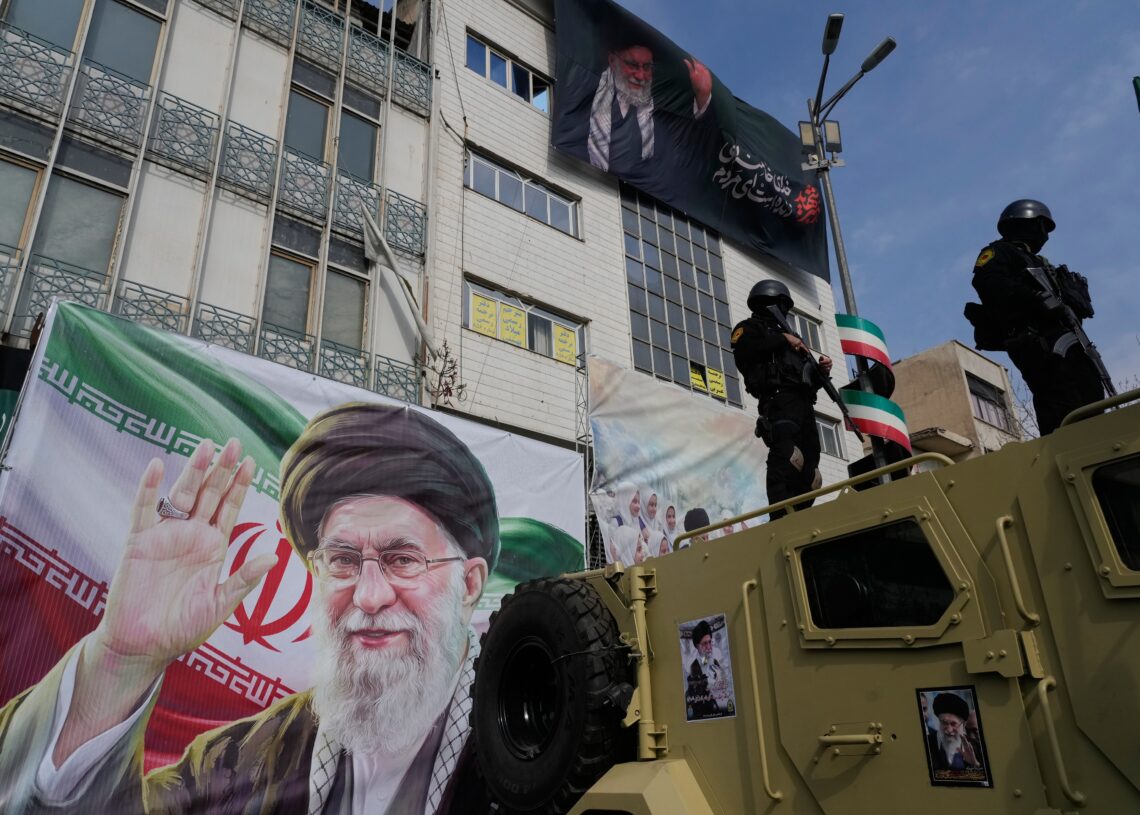
TEL AVIV — As U.S. and Israeli military commanders met to map out war with Iran, they deliberated over how to divide responsibility for an array of targets, including missile batteries, military bases and nuclear sites.
It was clear from the outset, however, that one grim mission would belong to Israel: hunting and killing Iran’s leaders.
Israel has pursued this assignment with ruthless efficiency, killing Iran’s supreme leader in the opening salvo of the war and more than 250 other “senior Iranian officials” since, according to a count maintained by the Israeli military. The latest blow came Thursday when Israel said it had killed the naval commander of Iran’s Islamic Revolutionary Guard Corps.
The decapitation campaign relies on an assassination apparatus that Israel spent decades building but transformed over the past several years to achieve new levels of lethal proficiency, according to senior Israeli military and intelligence officials.
The officials cited a proliferation of sources and surveillance capabilities inside Iran — regime insiders recruited to spy for Israel as well as cyber-penetrations of thousands of targets including street cameras, payment platforms and internet choke points that Iran installed to impose communications blackouts on its citizens. These and other streams of data are being scoured by what Israeli officials described as a new, classified artificial intelligence platform programmed to extract clues to leaders’ lives and movements.
Israel’s targeted killing tactics — bombs planted months before being detonated, drones capable of slipping into apartment windows and supersonic missiles fired from stealth fighter jets — have been honed by years of conflict in Gaza, Lebanon and Iran.
Asked why the mission of targeting Iran’s leaders was assigned to Israel, a senior Israeli security official cited its experience and expertise, saying: “There was a need to target them. And we could do it.”
Less clear, however, is whether the ongoing decapitation campaign will enable Israel to achieve its core war objectives: eradicating the threat of Iran’s missiles and proxy forces, blocking its path to a nuclear weapon, and weakening the regime to the point that it could be toppled.
So far, those goals seem elusive. Those killed often have been replaced by more militant subordinates, and street protests have failed to materialize amid continued U.S.-Israeli bombing and fears of a regime crackdown.
Senior Israeli officials described the regime in Iran as battered but resilient, stable and feeling triumphant after withstanding a month of strikes by two of the world’s most powerful militaries.
This article was based on interviews with senior security officials who spoke on the condition of anonymity to discuss sensitive intelligence and operations.
Some experts worry that Israel’s growing proficiency at targeted killings, even when conducted with precision, is creating a dynamic of dependency on assassinations and a tendency to expand the boundaries of who can be targeted.
“We have taken it too far in terms of making it into a strategy as opposed to an occasional operational necessity,” said Ariel Levite, a nuclear policy and Israeli security expert at the Carnegie Endowment for International Peace.
The divisions of labor in the current conflict create the impression that “the United States has relied on Israel to do the dirty jobs in the war,” Levite said, with the United States seeming to adopt a stance of “we can’t kill them, but we’ll be more than happy if you do.”
A U.S. official familiar with operations of the campaign said that Israel’s responsibility for leadership strikes reflects an arrangement in which “we’re working together but we have our own objectives.” U.S. officials said the division of duties reflects each side’s capabilities and not any legal impediments. The United States previously has carried out targeted killings of its own, including the 2020 assassination of Iran’s Quds Force commander Qasem Soleimani.
President Donald Trump has cast the strikes on Iran’s leaders as a joint undertaking. “We killed all their leadership, and then they met to choose new leaders and we killed all of them,” Trump said to reporters last week. He went on to assert that the objective of regime change had been met because “the leaders are all very different than the ones we started off with.”
Israel has accomplished that turnover at a staggering pace, starting with the Feb. 28 attack that killed Ayatollah Ali Khamenei, ending his 27-year reign as Iran’s supreme leader, as well as the head of Iran’s defense council, the commander of the IRGC, the leader of the country’s armed forces, the minister of defense and at least a dozen other senior lieutenants.
The strike has been depicted as the result of a singular intelligence breakthrough. In reality, Israeli officials said that the country’s intelligence services had been monitoring gatherings of the “Group of Five,” a term for Khamenei and his closest advisers, for much of the past year.
“Almost every week they gathered,” an Israeli security official said. “Sometimes in different locations. Sometimes in more secure settings. Sometimes less.” The intelligence was considered so reliable that the possibility of striking the group was raised before the 12-day war against Iran in June, officials said, but set aside because of a U.S.-Israeli agreement that Iran’s nuclear program remain the priority.
Khamenei was among family members in an aboveground floor of his residence when he was killed, Israeli officials said. His son, Mojtaba, since anointed to succeed his father, was also at the compound and was badly injured but survived in part because he had ventured into an adjoining garden, officials said.
The younger Khamenei, whose wife and daughter were reportedly killed in the strike, has had a limited leadership role since his father’s death. “He makes decisions from time to time,” a senior Israeli security official said, and is believed to have approved the involvement of Mohammad Bagher Ghalibaf, the speaker of Iran’s parliament, in preliminary talks with the United States. But the surviving Khamenei appears to be largely isolated in an effort to protect him.
Hitting the Group of Five in an opening barrage had been built into the U.S.-Israeli war plan devised during extensive consultations between senior officers with the Israel Defense Forces and their U.S. Central Command counterparts, officials said. The timing was altered at the last minute as Israel obtained intelligence indicating that a meeting originally scheduled for the evening of Feb. 28 had been moved to the morning.
By then, the United States had positioned an armada of forces at Iran’s doorstep, with aircraft and missiles capable of reaching Tehran in minutes. But it was Israeli fighter jets departing that country’s air bases two hours away that unleashed a barrage of missiles on the leadership complex.
The strikes marked the culmination of a multiyear effort by Israel to acquire up-to-the-minute intelligence on the locations and movements of Iran’s leaders — an effort spearheaded by the Mossad, a spy agency responsible for recruiting human sources and covert operations, and Unit 8200, an elite cyber-operations branch of IDF intelligence.
The two agencies sit across a tree-lined road from one another on the northern outskirts of Tel Aviv near a shopping mall and a cinema. The area has the feel of a sleepy suburb, with breezes off the Mediterranean, except with busloads of soldiers, layers of security and IDF eavesdropping towers looming in the distance.
Israel’s spies and their U.S. counterparts — the CIA and NSA — have collaborated for years on covert operations targeting Iran, including “Stuxnet,” a scheme exposed in 2010 to sabotage Iran’s nuclear enrichment efforts with malicious computer code.
But many of the intelligence capabilities now fueling leadership strikes came into play only in the aftermath of an Iran-Israel exchange of cyberattacks that erupted five years ago, according to Israeli officials.
After alleged Iranian offensives caused outages in Israeli water utilities and other targets, Israel responded with a wave of retaliatory strikes, officials said, snarling traffic by disrupting Tehran’s streetlights, closing gas stations by sabotaging their electronics and blocking members of Iran’s Basij — a regime-backed militia — from being able to withdraw cash at ATMs.
These relatively benign moves masked a much broader campaign by Unit 8200 to penetrate Iran’s digital nervous system, officials said. “Everything that can be breached we tried to breach,” a senior IDF official said. “From phone calls to traffic cameras to inner security systems.”
Among the targets, the official said, were databases that Iran’s security forces maintained on facilities meant to function as crisis headquarters and fallback locations for leaders in case of attack or uprising. “Sometimes we saw things from the database of the intelligence wing of the IRGC,” the IDF official said. “Sometimes the military. Sometimes the police force. We became more and more able to reach in for information.”
Iran’s paranoia and internal suppression efforts have also created vulnerabilities. In recent years Iran began forcing the country’s communications traffic through centralized hubs so that the regime could wield an internet “kill switch,” a capability it has used since the start of the war to block citizens’ ability to communicate or get information.
But doing so meant that regime members’ own communications were also being routed through the new choke point. “A covert intrusion would provide a really strong hidden vantage point” for Israeli operatives to vacuum up the emails, messages and calls made by regime guards, advisers and relatives, a former Western intelligence official said.
Iran has moved swiftly to eliminate vulnerabilities. The regime cracked down on cellphone use by security guards last year amid suspicion that Israel’s monitoring of their devices had exposed leaders’ movements. Iran’s new precautions were a setback to Israeli intelligence gathering, officials said, but only temporarily.
Even when barred from using a cellphone on the job, “you will go check your phone” the minute your shift ends, one official said. “Nobody can live in a bubble.”
These breaches would be of more limited value if not for a new AI platform that Israeli officials said is being used to scour mountains of data harvested from Iran for clues to the whereabouts and behavior of its leaders — a tool that Israeli security officials described as one of the most consequential espionage advances of the past decade.
AI advances have “provided Israel with a way to take advantage of data that was always available but was previously impossible to process,” said Raz Zimmt, who is director of Iran research at the Institute for National Security Studies and previously served in IDF units including 8200.
An early glimpse of these capabilities came during last year’s 12-day campaign of U.S. and Israeli strikes on Iran’s nuclear infrastructure. Israel launched simultaneous attacks on Iran’s military leaders.
Israel’s intelligence on certain commanders was so precise that missiles were redirected mid-flight based on the targets’ movements, officials said. A June 13 strike that killed Amir Ali Hajizadeh, commander of the IRGC aerospace force, was adjusted as he moved from an office to a nearby apartment, according to a former senior Israeli military officer briefed on the operation.
The accuracy of Israel’s intelligence on regime figures at times has appeared less than foolproof.
In early March, Israel said it had bombed the Qom headquarters of Iran’s Assembly of Experts at a moment when dozens of assembly members were expected to be gathering to discuss who would succeed Khamenei. The building was destroyed, but assembly members were unscathed, having held their meeting online instead of in person. An Israeli defense official said the strike was intended to prevent the assembly from meeting, not to kill its members.
Israel has employed a wide range of methods in its assassination operations in recent decades, using motorcycle-borne assailants to attach explosives to vehicles carrying Iran’s nuclear scientists and a bomb hidden in an IRGC guesthouse in Tehran in 2024 to kill a visiting Hamas commander.
The latest campaign in Iran, however, has mainly relied on air-to-surface missiles fired from Israeli fighter jets and drones that have patrolled the skies constantly since Iran’s air defenses were crippled at the war’s outset.
Israeli officials overseeing the campaign acknowledge that its success owes at least in part to seemingly inexplicable lapses by its targets.
Even four weeks after the opening attack, senior Israeli officials continued to express amazement that Khamenei and his top lieutenants opted to gather in central Tehran at a moment when negotiations had broken off and the United States had completed the largest military mobilization to the region in two decades.
Many of Iran’s military leaders had been killed in the opening strike of the 12-day war eight months earlier. Yet Khamenei and others gathered above ground on Feb. 28 rather than scattering across the city or retreating to a warren of tunnels and bunkers built beneath the leadership complex to ensure their survival.
“Nobody can explain it,” said a senior Israeli security official with access to intelligence on Iran’s leaders and their decisions. “Every human being on the planet would have seen the perfect storm coming,”
Lior Soroka in Tel Aviv and Dan Lamothe in Washington contributed to this report.
The post Israel targets Iran’s leaders with lethal expertise using new AI platform appeared first on Washington Post.