The Democratic primary race for Senate in Maine is swiftly becoming a test of how liberal voters perceive risk and electability as their party searches for a path back to power.
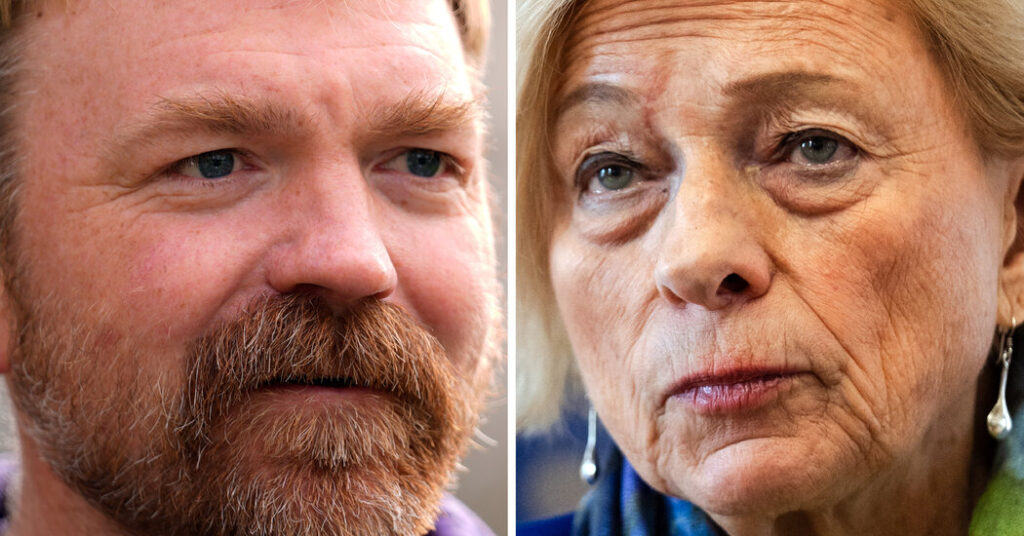
Trailing in public polls and fund-raising, Gov. Janet Mills of Maine, 78, has unleashed a barrage of scathing attack ads against Graham Platner, a 41-year-old oysterman and veteran, that highlight his online history of dismissive remarks about rape. His broader record of inflammatory comments online, Ms. Mills argues, could doom his chances in a general election against the battle-tested Senator Susan Collins.
The stakes of the race, which has quickly become one of the most contentious Democratic primaries of the midterm season, could not be higher for the party. To have any chance of retaking the Senate, Democrats must defeat Ms. Collins, a Republican who is widely seen as vulnerable but who has repeatedly dashed their hopes of unseating her.
As they look toward the general election, Maine Democrats are debating whether it is safer to nominate an experienced, older governor who struggles to energize the party’s base, or a younger insurgent who is feeding off the country’s anti-Washington energy but appears to have significant political baggage.
Similar tensions are playing out in primary contests across the country, as Democrats reassess what constitutes electability — and what red lines still exist in a Democratic Party that until recently was acutely sensitive to language about race and gender and agonized over issues like pronoun usage.
In interviews with The New York Times last week, the candidates laid out radically different views of what it will take to win the general election.
“It’s his own words,” Ms. Mills said, defending her aggressive ads. One features a gravelly male voice reciting lines from Mr. Platner’s 2013 social media posts admonishing women to stay sober and “act like an adult” to prevent sexual assault. Another is a direct-to-camera spot from a woman who introduces herself as a rape victim.
As some Democrats worry that the newly ugly tone of the race could damage the eventual nominee, Ms. Mills said that her advertising was “nothing — it’s nothing — compared to what the Republican national Senate folks will do in a general election.”
“They will tear him apart if he’s the nominee,” she added.
Mr. Platner suggested her campaign was engaging in “deeply toxic and divisive politics.” He also argued that her ties to the party establishment — Senator Chuck Schumer, the minority leader, urged her to run — was the bigger liability in a general election.
“Of course, when the Republicans go after me, it’s going to be probably worse,” he acknowledged. But, he added, “it is far more risky to go with someone who’s been in politics for a very long time.”
‘We Are 100 Percent in a New Era’
Mr. Platner’s online paper trail is extensive and ripe for exploitation by his political opponents.
In old Reddit posts, he downplayed sexual assault, used homophobic slurs, made anti-L.G.B.T.Q. jokes, identified as a communist, referred to the police as “bastards” and suggested he believed that white rural Americans were racist and stupid. He has repeatedly apologized for the comments, which he made in his 20s and 30s, and has said he has changed.
He also faced controversy over a tattoo resembling a Nazi symbol. He said last fall that he had it covered up after being “appalled” to learn what it resembled.
Mr. Platner’s campaign is testing whether some Democratic voters may have grown more tolerant of a controversial past, particularly after a decade in which President Trump has survived countless scandals while Democrats have played by more traditional rules.
He suggested in the interview that voters no longer held such stringent standards regarding past comments about race, gender and identity, as evidenced by the large crowds he is drawing.
“We are 100 percent in a new era,” he said. “We have left behind an era of, I would say, elite performative politics.”
‘Fresh Blood’ vs. Experience
Republicans and some Democrats privately concede that it is difficult to game out who would pose the stronger challenge to Ms. Collins.
While Mr. Platner has clear vulnerabilities, the energy that he drives among Democrats, his aggressive campaign schedule and his charisma on the trail could be difficult for Ms. Collins to counter. Plenty of liberals see him as a populist fighter willing to challenge a broken political system.
Ms. Mills, for her part, believes that winning requires an experienced politician who can cut into Ms. Collins’s margins with more moderate voters.
The party’s leaders agree: Ms. Mills has the backing of the Senate Democrats’ campaign arm.
But that support is hardly an asset in the minds of some primary voters, many of whom remain wary of older candidates after President Joseph R. Biden Jr.’s failed re-election bid.
Unlike Mr. Biden, Ms. Mills has pledged to serve for only one term, ruling out the possibility of starting a second six-year stint in the Senate at age 85.
Voters are weighing both “fresh blood” and questions of electability and experience — “who would be able to hit the ground running,” said State Senator Mattie Daughtry, a Democrat and the Maine Senate president, who has not endorsed a candidate in the race.
“They’re also looking for someone who’s going to be a fighter,” she added.
No one expects defeating Ms. Collins to be easy. But the senator, who has both clashed with Mr. Trump and supported key parts of his agenda, represents a state that former Vice President Kamala Harris won by about seven percentage points. Democrats hope that the worsening political environment for Republicans will finally catch up with Ms. Collins.
The Republican Senate campaign arm has attacked Ms. Mills and Mr. Platner, aiming to weaken both candidates. The approach underscores Republican uncertainty about which candidate would be easier to defeat. In January, the main super PAC for Senate Republicans announced its largest ever investment in Maine — $42 million — to support Ms. Collins.
The Race to Define a Candidate
Ms. Mills and her team think that many voters — who, they say, have not yet fully tuned into the June 9 primary election — lack a complete understanding of Mr. Platner’s history.
“The voters deserve to know what he has said, and what he has done or not done,” Ms. Mills said.
At another point, in an apparent jab at her opponent’s explanations of his past remarks, she added pointedly, “Survivors of sexual assault also have P.T.S.D.”
Other elements of his past have so far attracted little attention, like a conviction for drunken driving. In 2011, his license was suspended for a year, other than driving to work and court-mandated appearances, according to court records.
In the interview, Mr. Platner said he had been driving home from dinner in Northern Virginia with his girlfriend and was hit by a drunk driver. After he called the police, he said, he was also given a breathalyzer test, which he failed.
“I got arrested, I got a D.U.I.,” he said. He added, “Got my license back, and moved on with my life.”
Mr. Platner and his supporters are betting that voters will look beyond his past.
He argued that his winding journey — serving in Iraq and Afghanistan, struggling upon return and ultimately rebuilding his life in Maine — was, for many, “just indicative of being a regular human being.”
“Character is an issue,” he said. “Being able to display very openly and talk openly about my kind of progression as a human being is a way of making character central.”
‘Like Anyone, He’s Made Mistakes’
Mr. Platner and his campaign are still navigating how to respond to the criticism.
At times, he has been more dismissive. He told The Daily Beast in January that the discussion about his old comments amounted to “an absurd litmus test.”
His campaign is spending more than three times as much money on digital and television ads as Ms. Mills, according to AdImpact, a media tracking firm, to try to introduce himself to voters as a veteran and a native Mainer.
But his team had also been quietly preparing for the attacks. A week before Ms. Mills released her first ad highlighting his comments about women, the Platner team had filmed footage that could be featured in a response to several of his previous comments.
Within a day, Mr. Platner was on the air with an ad responding to the Mills attack.
“These words are not who I am,” he said in the spot. “I’m asking you not to judge me for the worst thing I said on the internet on my worst day.”
On Thursday evening, a small group of campaign organizers and Platner backers held an online event aimed at helping supporters talk with their networks about Mr. Platner’s posture toward women.
Suggested language, according to a “tool kit” sent around later, included acknowledging that, “like anyone, he’s made mistakes,” but assuring that he had worked for years to grow and make amends.
“I’d rather talk to someone who has experienced trauma and is working on healing,” read another suggested line, “than someone who meets a purity test.”
Lisa Lerer is a national political reporter for The Times, based in New York. She has covered American politics for nearly two decades.
The post How a Democratic Battle in Maine Is Challenging the Idea of Political Risk appeared first on New York Times.