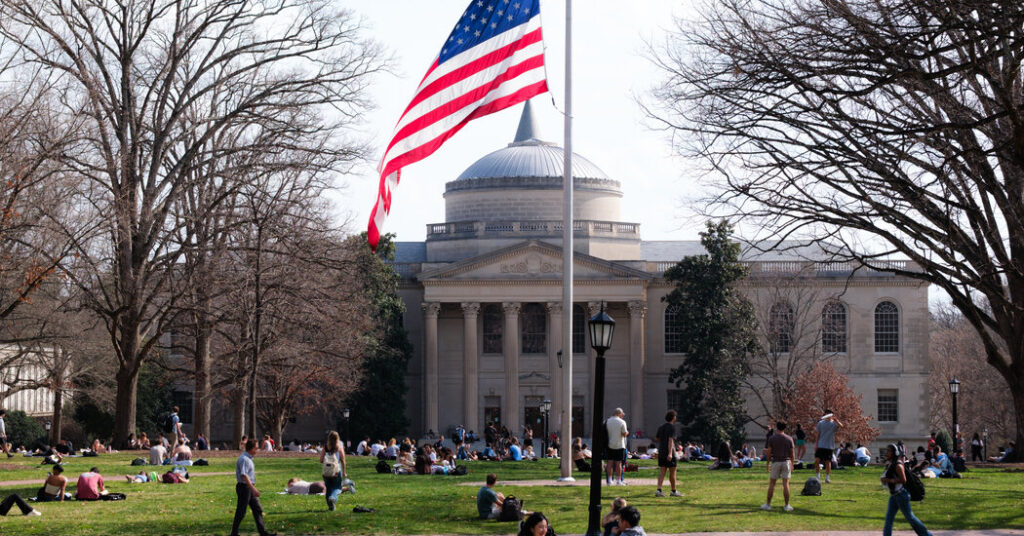
The syllabus for SCLL 230-001, also known as “Men and Women,” describes requirements different from the typical college course. Students in the class, at the University of North Carolina at Chapel Hill, must go on a date, plan their own weddings and organize a ball (a group project).
Guest speakers last fall included Chloe Cole, an activist against gender treatment for minors; Dr. William B. Hurlbut, a former White House bioethics adviser who warned about the dangers of premarital sex; and several married couples, one with a baby who was passed around to students.
The class reading list includes ideas from both the right and left, and the course is billed as a chance to openly debate issues affecting the genders in the age of a “masculinity crisis in the modern West.” But some students who took the class said it tilted toward promoting traditional gender roles in dating, marriage and family life.
The class is among the offerings at the U.N.C. School of Civic Life and Leadership, one of more than 40 academic programs that have sprung up across the country as part of a movement among conservatives to combat what they see as excessive leftism on college campuses. While the centers vary in curriculum, they emphasize Western thought, America’s founders and civil discourse.
The centers have built excitement — and drawn big-ticket donors — among those looking for a counterweight to classes on feminism, social justice and systemic oppression. Nine state legislatures in red-leaning states have passed laws requiring the opening of similar programs. In announcing the creation of a center at Ohio State University, lawmakers attacked “a monopoly of left-wing ideology” on campuses.
But the centers have also drawn controversy and criticism, including from some initial supporters. Shiri Spitz Siddiqi, chief researcher for the nonprofit group Heterodox Academy, which released a report on the programs last year, said the centers had generated “a lot of distrust among mainstream academics.”
At U.N.C., some conservative faculty members say the program has been hypocritical. The school, they argue, is mimicking the same problems that conservatives have said are endemic to left-leaning campuses, such as applying ideological litmus tests in hiring to keep out professors who don’t fit a certain political profile.
Jonathan Williams, a U.N.C. professor of economics who was appointed chief economist for the Trump administration’s Federal Communications Commission in January, supported the school at first. He noted that he had worked for a decade to fight “wokeness” on campus.
But last year, he called the school an “unmitigated disaster” in an email resigning from its advisory board, accusing the school of ignoring hiring protocols that are important to professors. The board did not respond to a request for comment.
Jed Atkins, the school’s dean, declined to be interviewed for this article. But in a written statement, he said that the school did not apply “political or religious litmus tests” to hiring.
‘Affirmative Action’ for Conservatives
The idea for the U.N.C. program predated the start of President Trump’s second term, which supercharged a movement to overhaul college campuses. In 2023, the state legislature pledged $4 million over two years and ordered the hiring of up to 20 faculty members for the new school.
But it faced controversy almost from its start. Dr. Atkins, a Greek and Roman scholar who came from Duke University, has clashed with faculty and advisers over how professors have been hired and what some believe is a set of courses too narrowly focused on the American story and religion.
Several of his hires are theology experts, including the professor who teaches “Men and Women,” John Rose, who has a Ph.D. in theology and who also came from Duke. He also teaches a course called “The Christian Story,” which examines the life of Jesus and what it means to be human, among other things, according to the syllabus.
Other professors teach classes with Christian themes, including a course about C.S. Lewis, the Christian author, and another called “Pursuing the Good Life,” in which readings include the Bible. The course ponders questions such as, “How should I live?” and “Whom and how should I love?”
Faculty expertise includes Greek and Roman political theory; Jewish, Christian and Muslim scriptures and thought; and American history and literature, Dr. Atkins said in a statement.
The school “educates citizens and leaders for constitutional self-government through free inquiry and civil discourse,” he added, “equipping students with the knowledge, judgment and habits to lead wisely, deliberate across differences and live with purpose in a pluralistic American democracy.”
Among the school’s first hires was David Decosimo, an opponent of diversity, equity and inclusion programs who had been recruited from Boston University. Within a year, though, he clashed with Dr. Atkins over hiring decisions, suggesting the school was applying “affirmative action” for conservatives.
“Schools devoted to civil discourse must exemplify it, starting at the top,” he posted in a long thread online. “They must welcome disagreement, not punish it.”
He remains a professor at U.N.C. but has been fired as associate dean.
One contentious point, several professors said, involved an Ohio State University historian, Sean Anthony, who had been recruited to apply. He complained that he’d been eliminated because his syllabus included a “land acknowledgment” recognizing that O.S.U. occupied the former home of Native Americans.
“I was rejected because of an ideological litmus test,” Dr. Anthony, a professor of Near Eastern and South Asian cultures, wrote in a letter of complaint to U.N.C. officials obtained by The New York Times.
Several administrators criticized the hiring process, including the university’s provost, Christopher Clemens, an avowed conservative who helped set up the program. He was forced out as provost after ordering a pause in hiring at the school, a decision that was ultimately overturned.
“A hiring process that relies on ideology would provide an excuse and even an incentive for the rest of the faculty to isolate, neglect, or even actively undermine the center’s efforts,” Dr. Clemens, an astrophysicist, wrote in a soon-to-be-published book chapter.
Tension over hiring came to a head during a vitriolic meeting in February 2025, when faculty members complained that the hiring committee’s recommendations were being overruled, according to meeting records obtained by The New York Times.
“I was supportive of the school,” Dr. Williams, who was on an advisory panel, told Dr. Atkins during the meeting. “I was openly mocked for supporting it. And if this process is not squeaky clean, our reputations are ruined on campus.”
The university ordered an outside investigation into the school. This month, the university said the findings of the 400-page report, which cost more than $1 million, would not be disclosed.
In a statement, the university’s chancellor, Lee H. Roberts, issued a vote of confidence in Dr. Atkins, noting his resolve and the fact that he had secured a major donation.
A Deal for Students
Some of the centers have had difficultyrecruiting students. But the U.N.C. school says it has grown, from 84 students in the fall of 2024 to 487 this semester.
The curriculum attracted Devin Duncan, the student body president, who said he decided to minor in the school after taking a course on the Federalist Papers. He said it posed “really large questions” such as: “What is the American experiment? What makes a good leader and what makes for a bad one?”
Other students have been skeptical. A progressive U.N.C. group called TransparUNCy called for a boycott of the school. One of the group’s leaders, Toby Posel, called it a “key element of Donald Trump’s MAGA agenda.”
Some of the classes are nearly at capacity, according to enrollment information obtained by The New York Times. But classes like “Seeking a Just Society” and “Classics of Civic Thought” filled fewer than half their seats. (The school did not respond to questions about enrollment for specific classes.)
Some students have been drawn to the school because of special financial offers. Students who pursue minors are eligible for the Libertas Scholarship, valued at $12,000 over four years. Tuition at U.N.C. is about $7,000 a year for in-state students and about $43,000 for out-of-state students.
Before freshmen arrived on campus last fall, the school had offered another deal for them, even if they hadn’t signed up for the minor.
“Students: we offer a $3,000 scholarship, transformational programming (including a tech-free retreat in the NC mountains), and superb faculty leadership,” the promotion read. To receive the money, students had to live in a residential “civil discourse” community — called Civ-Comm — connected to the school.
Erik Gellman, a history professor, calls the offers bribery. “If you join us in this school, we will throw money at you,” said Dr. Gellman, a leader of the American Association of University Professors chapter on campus.
A spokesman for U.N.C. said similar scholarships had been offered at other schools.
Kirstin Crump lives in the residential community, has taken two courses and also applied for the scholarship for those declaring minors. “I’ve had a really positive experience with the courses themselves,” she said. But she said she was concerned by allegations circulated on campus that the school was created to push specific ideologies.
“It’s probably just going to come down to financial considerations,” she said. “It’s a lot of money.”
The offers come during a period when U.N.C., one of the nation’s most prestigious public universities, is facing millions of dollars in cutbacks.
The School of Civic Life and Leadership has seen a windfall, however, with funding from the state, private donations, an Education Department grant of nearly $1 million, and more than $10 million from the National Endowment for the Humanities to fund “a world-class civics faculty.”
Dr. Hurlbut, a Stanford medical doctor who spoke to Dr. Rose’s class last semester about the dangers of sexually transmitted diseases, said the school’s professors were steering their students through important debates.
“I think John Rose is trying to get students to really talk to one another so they can find common ground,” said Dr. Hurlbut, who served on President George W. Bush’s Council on Bioethics.
Dr. Rose said in a statement that he was introducing diverse perspectives to encourage healthy discourse. During one class, students heard both from Simone and Malcolm Collins, an activist couple who promote having more babies, and from Amy Glaser, a North Carolina State University professor who founded an L.G.B.T.Q. organization.
Outside the Civ-Comm residential community, Sasha Widman, an aspiring nurse, said she had accepted the $3,000 residence scholarship, enticed by what she believed would be vibrant, organized discussions.
Still, she does not plan to declare a minor.
“I don’t think that’s necessarily where I want our society to go, or where I want my education to go,” Ms. Widman said.
Stephanie Saul reports on colleges and universities, with a recent focus on the dramatic changes in college admissions and the debate around diversity, equity and inclusion in higher education.
The post How a Civics School With a Conservative Bent Divided Its Supporters appeared first on New York Times.