The Spanish theater-maker Angélica Liddell has taken her obsession with death to some disturbing extremes. Since the 1990s, she has played women who throw themselves out windows and hang themselves, expressed her fascination with cannibals and mass shooters, and described performing as her way “to avoid real suicide.”
At 59, she has now made death the central focus of a work — three times over. Her “Trilogy of Funerals,” created from 2023 to 2025, opens with a theatrical staging of Liddell’s plans for her own funeral and goes on to reimagine the death of two of her favorite artists, the Swedish filmmaker Ingmar Bergman and the Japanese author Yukio Mishima.
Liddell’s unwieldy, graphic shows don’t make for easy touring: Nudity and blood are practically a given, and many are rated for adults only. It took three years to bring the first installment, “Vudú (3318) Blixen,” to France, despite her popularity here; it opened Friday at the Odéon-Théâtre de l’Europe, one of Liddell’s frequent venues in Paris. The third installment, “Seppuku: Mishima’s Funeral or the Pleasure of Dying,” premiered in Spain last year and made its way to Strasbourg, France, in January.
It’s a shame that no programmer has yet signed on for all three shows, because together, they act like a macabre house of mirrors — and help reframe “Demon: Bergman’s Funeral,” the trilogy’s centerpiece, which generated a storm of controversy when it opened France’s prestigious Avignon Festival in 2024.
At the time, much of the attention was directed at a scene in which Liddell read out negative reviews of her work, before unleashing a string of cheap insults on the critics who were in attendance. One journalist from the radio station France Inter was targeted with such ferocity that he subsequently sued Liddell for defamation.
It was a totally unnecessary scene, and without it, Liddell’s larger goals with her “Trilogy of Funerals” might have been more apparent. Her fixations echo across it, but underneath the provocation there is a new strand of vulnerability.
Coming from Liddell, this is almost more unsettling than yet another scene involving her bodily fluids. “Vudú (3318) Blixen” opens with a story as old as time: a doomed love affair. Jacques Brel’s 1959 song “Ne Me Quitte Pas,” a French breakup classic, plays in the background, and Liddell starts singing over it, her voice working up to angry, dissonant cries before dialing down to a whisper.
Liddell follows it up with one of her trademark monologues. “I did nothing to deserve it,” she says of her abandonment by a mystery man. “Did you need to be so cruel?”
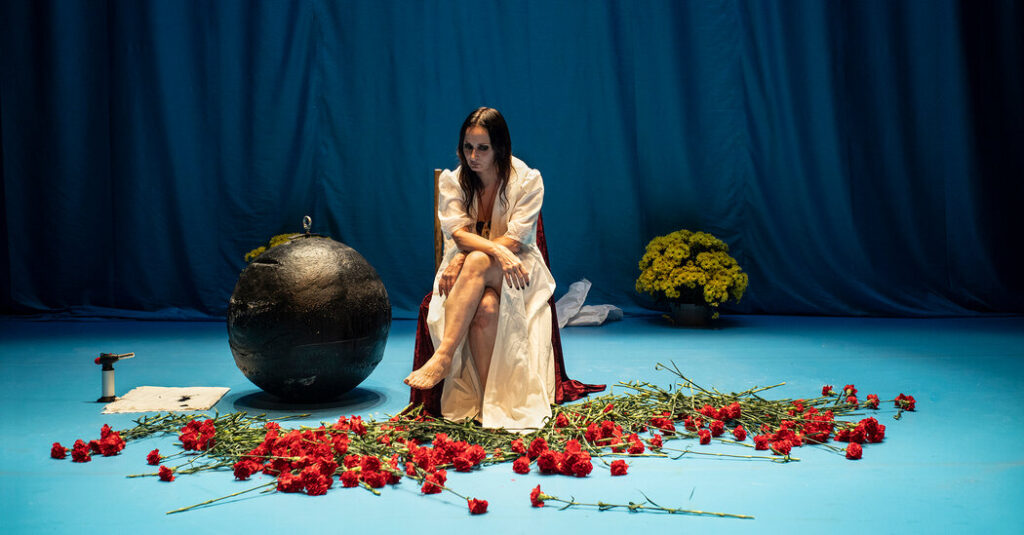
It was by far the most conventionally relatable that Liddell, a self-styled “monster,” has ever sounded onstage, and a strange experience for longtime watchers of her work. She rails against her former lover in incendiary terms, of course; she fantasizes about running him through with a sword, “to hear the drip of your blood,” and about building a pigsty on his grave. But when she sits down in a white dress to recount his betrayals, surrounded by red flowers, she is practically in Taylor Swift territory. (At one point, Liddell actually says that “love will never disappear.”)
It lends “Vudú (3318) Blixen,” a production lasting five and a half hours, a welcome level of humanity. That show was inspired in part by the Danish author Karen Blixen and what Blixen called her “pact with the devil”: Losing her family and her farm in Kenya was the price she had to pay, she later said, to become a writer.
Liddell has long framed her own artistry in Faustian terms and repeats ritualistic motifs from production to production. Silent actors regularly appear dressed as religious figures (here, men in Christian cassocks). Naked extras are also a standard feature — in the trilogy, either young women with long hair or older people, like a metaphor for the cycle of life.
The final part of “Vudú (3318) Blixen” leans into this notion with one of Liddell’s most affecting monologues. Done in voice-over with the stage darkened, it delves into the indignities of aging and Liddell’s longing for death. Her voice, often grating, is suddenly soft and tinged with aching sadness.
When the lights finally come on, there is a coffin onstage. A French notary reads Liddell her will and asks her to sign it. Then, with an actress taking her place in the coffin, Liddell stages her own funeral, complete with 101 cannon shots. By the time the curtain comes down on a long night, she is dancing around her own grave.
In “Seppuku,” the trilogy’s final part, Liddell picks up before dawn. At the Temporada Alta festival in Spain, where the show premiered, the curtain rose at 5:45 a.m. While such an early start is unrealistic for most venues, France’s Théâtre National de Strasbourg staged one performance in the show’s run at 6:30 a.m. on a Saturday in early February. (When the show plays at the Wiener Festwochen in Vienna this summer, there’s a more manageable 7:30 p.m. start time.)
The line at the Strasbourg theater’s coffee counter before the show was a sight to behold, but “Seppuku” kept us alert throughout. The tight, focused two-hour running time helped: Liddell distills her longtime passion for Mishima, who died by suicide in 1970, and for Japanese culture as a whole, into the trilogy’s most cohesive show.
The stage is set up to evoke Noh theater, with a narrow bridge upstage leading to a raised platform. Around Liddell, Japanese performers move between traditional performance practices and “Liddellisms” like stripping naked and holding poses.
There is no doubting Liddell’s sincerity when she delves into her own death drive and explains how she started planning a suicide attempt in 2010, down to staging photos to see what it might look like. For all her bravado, she approaches the decision to leave life behind with matter-of-factness, without making light of it.
For one affecting scene, the theater put out a call for people around Strasbourg to share an item of clothing that belonged to someone they had lost. Onstage, the garments are brought to Liddell neatly folded, and she puts them on one by one, with care, before reading aloud a note about the deceased.
There is no sentimentality: Liddell simply addresses their disappearances head-on, without judgment. Her dance with death, across the “Trilogy of Funerals,” is ultimately gentler than any of her views on life. For the high priestess of extreme performance art, it’s a welcome new act.
If you are having thoughts of suicide, call or text 988 to reach the 988 Suicide and Crisis Lifeline or go to SpeakingOfSuicide.com/resources for a list of additional resources.
The post For a High Priestess of Extreme Theater, Death Is Gentler Than Life appeared first on New York Times.