Regarding the March 24 front-page article “Border wall expansion raises alarms on all sides”:
On June 6, 1944, between military briefings on the D-Day landings in Normandy, President Franklin D. Roosevelt, our grandfather, met with a delegation of Texans led by Amon Carter. Carter presented Roosevelt with the deed for about 700,000 acres on the northern bank of the Rio Grande. Six days later, these acres became Big Bend National Park.
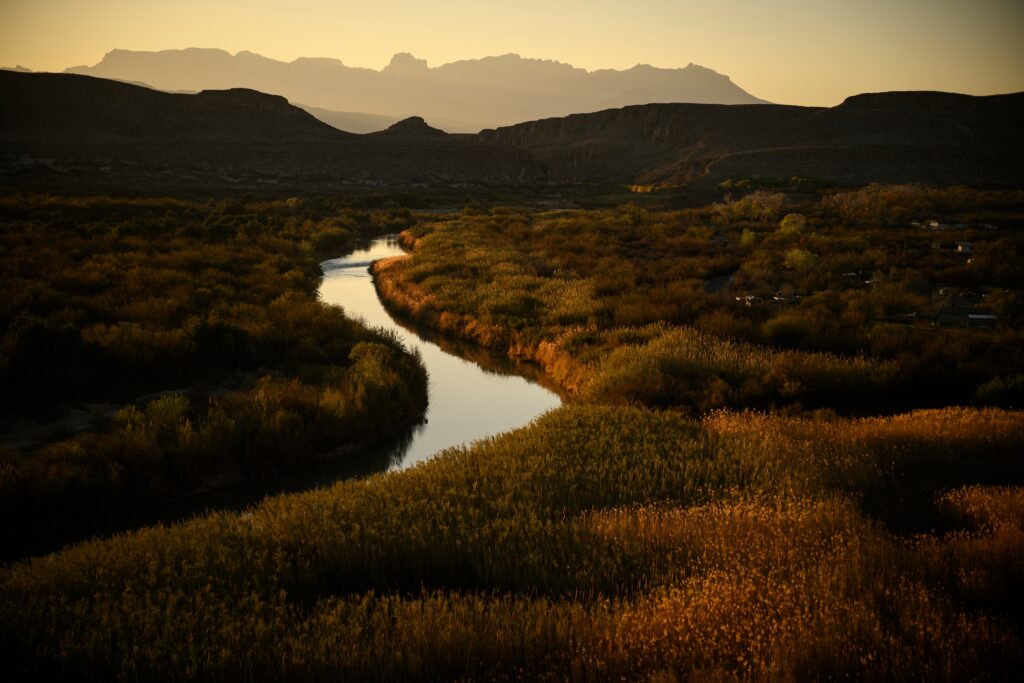
Big Bend’s river, desert and mountain terrain are home to an extraordinary variety of wildlife, and provide opportunities for camping, hiking, birding and canoeing. More than half a million people visit Big Bend each year, contributing nearly $57 million to the local economy in 2024.
The Department of Homeland Security has announced plans to build a physical border wall or “virtual” wall of floodlights and sensors through Big Bend National Park and the adjoining Texas state park. We oppose the park’s degradation.
Big Bend is not a major crossing. It is desert, both in the United States and in the adjoining Mexican protected nature area south of the Rio Grande. It is many miles, three to five days by foot, from the border to the nearest highway. Water, food and shelter are hard to find. The wall would just be one more unnecessary barrier
Even in wartime, Roosevelt planned for a time when Americans could enjoy the beauty of their land and waterways. We should not betray that vision by limiting Americans’ ability to do exactly that. We call on DHS to reconsider its unwise and destructive plan to build a wall through Big Bend, and if necessary, for Congress to stop DHS from proceeding.
Eleanor Roosevelt Seagraves, Bethesda
Nina Roosevelt Gibson, Tucson
Michael Roosevelt, Berkeley, California
Anna Eleanor Roosevelt, Embden, Maine
Nancy Roosevelt Ireland, Greenwich, Connecticut
James Roosevelt Jr., Cambridge, Massachusetts
Border wall expansion threatens a sacred peak
The March 24 front-page article “Border wall expansion raises alarms on all sides” appropriately highlighted the potential environmental and cultural heritage impacts of border infrastructure construction near Big Bend National Park as well as along the Arizona border.
There are similarly sensitive concerns along the California-Mexico border near Tecate, where planned and existing border barrier construction intersects fragile ecosystems, a transboundary watershed and a culturally significant Indigenous site.
Kuuchamaa, also known as Tecate Peak, is a sacred mountain used for spiritual ceremonies by the Kumeyaay people and is listed on the National Register of Historic Places, but it is now at risk due to the border fence construction. The U.S. Bureau of Land Management is also a signatory to a memorandum of understanding for cross-border habitat conservation planning and management of Tecate Peak. The surrounding area supports cross-border wildlife corridors and shared groundwater resources that communities on both sides of the border depend upon.
The Department of Homeland Security plays a vital role in safeguarding the nation’s borders, but border protection efforts can and should be implemented in ways that minimize unintended impacts on transboundary ecosystems and irreplaceable cultural landscapes. Careful siting, consultation with tribal communities, and binational environmental coordination are essential to avoid irreversible damage.
As planning for border wall expansion continues, the biologically and culturally sensitive Tecate region deserves the same level of national attention given to other priority border landscapes like Big Bend. Balanced solutions that advance both security and stewardship are not only possible — they are also necessary.
Richard Kiy, La Jolla, California
The writer is president and CEO of the Institute of the Americas.
Pitch in to help travelers
The focus of the blame for airport disruptions has rightfully been on members of Congress who have not yet reached a deal to fund the Department of Homeland Security. However, not enough attention has gone to how the airline industry has the power to help.
Airlines should waive checked-baggage fees for the remainder of this crisis. Doing so would encourage travelers to check their bags rather than take them through security. Fewer bags to screen would help shorten lines.
Regardless of whether airlines take this step, we should carry as little through the line as possible and check bags when we can. Let’s all be kind to one another, especially Transportation Security Administration workers, and show Congress how reasonable people can find solutions to problems.
Maggie Corfield, Rockville
Post Opinions wants to know: Do you have experience dating someone with different political beliefs? How did it go, and what did you learn? Send us your response, and it might be published as a letter to the editor. wapo.st/purple_dating
The post FDR was our grandfather. DHS is betraying his vision. appeared first on Washington Post.