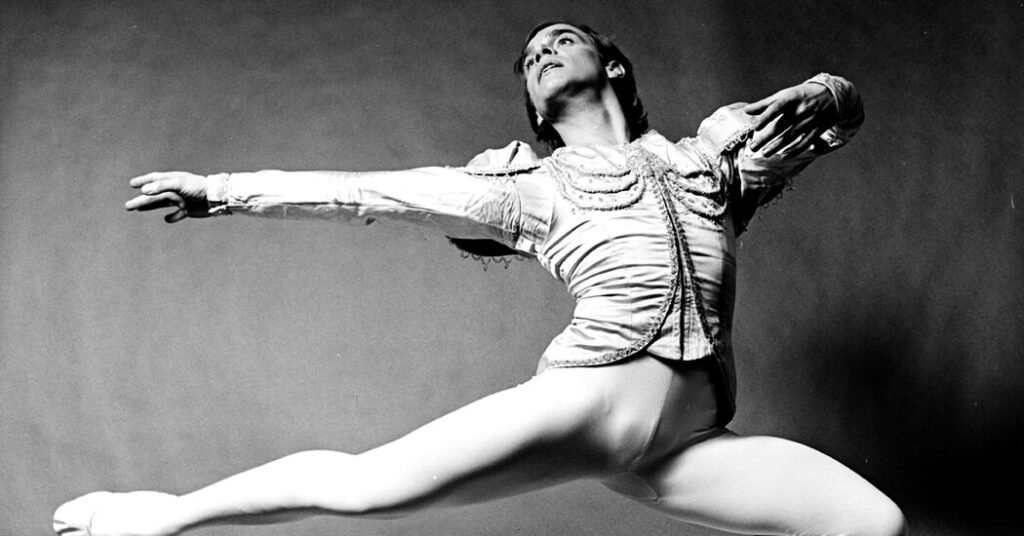
Ben Stevenson, a British-born ballet choreographer whose works were performed by major companies around the world, and who built Houston Ballet into one of the largest and most prominent troupes in the United States, died on Sunday in Fort Worth. He was 89.
Justin Urso, the business manager of the Ben Stevenson Trust, confirmed the death, in a hospital, and said the cause was a cardiac event.
In 1996, Mr. Stevenson told The New York Times: “The idea that I’m a considered a ‘British choreographer’ is strange to me. All my choreography has been done in America.”
That was a slight exaggeration. Mr. Stevenson’s career as a ballet dancer transpired in Britain in the 1950s and ’60s, first with the Royal Ballet and then with the London Festival Ballet (now known as English National Ballet). And in 1967, before he left the London Festival troupe, he staged a well-received production of “The Sleeping Beauty,” adding a little of his own choreography to the Marius Petipa original.
But soon after, he moved to the United States, where his career as a choreographer and a company director took off. While leading Harkness Youth Dancers in 1969, he made “Three Preludes,” a ballet set to Rachmaninoff that tastefully depicts attraction at a ballet barre; it is still performed by American and European troupes.
In 1970, he choreographed “Cinderella” for the National Ballet of Washington, D.C. He joined the company as co-director (with Frederic Franklin) the following year, and his “Sleeping Beauty,” starring Margot Fonteyn, was the first ballet performed at the Kennedy Center, which had just opened. The National Ballet folded in 1974, but Mr. Stevenson’s “Cinderella” would be one of the most popular versions for decades to come, performed by American Ballet Theater and other troupes.
In 1976, he became the artistic director of Houston Ballet, a small ensemble that had shuffled through many directors since its founding less than a decade before. Mr. Stevenson stayed until 2003. During the first 10 years of his tenure, the company grew — in roster, budget and endowment — into the fifth-largest ballet company in the country.
Under his leadership, the Houston repertory developed a strong foundation of full-length classics: his stagings of “Cinderella” and “Sleeping Beauty,” plus “Swan Lake,” “Giselle,” “Don Quixote,” “The Nutcracker” and several others. But Mr. Stevenson also attracted attention by creating new narrative ballets with unusual subjects: a “Peer Gynt,” based on the Ibsen play, in 1981; “Dracula” in 1997; “Cleopatra” in 2000.
Mr. Stevenson created “Cleopatra” as a vehicle for a star dancer, Lauren Anderson. Trained at the Houston Ballet Academy, Ms. Anderson became a principal dancer in 1990 — the company’s first African American dancer at that rank and the first Black woman to achieve that position at any major American ballet troupe. Through the 1990s, Ms. Anderson was often paired with another dancer that Mr. Stevenson hired and mentored: the Cuban-born Carlos Acosta, who left for London’s Royal Ballet — and global fame — in 1998.
Mr. Stevenson made “The Miraculous Mandarin” and “Zheng Ban Qiao” for Li Cunxin, a Chinese dancer he had met in 1979 when visiting Beijing as part of a cultural delegation. Mr. Li was among the Chinese students Mr. Stevenson invited to take summer classes at Houston Ballet Academy. During a subsequent visit to Houston in 1981, Mr. Li decided to defect, causing a brief diplomatic crisis.
Mr. Li joined Houston Ballet and stayed for 16 years, becoming one of its most celebrated dancers. He wrote about his experiences and Mr. Stevenson’s mentorship in his 2003 autobiography, “Mao’s Last Dancer,” which was made into a film in 2009. Mr. Stevenson continued to teach regularly in China for many years.
Benjamin Stevenson was born in Portsmouth, England, on April 9, 1936. His father, also named Benjamin, was a bus driver, and his mother, Florence (Hayward) Stevenson, was a florist.
Ben began taking dance classes when he was 7, on a doctor’s suggestion that ballet might help correct overpronated feet. He did not have much interest in dance at first, he told the Texas PBS station KERA in 2023, but recalled: “I liked the building. I couldn’t wait to go inside.”
By the time he was 12, his love of dance had grown — “like a disease,” he said. At 14, he enrolled at Arts Educational Schools in London, which had a highly regarded ballet department.
Four years later, he joined the Royal Ballet, where he learned from the foremost British choreographer of the time, Frederick Ashton. Yet he did not feel at home in the company, later telling The Times, “I hadn’t gone to their school, and I was intimidated.” Besides, most of his school friends had joined the London Festival Ballet — as he soon did, too.
With the London Festival Ballet, he danced leading roles, but he also kept up a side career dancing in musical theater productions, including “The Music Man,” as well as television specials. This theatrical experience would feed into the storytelling of his choreography.
“I have been brought up with theater,” he told The San Francisco Chronicle, “so I realize what a strong part of ballet theater is.”
While on a two-week vacation to New York City in 1968, Mr. Stevenson was offered the directorship of Harkness Youth Dancers, an offshoot of the ballet school founded by the heiress Rebekah Harkness. During the next few years, he led not only the National Ballet but also Chicago Ballet. Then came his long tenure with Houston Ballet.
That company’s New York debut in 1981 divided critics. Anna Kisselgoff, in The Times, praised Mr. Stevenson’s “Four Last Songs,” as well as the troupe’s “range and unusual repertory” and its style, which she wrote was “compatible with British classicism.” Arlene Croce, in The New Yorker, wrote that Mr. Stevenson had “turned Houston into a reactionary outpost of British ballet.”
“I don’t have a New York company,” Mr. Stevenson told The Times. “We owe a different service to our community.” To The Washington Post, he added: “We have to bring in audiences. We have to be popular.”
“Straightforward” was an adjective that was often applied to Mr. Stevenson’s staging of ballet staples. Most of his experimentation was thematic: not just “Dracula” and “Cleopatra” but also “Space City,” a ballet danced in spacesuits, and “Image,” a piece about Marilyn Monroe.
Mr. Stevenson also expanded Houston Ballet’s repertory with the work of others, especially the British choreographers Christopher Bruce and Kenneth MacMillan. He commissioned the leading modern dance choreographer Paul Taylor, who made “Company B,” a beloved work set to Andrews Sisters recordings.
Among the choreographers Mr. Stevenson nurtured from inside Houston Ballet was Trey McIntyre, who went from being the company’s choreographic associate to founding the popular Trey McIntyre Project. Among those from the outside was Stanton Welch, an Australian who took the reins of Houston Ballet in 2003.
The following year, Mr. Stevenson became the artistic director of the smaller Texas Ballet Theater (formerly Fort Worth Dallas Ballet), a position he held until 2022, when he took on emeritus status. That company also grew under his direction, both in budget and repertory — a similar mix of classics and original works, including “Mozart Requiem.”
Mr. Stevenson continued to serve as the artistic director emeritus of Houston Ballet. In 1999, he was named an Officer of the Order of British Empire by Queen Elizabeth II. He leaves no immediate survivors.
“Most of my energy has gone into developing a school and dancers,” Mr. Stevenson told The Times in 1985, noting that three-quarters of the Houston Ballet company members had been trained at its school, which was renamed after him in 2003. “There’s a satisfaction in starting from the very beginning, rather than struggling to put your mark on something famous.”
The post Ben Stevenson Dies at 89; Choreographer Made Houston Ballet Thrive appeared first on New York Times.