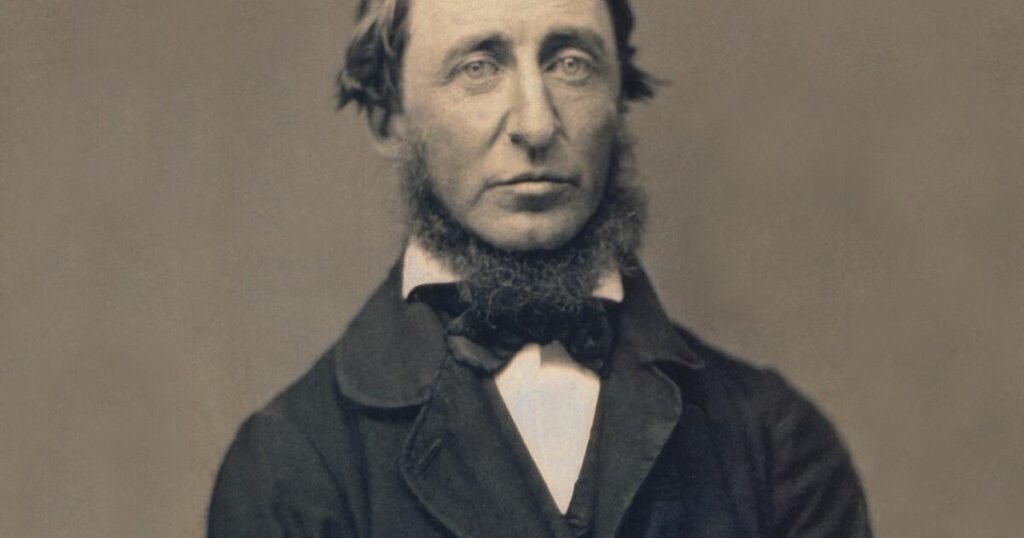
Henry David Thoreau is one of those figures whose name one may know but whose writing often boils down in the mind to titles of works never read — including “Walden” and “Civil Disobedience.” Some lines may be familiar: “The mass of men lead lives of quiet desperation”; “Our life is frittered away by detail … simplify, simplify!” (The latter I first heard quoted by a character played by Dick Van Dyke in the movie “What a Way to Go!”) Thoreau coined the phrase “different drummer,” which links him directly to Mike Nesmith of the Monkees, whose song “Different Drum” became a hit for Linda Ronstadt and the Stone Poneys in 1967.
At the same time, since Thoreau’s death in 1862 at age 44, his writing has traveled far, wide and long, influencing many who did happen to read it, including Malcolm X, the Rev. Martin Luther King Jr. and Mahatma Gandhi. His thoughts on how to live in the world remain inspiring, even as his observations on man’s inhumanity to man and nature have been, unfortunately and increasingly, relevant in the nearly two centuries since his works were published.
“The winds and the waves are not enough for him; he must needs ransack the bowels of the earth that he may make for himself a highway of iron over its surface” is as true as it ever was. An observation like, “Fools stand on their island of opportunities and look toward another land. There is no other land; there is no other life but this,” could easily apply to those who quixotically believe the remedy for a trashed Earth is to live on Mars. “A government which deliberately enacts injustice and persists in it will at length ever become the laughingstock of the world … I say break the law; let your life be a counter-friction to stop the machine,” foreshadows our current state of federal domestic terrorism and grassroots resistance. “Who can be serene in a country where both the rulers and the ruled are without principle?” he asked. “My thoughts are murder to the State, and involuntarily go plotting against her.” Been there.
“Ultimately his life would be reduced to legend and his complex prose to one-liners,” says narrator George Clooney at the start of “Henry David Thoreau,” a new documentary, airing Monday and Tuesday on PBS (and available any time to stream), that aims to highlight the prose, fill in the biographical blanks and bring the legend back to earth — picturing the warts while still celebrating him as a great American writer, thinker, naturalist and weirdo. Directed by brothers Erik and Christopher Loren Ewers and written by David Blistein, it has as executive producers America’s chronicler Ken Burns and Don Henley from the Eagles, who in 1990 founded the preservationist Walden Woods Project. Jeff Goldblum (in a David Strathairn mood) speaks Thoreau’s words, while Ted Danson, Meryl Streep and Tate Donovan supply other voices.
Three hours might seem a stretch for this subject, but with the Walden period bookended by the lesser known pre- and post-Walden years, it stays interesting all along. Suggesting the scope of Thoreau’s interests and effects, the commentators include, along a host of “literary scholars,” a religious studies scholar, a geologist, an environmental activist, a Penobscot historian and, identified simply as “writer,” the well-known Michael Pollan, Rebecca Solnit and Pico Iyer.
Thoreau had the good luck to be born in Concord, Mass. — the very center of transcendentalism, a spiritual cum philosophical cum literary movement that saw divinity in everything — with Ralph Waldo Emerson, whose protege, handyman and lodger he would become; Nathaniel Hawthorne; and Bronson and Louisa May Alcott for neighbors. His mother, who introduced him at age 5 to Walden Pond, was an abolitionist who ran a station on the Underground Railroad, for which he would act as a conductor.
In 1845, age 27, he built himself a 10-by-15-foot cabin by the pond, on land owned by Emerson, where he would live for two years, two months and two days. “I went to the woods because I wished to live deliberately,” he famously wrote, “to front only the essential facts of life, and see if I could not learn what it had to teach, and not, when I came to die, discover that I had not lived.” He might spend a whole day in his doorway thinking, but much of the time spent at the cabin was taken up by committing thoughts to paper, or more scientifically recording his observations of the natural world.
But he was no hermit. People dropped by. He walked regularly up to Concord to sell vegetables he grew or hear the local gossip (which, “when taken in homeopathic doses was really as refreshing as the rustle of leaves”), see the family, drop off his laundry, do some chores. It was on one of these trips that he ran into the town constable, who asked him to pay six years of back poll taxes, which Thoreau had withheld in protest of the federal government’s condoning slavery; Thoreau refused and spent the night in jail — someone did pay the tax, to his displeasure — which became the stuff of “Civil Disobedience.”
His experiment in self-realization put him in a long line of spiritual seekers, and like innumerable young persons in every generation, he was actively engaged in evolving a design for living, drawing from sources near to and farther from home. (Thoreau scholar Lawrence Buell calls Transcendentalism “the first youth movement in American history.”) “In the morning I bathe my intellect in the stupendous and cosmogonal philosophy of the Bhagavad-gita,” Thoreau writes in “Walden,” and imagines that via the global ice trade “the pure Walden water is mingled with the sacred water of the Ganges.”
Apart from the Walden adventure, Thoreau appeared as a public speaker and worked as a surveyor and in his father’s very successful pencil factory, for which he created some important innovations. With his older brother John, he ran a school, having left a previous teaching post from a disinclination to administer corporal punishment. He traveled around New England and wrote about it, looking for nature at its most untamed, but sometimes finding mills and factories and a river dammed. (The Industrial Revolution was in full swing.) He had fanciful notions about Native Americans until he got to know some as people.
Whatever else he was, he was a writer first, and “Henry David Thoreau” shows you the words, photographing them on a typeset page or in Thoreau’s own hand (his journaling ran to more than 2 million words), putting passages onscreen. Because there are few actual images of Thoreau or his kin, we see the same ones over and over again; the documentary is illustrated with archival photos and artworks, not all exactly from the period or illustrating the event discussed — but good to look at. The directors take a visual essay approach, contrasting Walden Pond and its woods and the rivers Thoreau rowed with sped-up footage of our crazy modern world — which can be a little on the nose. Well, you work with what you’ve got.
And the shots of nature are very pretty indeed — the documentary might inspire you, once you’re done watching, or even sooner, to get off the couch and go into the world.
The post A new PBS documentary reveals why Henry David Thoreau’s radicalism resonates today appeared first on Los Angeles Times.