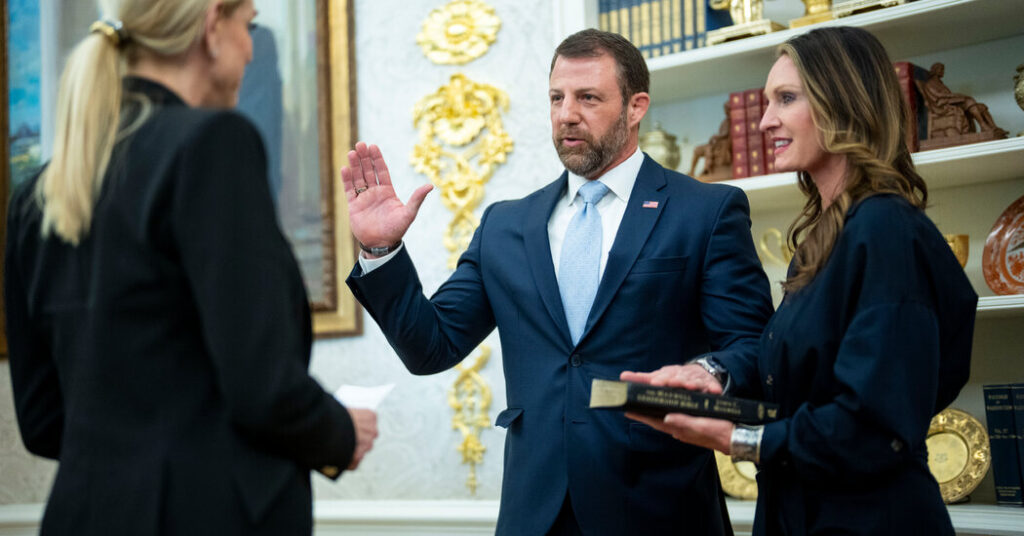
In his first days as head of the Department of Homeland Security, Markwayne Mullin has stuck to a suit and tie, not the ICE-emblazoned bulletproof vest worn by his predecessor, Kristi Noem, in her debut video when she started the job. While Ms. Noem, cameras in tow, growled about “getting the dirtbags off the streets,” Mr. Mullin has worked toward a less flashy debut: briefing members of Congress on the effects of the government shutdown, attending White House meetings and doing a video talking up the people he now oversees. “I think I have the greatest employees working at D.H.S. ever — I mean that sincerely,” he said in a video he posted on social media.
It remains to be seen whether the more diplomatic style of Mr. Mullin, a former Republican senator for Oklahoma, will help him achieve President Trump’s hard-line immigration policy and navigate the intense backlash triggered by the department’s deportation tactics. Mr. Mullin, 48, must now also look inside an agency that critics say was badly damaged under Ms. Noem, though she has said she worked with the full backing of the White House. He has taken over a department that is in declining public repute, especially after the fatal shootings of two U.S. citizens in Minneapolis in January.
Time and again, the Homeland Security Department has struggled to explain to the American public its deportation strategy or how it goes about its work. What is more, the Noem era, which ended with her dismissal earlier this month, frustrated department officials who believed the agency was being used as a pawn in her political endeavors. Her handling of contracts drew criticism for benefiting well-connected allies. (Ms. Noem has said she was not involved in doling out contracts for a $200 million department advertising campaign). The problem is not just a public relations disaster: The agency is facing serious questions over whether it follows due process, is being investigated by the inspector general’s office for matters including the handling of contracts and remains under pressure to deliver on more deportations as promised by Mr. Trump. It is also not fully funded because of an ongoing partial shutdown over Democrats’ objections to the agency’s immigration tactics. Congress is deadlocked on the issue.
“They’ve got to regroup in terms of how they approach the immigration commitments the president made,” said Ken Cuccinelli, a former acting deputy head of the department during Mr. Trump’s first term.
Mr. Mullin has already said he plans to keep the agency out of the headlines while still carrying out the president’s deportation policies.
“My goal in six months is that we’re not in the lead story every single day,” Mr. Mullin said during his confirmation hearing. “My goal is for people to understand we’re out there, we’re protecting them and we’re working with them.”
Balancing the public reset of the Trump administration’s immigration strategy while also accomplishing the president’s stated demands will be difficult. Former Trump officials, however, believe it is necessary.
They point to managerial and messaging problems under Ms. Noem. Case in point: At the same time that Immigration and Customs Enforcement officials would publicly discuss targeting serious criminals through a sophisticated method, Americans would see images of immigrants running from agents at Home Depots or car washes, and hear stories of citizens and legal status holders caught up in the dragnet.
Inside the agency, there is hope that Mr. Mullin will adjust course after months of intense controversy stemming from not just the actions of officers on American streets, but also from Ms. Noem’s unusual publicity stunts, documented in part by the costly advertising campaign that appears to have been one reason for her dismissal.
Department officials believe Mr. Mullin will allow heads of agencies like ICE and U.S. Customs and Border Protection to have more latitude to make key decisions, according to an administration official and a senior department official.
That would be a dramatic shift from the Noem era, when officials in her circle, most notably Corey Lewandowski, held considerable sway. At ICE in particular, Mr. Lewandowski was deeply involved and would press officials for more arrests and deportations. (The Homeland Security Department has previously said he was on the same page as other agency leaders).
One administration official said there were issues with the chain of command during Ms. Noem’s tenure, a pointed comment on the power given to Gregory Bovino, a former midlevel border official, who ran major immigration operations in the United States and reported not to the head of Border Patrol but to Ms. Noem.
“Secretary Mullin is perfectly suited to lead the Department of Homeland Security and work closely with President Trump to continue building on his many successes,” Abigail Jackson, a White House spokeswoman, said in a statement. “Whether it be protecting the homeland from bad actors, stopping dangerous drugs from flowing into American communities or removing the worst-of-the-worst criminal illegal aliens, Secretary Mullin will work tirelessly to implement the president’s agenda.”
Mark Morgan, the former acting head of ICE during Mr. Trump’s first term, said that the Homeland Security Department under Ms. Noem had gone too far with its tactics, though he is part of a group pushing for more deportations. He said he was concerned that election-year politics might get in the way of that regardless of the change in leadership.
“Republicans now are, in my opinion, they’re scared, and they’re worried about the midterms,” he said. “And so now they want to adjust what they’re doing.”
Still, he said, any strategy focusing only on the most serious criminals would fail to achieve the mass deportations Mr. Trump promised during his campaign and has discussed during his time in office.
Mr. Mullin “needs to be cleareyed that it’s his responsibility to enforce the law, in its entirety, without favor, without political carve-outs or ideologic-driven carve-outs, without being influenced by special interest groups,” Mr. Morgan said, adding that Mr. Mullin should carry out targeted operations against those with deportation orders, those overstaying visas and criminals. “He must apply the law to all of those who are violating it.”
Those in favor of more progressive policies on immigration said they were not expecting much of a shift on the ground.
“I think some things administrative will change, and it will likely improve the experience for careers and may make the department run better, but I am unclear of noncosmetic substantive improvements, especially with Miller still in charge,” said Claire Trickler-McNulty, a former senior ICE official in the Biden administration, referring to Stephen Miller, Mr. Trump’s deputy chief of staff.
Hamed Aleaziz covers the Department of Homeland Security and immigration policy for The Times.
The post A New Boss Takes Over Homeland Security With Less Flash but Same Mission appeared first on New York Times.