The United States will be in a far stronger position to win the artificial intelligence race if government works with, rather than against, the companies pioneering frontier technology.
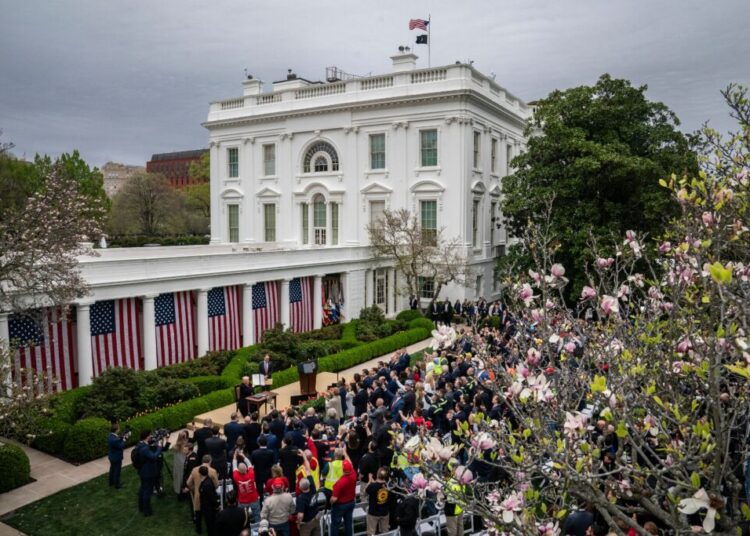
This past week showcased the strengths of carrots and the weaknesses of sticks. On Wednesday, President Donald Trump named 13 of the country’s smartest executives to a new Council of Advisors on Science and Technology, including Nvidia’s Jensen Huang, Meta’s Mark Zuckerberg, Michael Dell and Google co-founder Sergey Brin.
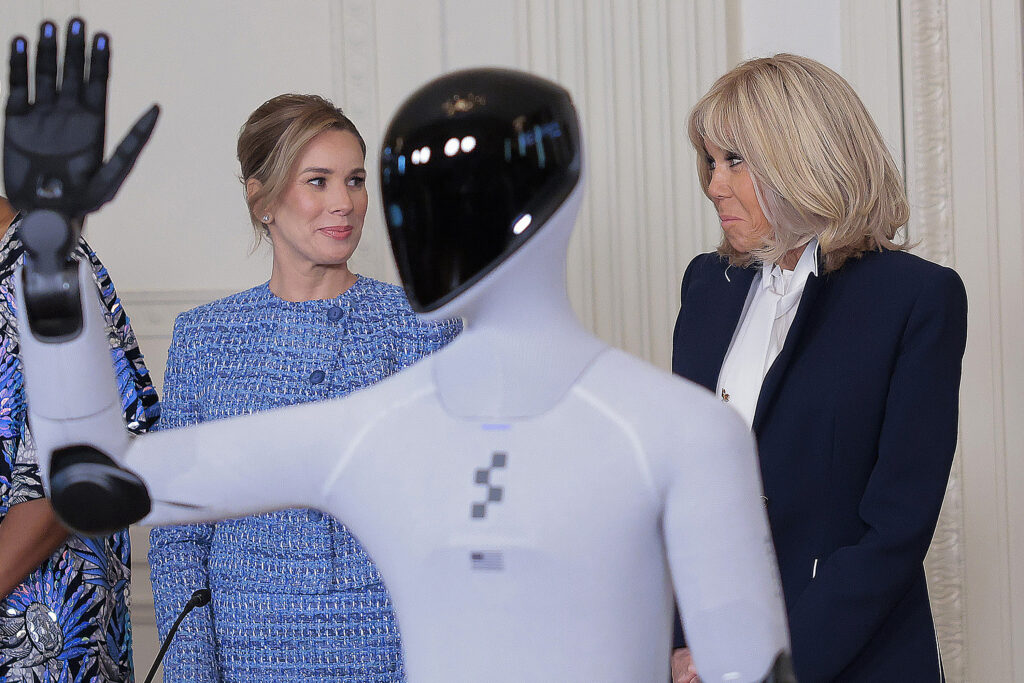
The same day, First Lady Melania Trump hosted an event at the White House featuring an AI-powered humanoid robot. If successfully scaled, such robots have the potential to teach personalized lessons to children who are otherwise falling behind. An army of these might help bridge the achievement gap at low cost, and they could become a great American export.
On Thursday, meanwhile, a federal judge in San Francisco blocked the Pentagon’s recent order labeling Anthropic a national security risk. “Nothing in the governing statute supports the Orwellian notion that an American company may be branded a potential adversary and saboteur of the U.S. for expressing disagreement with the government,” wrote District Court Judge Rita F. Lin.
Lin correctly said the government has every right not to do business with Anthropic if it doesn’t want to, but Defense Secretary Pete Hegseth’s order barring other defense contractors from using its Claude models was obviously improper retaliation. Meanwhile, Anthropic’s impressive products continue to help the military identify targets in Iran.
To its credit, the firm seems eager to put the fight behind it. “Our focus remains on working productively with the government to ensure all Americans benefit from safe, reliable AI,” Anthropic said in a statement after the ruling, which will likely be appealed.
That this contractual dispute is being resolved in court is a testament to the value of America’s rule of law. It’s a striking contrast to what’s playing out simultaneously in China, where the communist regime has indefinitely banned the CEO and chief scientist of a Singapore-based AI firm from leaving the country. Beijing is trying to block Meta’s $2 billion acquisition of their company, called Manus, a start-up that makes AI “agents.”
The exit ban was imposed with no due process. It’s part of an effort by dictator Xi Jinping to tighten control over AI products being created by Chinese nationals. Ultimately, such an approach is not going to get the most creative work out of businesses.
During Trump’s first term, many companies boycotted and executives resigned from advisory groups like the one the president just unveiled. They did so because of pressure from activist staff. But this did not serve the country. Companies need to think of themselves as American citizens, and government has a responsibility to be as helpful as possible as companies forge ahead at the cutting edge.
Success is not assured. Sen. Bernie Sanders (I-Vermont) formally introduced legislation on Wednesday to impose a federal moratorium on new data centers, an effort to bring AI to heel. Individual states are passing a patchwork of laws that make compliance costly and nearly impossible. Congress will need to step in to preempt such legislation from hampering innovation.
Free societies beat closed societies by embracing freedom. They lose by trying to imitate repression.
The post To win the AI race, cooperation trumps confrontation appeared first on Washington Post.