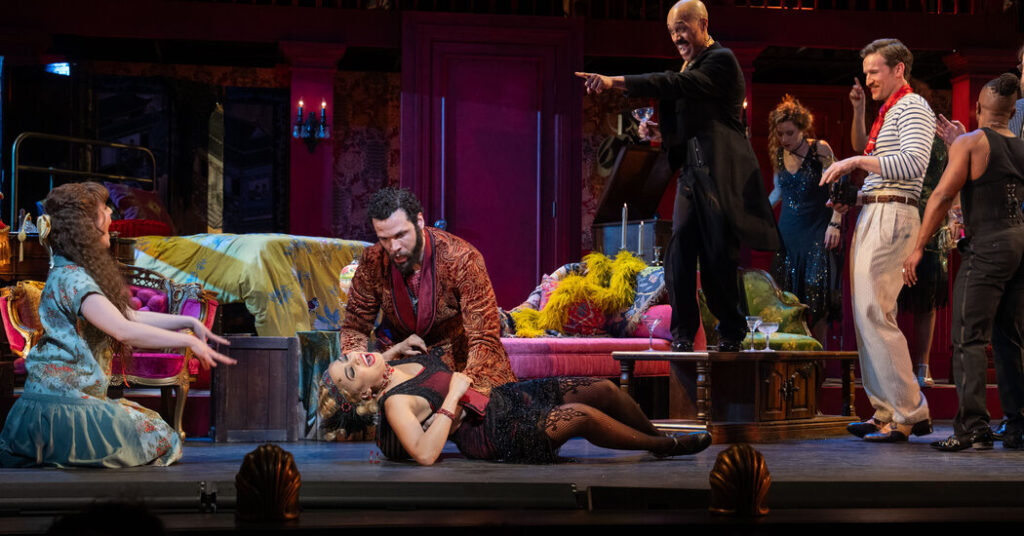
The drinks flow as a rambunctious group of revelers follow a stunning blond woman in a lively dance of hops, slaps and flapping limbs. As the night rolls on, the booze turns to cocaine; there will be punches thrown and even more sex.
That’s how it plays out onstage at New York City Center, as set in a cozy 1920s New York City studio. This wild soirée was first depicted nearly a hundred years ago, and it was in the lines of a poem.
Joseph Moncure March’s “The Wild Party” isn’t your typical work of classic American verse. A narrative poem full of sex, drugs and violence, it tells the story of a crazy gathering hosted by a beautiful vaudeville singer named Queenie and her crass clown performer boyfriend, Burrs. The poem’s jazzy syncopated rhythms make it as lively and unpredictable as the action of the story itself.
An unruly lineup of guests — performers, producers, an old prizefighter, an impressionable teenager — tangle in a little studio apartment. By the end of the night there will be a death.
March wrote “The Wild Party” in the summer of 1926; he quit his job as the first managing editor of The New Yorker to focus fully on his poetry. But because of the poem’s depiction of homosexuality, sexual violence, drug use and general hedonism, March couldn’t find anyone to publish the work for two years. In 1928, a limited run was banned for its risqué content. The poet Louis Untermeyer called it “repulsive and fascinating, vicious and vivacious, uncompromising, unashamed” and “unremittingly powerful.” And the Beat writer William S. Burroughs called it “the book that made me want to be a writer.”
In 1968, March published a significantly tamer, self-censored version of “The Wild Party” with many of the references to characters’ races edited out, but years later the original poem, with all of its dirty gin and grit, came to the fore. It has since been translated into various languages, and in 1994, a stylish new edition was published with illustrations by Art Spiegelman. It was adapted into a film in 1975, and 25 years later, two separate stage musicals based on the poem ran in the same season in New York: an Off Broadway production with book, lyrics and music by Andrew Lippa, and a Broadway production by Michael John LaChiusa and George C. Wolfe.
All the devilish fun that is March’s poem could have easily gone the way of Model Ts and secret speakeasies, lost to the 1920s. But it, and its stage adaptations, have endured. When I saw March’s poem come to life in the Encores! revival of the LaChiusa and Wolfe musical (running through March 29 at New York City Center), I thought of how uncommon it is for a poem — not just its characters, but its sounds, its rhythms, its attitude, its particular kind of daring — to translate onto a stage. It’s a testament to the strength of the poet’s vision, and, of course, his words. Here are four stanzas from March’s original poem that show how the daring work of verse still seduces readers in 2026.
Setting the Scene
The gang was there when midnight came. The studio was lit by candle-flame; Dim: mysterious: shrouded. Unbidden shadow-guests swarmed About the room. They huddled crowded In every corner; raised deformed Ungainly shoulders, hideous, tall Necks and heads against the wall. Enormous blurred hands kept stealing Spider-like, across the ceiling; Crossing with sharp, prismatic masses Of light from swaying spectre glasses. The flames flickered: The shadows leapt: They rushed forward boldly; Swept Triumphant Across white faces: Wavered, retreated; Turned, defeated, And shrank back to darker places.
March strikes a gothic, ominous tone in this stanza about the start of the party. It’s Poe meets the Jazz Age; even in a poem so resolutely set in a place of worldly pleasures, there’s an otherworldly haunting that clings to the bottom of the gin glasses.
Shadows are a recurring image throughout the poem, and the ways they eerily distort the guests’ silhouettes reveal the true nature of the partygoers. The poem’s speaker, though familiar, doesn’t outwardly judge even the most miscreant figures, but there is a looming sense of coming judgment throughout. Another motif is the holy and profane. The candles recall church and purity, yet the flickering flames symbolize lust, and the shadows cast by the light recall all the debauchery and social taboos at play.
“The Wild Party” doesn’t follow any particular poetic form but falls into the genre popularly referred to as jazz poetry, a style that was popularized during the Harlem Renaissance with writers like Langston Hughes and varies wildly in form, sound and rhythm.
So March dots his poem with dramatic punctuation: colons and semicolons that help set the rhythm and also subtly evoke the grim atmosphere. Consider the odd sibling colons in the third line: “Dim: mysterious: shrouded.” A colon is meant to open a sentence to some reveal or explanation, but here each colon leads from one opaque adjective to another. March is improvising, openly riffing on a familiar time signature.
Sexy Stanzas
The bed was a slowly moving tangle Of legs and bodies at every angle. Knees rose: Legs in sheer stockings crossed, Clung: shimmered: uncrossed: were lost. Skirts were awry. Black arms embraced White legs naked from knee to waist.
There are plenty of explicit sexual moments in March’s poem, but this lyrical description of the party at its orgasmic peak is perhaps the most memorable.
March is using metonymy and synecdoche to show us the sex without spelling it out: “The bed was a slowly moving tangle / Of legs and bodies at every angle.” We just see snatches of body parts: legs, knees, legs, arms, legs, knee and waist. There’s a subtle hint of innocence long lost in the fourth and fifth lines: the “sheer stockings” evoking a more demure attitude, with “sheer” also able to be interpreted as “pure” or “unadulterated.” The crossing and uncrossing of the legs — and the prominence of legs throughout the stanza overall — is part of the poem’s seduction. We’re drawn in to the action through each subtle gesture until consummation, hinted at in those lost stockings from the fifth line.
And in those last two lines of the stanza, the “black arms” and “white legs” may come as a bit of a surprise; here March is intentionally recalling the mixed racial makeup of the party guests. There are Black characters and also blackface, white characters but also characters who are powdered white. Everyone is playing at race in some way or another, and the differences don’t particularly matter in this sensual tangle of limbs.
Violent Sounds
His shoulders swung: His fist drew back, Shot out, Struck With a dull smack.
Back went the man’s head: He spun where he stood: He fell flat, and lay there, His face oozing blood.
As the evening rolls on, tensions rise among some of the drunken partygoers. March takes a play-by-play approach to the action in these scenes, guiding our eyes as a director would. Just as the rhythm becomes syncopated, so too is the action.
The short lines of these two stanzas frame each instance in the fight, and March also applies his own kind of soundtrack to the action through his sonic choices. The first stanza of this altercation moves swiftly with “s” sounds: the consonance in “His shoulders swung: / His fist drew back, / Shot out, / Struck / With a dull smack” seems to mimic the choreography of the attack.
The hard rhyme of “smack” and “Back” across the stanza break also replicates the impact of the hit and the recoil of the attack.
The poem, and the musical, end with a similarly violent altercation, but March doesn’t linger on the chaos. An abrupt nine words leave several of the characters’ fates an open question: “The door sprang open / And the cops rushed in.” We’ve had our introductions and our drinks, our sex and fights, but after all of that free, hedonistic partying, there is a consequence. Our speaker may not judge these shadowy figures but at the end of the night, society sure does.
Maya Phillips is an arts and culture critic for The Times.
The post The Vivacious Play That Started as a Scandalous Poem a Century Ago appeared first on New York Times.