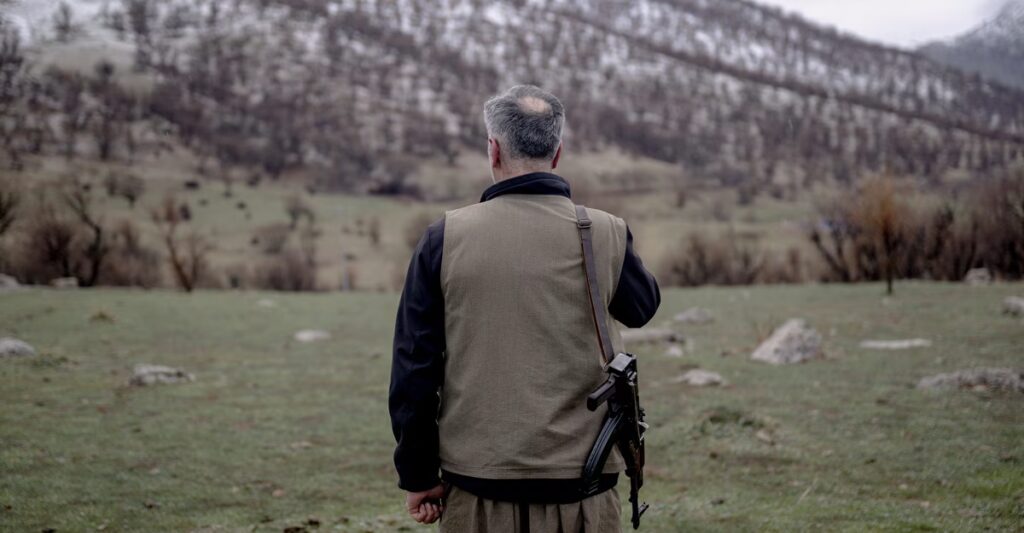
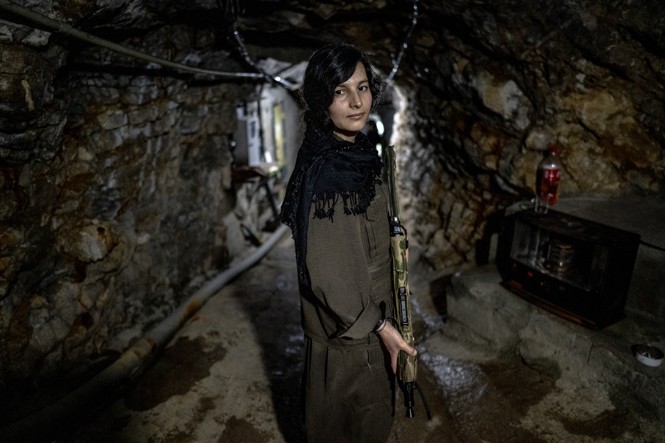
Earlier this month, high in the snow-capped mountains near the border between Iran and Iraq, a Kurdish rebel led me down a foot trail to the opening of a cave. We stepped inside and walked about 50 yards along a dark man-made passageway where water dripped steadily from the rocky ceiling. Then we turned down one of the cave’s branching tunnels and passed through a wood-framed entryway into a brightly lit and immaculate room with a long table and a television mounted on a wall.
A dozen men and women wearing the short jackets, baggy trousers, and waist sashes of the Kurdish rebels known as the Peshmerga greeted me. These were the leaders of the Kurdistan Free Life Party, better known as PJAK, which has been aspiring to topple the Iranian regime for decades.
“We are on the trigger finger,” one of them told me. “After 22 years in the movement, we have never been this busy.”
The American-Israeli effort to bring down the Iranian regime is not likely to succeed without the help of PJAK and other Kurdish armed groups, whose fighters could easily slip across the border that lies near their network of bases in northern Iraq. When Donald Trump and Benjamin Netanyahu appealed to the Iranian people to rise up against the regime, their message was aimed partly at Iran’s minority population of Kurds, who—like their fellow Kurds living in Turkey, Syria, and Iraq—have long been at odds with their rulers. The Kurds now face the latest in a long series of temptations: a chance to overthrow an oppressor that could leave them more vulnerable to retribution than ever before.
[Read: A turning point in the Iran war]
Hundreds of Iranian Kurds living abroad have been returning to the Middle East from Europe over the past two months, hoping to help liberate their homeland. No other segment of Iran’s population is as well prepared. PJAK and other Kurdish factions say they have thousands of sleeper-cell members in Iran who would join the fight as soon as a ground invasion started.
But the prospect of a Kurdish invasion is fraught with danger, not least to the Kurds themselves. They cannot count on support from the American president. And many people in Iran’s Persian majority—including opposition figures such as Reza Pahlavi, the 65-year-old son of the last shah—are deeply suspicious that the Kurds have separatist ambitions. Some Iranians might even rally to the regime’s defense if they feel that their country’s unity is under threat.
If the Iranian regime is left standing, the Kurds will probably be the first victims of its reprisals. If it collapses, the Kurds may be the unwitting agents of a civil war that would probably draw in Turkey and other neighboring states. That could in turn provoke a refugee crisis like the one that followed the Syrian civil war, sowing havoc across the Middle East and even across Europe. All of this might suit Israel, whose leaders have tended to believe that they are safest when their neighbors are weak and divided. But it would make the world a more dangerous place.
PJAK, which has been fighting the Iranian regime from a network of hidden bases since it was founded in 2004, embodies the opportunities and hazards of the Kurdish option. It is widely acknowledged to be the most organized and militarily experienced of all the factions.
The leaders I met in their mountain grotto had the selfless glow of monks, with a similar daily discipline: They all rise at 5:30 a.m. and follow a regimented schedule, which includes shared chores among the male and female fighters. They are well educated and fiercely dedicated to their leftist ideals of feminism, environmentalism, and local democracy. Alcohol is forbidden, and smoking and romantic relationships are strongly discouraged. “We believe we are sacrificing ourselves for the struggle,” Peyman Viyan, a co-chair of PJAK, told me.
PJAK would appear to be a natural candidate if the United States were to arm the Kurdish factions. The CIA may already be doing so, as CNN reported earlier this month, and as one Kurdish leader from another faction hinted to me during an interview. But there is a hitch: PJAK is listed by the U.S. as a terrorist group.
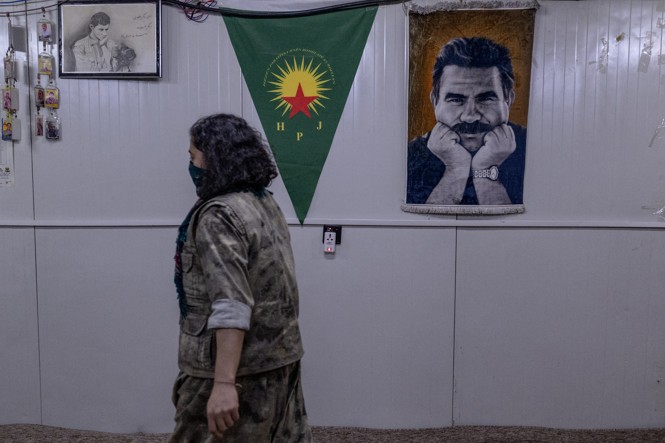
The reason was apparent the moment I entered the meeting room inside PJAK’s underground base, which extends deep into the mountain. On the walls, surrounded by pictures of martyred Kurdish fighters, was a large portrait of Abdullah Ocalan, the imprisoned Kurdish rebel whom the group treats with a cultish reverence.
Ocalan is the founder of the Kurdistan Workers’ Party, or PKK, a Kurdish group that fought a 40-year insurgency against the Turkish state. The struggle left tens of thousands of people dead, and Turkey considers any group aligned with the PKK, including PJAK, a mortal enemy. PJAK and most other Kurdish factions say that their goal is not a Kurdish state but some form of autonomy within a democratic Iran. Nonetheless, if PJAK fighters were to cross the border into Iran, they might find themselves under attack by Iranian and Turkish forces.
Perhaps the Trump administration could have ironed out some of these problems if it had taken regime change in Iran more seriously and put time and effort into planning for it. Instead, PJAK and other Kurdish factions have found themselves in a strange position: eager to join the American campaign, but deeply uneasy about where it might lead.
Viyan told me that the Kurds would “very likely” take part in a ground invasion of Iran, and soon. She then said that the invasion plans were not ready yet, and that “lots of discussion has to take place about how to proceed.” The position of the United States and Israel would be essential, she said, but no one could say what that was. She pleaded, a little poignantly, for the American government to provide a “guarantee of Kurdish rights in the future”—as if anyone could guarantee anything about the future of Iran.
The evening I arrived in Erbil, the capital of northern Iraq’s autonomous Kurdish region, I passed a huge pillar of black smoke pouring skyward from an Iranian drone strike. The Iraqi Kurds are not involved in the current military campaign, but they have long given shelter to Kurdish groups from other countries, and that has made their region an incidental battleground.
Iran has been targeting Iraqi Kurdistan almost constantly since the war started, as have its Shiite proxy militias inside Iraq. Some of the strikes have been aimed at American military and political targets. Several times, I saw missiles being intercepted right above me—a jet-like sound followed by a loud boom and a flash in the sky, like fireworks.
But most of the attacks seemed to be aimed at the bases of the Iranian Kurdish parties. They do not enjoy the protection of America’s expensive missile defenses: Many have been struck, and a number of Peshmerga fighters have been killed.
On a hillside not far from Erbil, I toured one rebel camp whose tin sheds had been shredded by a drone strike the day before. I interviewed one of the group’s commanders in a car—it was raining—and he spoke dismissively about the Iranian regime, saying that it was weak and running out of weapons. The Kurds massing in Iraq were “ready to fight,” he said, and thousands more would join them the moment they crossed the border.
Shortly afterward, we heard a series of dull thudding sounds in the distance. “I have to go,” the commander said. He yanked open the car door and ran back to his camp, which was under another drone attack.
[Read: The countdown to a ground war]
Iran would not be striking the Kurdish camps if it didn’t fear that the Kurds could soon open up a new front against it. But in another sense, the Islamic Republic has been at war with the Kurdish groups for decades.
At least 30 million Kurds live in the Middle East, scattered across five countries, and they have long dreamed of establishing a nation of their own. Northwestern Iran was where they came closest to achieving this, during a brief Soviet-sponsored period of self-rule in 1946. That lasted less than a year before Soviet forces withdrew under Western pressure, and the Iranian army recaptured the Kurdish region.
The chaos that followed the Iranian Revolution in 1979 offered another opportunity. Kurdish towns began setting up their own local administrations, and the Peshmerga organized to defend them. The Kurds managed to briefly maintain their independence against the forces of the new Islamic Republic. But Ayatollah Khomeini declared jihad against them, and after the regime consolidated its forces, it waged a bloody campaign against the Peshmerga, who eventually retreated to bases across the border in northern Iraq.
Ever since, the regime has waged an unrelenting campaign of assassinations and bombings against its Kurdish opponents. Some of the better-known incidents of this cold war took place in Europe, including the 1992 assassinations of four Kurdish activists at the Mykonos restaurant in Berlin.
The war has been fought mostly in Iran and Iraq, largely unseen by the rest of the world. The Democratic Party of Iranian Kurdistan, the oldest of the Iranian Kurdish groups, has had some 400 members killed in northern Iraq alone, Amanj Zibaee, one of its leaders, told me. Many others have been injured; I met an elderly man in Erbil whose cousin opened a book he received in the mail only for it to explode, leaving him without eyes or hands.
This grinding, surreptitious war has touched almost everyone in the Iranian-Kurdish-exile community in some way. Reza Kaabi, the secretary of the Komala Party, told me that he had lost 36 members of his family in the struggle, including two older sisters who were executed by an Iranian firing squad in 1980, a brother who was assassinated in 2013, and another brother who was killed in a clash with regime soldiers.
After all this suffering, it is not surprising that so many Kurds have embraced the new American-Israeli bombing campaign as their great opportunity to reclaim a lost homeland. I got used to seeing people’s eyes light up when they learned that I was American, and hearing them declare their gratitude to Trump. “The Israelis will destroy Iran,” one beaming Kurdish driver told me several times during a road trip, “and then they will destroy Turkey.”
Iranian Kurds living in exile started trickling back to the region in January, after Trump began assembling an armada for what looked like a renewed war with Iran. I met some of those returnees at a mountainside Peshmerga camp not far from Erbil. One of them was a 53-year-old named Shaho Bluri. He had come back two months earlier from Northern Europe—he preferred not to name the country—where he has lived for the past two decades. He told me he had joined the Peshmerga at the age of 17 and fought for six years, and had lost all three of his brothers in battles during the 1980s and ’90s. He had always dreamed of returning to Iran.
He spoke of night raids that he and his fellow Peshmerga have made across the Iranian border in recent weeks, not to fight but to meet with sympathizers and sleeper cells who provide them with information about the regime’s defenses. “If I go inside Iran, I will never go back to Europe,” he said. “I am there for good.”
After our talk, Bluri and his fellow Peshmerga did a live-fire exercise, the gunshots echoing off the valley walls. As dusk approached, they built a bonfire and sang a rousing song about their movement’s martyrs.
Bluri told me he had taken great comfort from the news in February that the various Iranian Kurdish parties were planning on forming a united coalition. The Kurds have long been plagued by factional disputes, and the coalition was a sign that they were now capable of overcoming them, he said.
But there is no such unity in the broader Iranian opposition. After the Coalition of Political Forces of Iranian Kurdistan declared its formation on February 22, Reza Pahlavi lashed out on X at “separatists” who have made “baseless and contemptible claims against the territorial integrity and national unity of Iran.” It was not the first time that Pahlavi has disparaged the Kurdish opposition, some of whose members he was once friendly with. Every Kurdish leader I spoke with told me they were willing to work with anyone except Pahlavi, whom they regard as an autocrat and a bigot.
How ordinary Iranians see the prospect of a Kurdish front against the regime is difficult to say. In the past, many regime opponents seemed to have shared Pahlavi’s distrust of the Kurds as possible bearers of a separatist agenda. But that began to change in 2022, with the protest movement that arose from the killing of Mahsa Amini, a 22-year-old Kurdish woman arrested by Iran’s morality police for failing to properly cover her hair.
The protests became known inside Iran by the Kurdish-language slogan Jin, Jiyan, Azadi, or “Woman, Life, Freedom.” Although the regime suppressed them, the protests fostered a sense of solidarity between Kurds and the broader Iranian public, and they forced the regime to loosen its enforcement of mandatory head covering for women.
This new solidarity poses something of a dilemma for the Kurdish factional leaders I met in northern Iraq. They know that their fortunes could depend on their ability to appeal to Iranians outside the Kurdish region. But the U.S. and Israeli war against Iran risks making them look like traitors, riding back into their country “on the backs of the American tanks,” as Iraqis said scornfully of the exiles who returned after the American invasion in 2003.
The other great risk for the Kurds became apparent just after Trump started the new bombing campaign on February 28, when they got a real-time illustration of his unreliability. On March 5, Trump declared that a Kurdish ground invasion of Iran would be “wonderful.” Two days later, he said, “I don’t want the Kurds to go into Iran.”
The reason for his reversal was no mystery: The Turks, who have long been extremely suspicious of any military role for the Kurds, appear to have issued indirect but firm warnings to the White House. Turkey is now engaged in negotiations with the PKK, which agreed to disarm a year ago, but the last thing that Turkish leaders want is another Kurdish rebellion on their doorstep.
The Kurds scarcely needed a reminder of American fickleness. Only six weeks earlier, the Kurdish-run statelet in northeastern Syria, which has been a showplace for Kurdish aspirations for more than a decade, was mostly overrun by the forces of Syria’s new leader, Ahmed al-Sharaa. The U.S. military stood by and did nothing to oppose the Syrian onslaught. That left many Kurds—who had looked to the Pentagon as their ally in fighting the Islamic State and other shared causes—feeling betrayed.
The worst-case scenario for the Kurds would be risking their fortunes in this war only to lose their tenuous support both inside and outside Iran. The result could be a bloodbath.
A 23-year-old woman who had just left Iran two months earlier expressed this fear to me more vividly than anyone else I met. At a café in Erbil, she and her husband spoke at length about how miserable their lives had been under the Islamic Republic. (They asked that their names be withheld for their safety.) They are both highly educated and secular, and come from families with legacies of involvement in the Kurdish national cause, which has put them in the regime’s crosshairs. At one point, the woman told me, she cried for hours every day and was unable to do basic household chores. She could not have been more eager to see the mullahs fall. But when I asked her about the prospect of an armed intervention by Kurdish rebel groups, she looked troubled.
“I always dreamed of those groups coming to Kurdistan, but deep down I wish they would not do that,” she said. “I know the slightest thing the Kurds will do, the Islamic regime will bomb every place” in the Kurdish region of Iran, where her family still lives.
Even among the Peshmerga, not everyone is baying for an invasion. One of the Iranian Kurdish factions, a branch of the Komala Party, has not endorsed the war or joined the new coalition of Kurdish parties. Adib Watandust, a white-haired man of 72 who has been in the movement for Kurdish rights since the mid-1970s, walked with me up the mountain valley where the Komala Party maintains its bases.
Watandust described the decades he spent with an AK-47 over his shoulder, fighting the Iranian regime in northwestern Iran. He noted proudly that his party was the first to arm women, a practice that was shocking in the Middle East’s patriarchal culture but was gradually adopted by other Kurdish rebel factions. He told me he had watched the Iranian regime grow stronger during its bloody war with Iraq through the ’80s, and that this experience had changed his perspective.
[Eliot A. Cohen: The war with Iran is exposing big problems for the military]
“History tells us that you cannot bring freedom and liberation with bombardment,” he said. “It doesn’t work this way.”
Watandust said he thought the current war could easily backfire—it could bolster the regime’s will to fight on, overshadow the brutal crackdown that left thousands of protesters dead in January, and silence the opposition. “The exit plan of the regime was this war; that’s why they welcomed it,” he said. “It seems that for dictators, war is a gift.”
We arrived at a house near the top of the valley, where rifle-toting young Peshmerga fighters laid out a blanket on a terrace and served tea. I asked Watandust what the Peshmerga should be doing instead of making war on the regime. He said they should allow those inside Iran to lead the way. It might begin with a general strike, something that has happened before in the Kurdish parts of Iran, and then spread across the rest of the country.
Once the regime begins to lose control, he said, a power vacuum will emerge. Then the Peshmerga could cross the border and help maintain order. “Our instructions to our people are to take charge of local security; to make sure there’s no chaos, no violence; to avoid looting or any other kinds of security issues.”
It was a hopeful scenario, and I wondered if it was as unlikely, in its way, as the more aggressive proposals coming from other Kurds. Watandust seemed to guess what I was thinking.
“The real alternatives to this regime are not outside Iran,” he said. “They are inside—the political prisoners, union activists, teachers, journalists in jail, women and men. They are the real leadership. And the West cannot dictate an alternative from outside.”
The post The Kurdish Ground Force Preparing to Fight in Iran appeared first on The Atlantic.